The photographs that captured a world we can never fully recover.
Some photographs show famous moments. Others show people whose names have disappeared into time. Together, they reveal something far more unsettling: history was not experienced as a collection of dates and monuments, but as millions of ordinary seconds. A child beneath a gas mask, a soldier smiling beside a battlefield, a woman carrying bread, a family waiting for someone to return—each frame seems complete, yet something remains outside the photograph.
A 1939 Moscow street offers one of the first clues. Towering Soviet trolleybuses move through the city, symbols of a modern urban world confident in its own future. Yet only a few years later, much of Europe would be consumed by war. The photograph cannot show what is coming. Perhaps that is precisely why it feels so haunting. History often looks most innocent immediately before it changes.
Elsewhere, a 1947 British Standard Vanguard represents another kind of beginning. Britain was rebuilding after years of destruction, and new automobiles carried hopes of industrial recovery. Technology appears repeatedly throughout these images: electric transport, aircraft, submarines, helicopters, driving simulators, giant artillery pieces, and eventually nuclear weapons. But the collection quietly asks a difficult question: when does technological progress stop serving ordinary life and begin changing the scale of destruction?

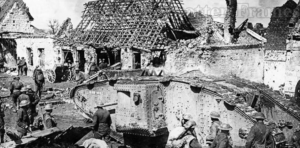
That contradiction appears with terrifying clarity in wartime photographs. Children wear oversized gas masks in Britain. Nurses prepare protective equipment for infants. Soldiers move through snow, ruins, deserts, and jungles. The machinery surrounding them is enormous, but the people remain remarkably small. A tank may weigh many tons; a bomber may cross continents; a battleship may carry enormous guns. Yet history ultimately reaches the individual person standing underneath it.
The Second World War repeatedly produced such contrasts. At Pearl Harbor, the USS Arizona burned beneath clouds of smoke. The USS Shaw erupted after being struck during the Japanese attack. In the Atlantic, Coast Guardsmen watched a depth charge detonate against a German submarine. In Normandy, Allied troops came ashore under fire. At Iwo Jima, Marines raised a flag above Mount Suribachi. Each photograph freezes a moment, but none can contain the full experience surrounding it.
And sometimes the most revealing images are almost ordinary.

American soldiers drinking bottled soda during the Italian campaign. Soldiers laughing together in wartime camps. London children turning a street lamp into a cricket wicket. Families embracing returning soldiers. People shopping in post-war stores. These moments matter because wars are not lived entirely through battles. Between danger and loss, people still eat, joke, work, play, repair equipment, write letters, and wait.
That waiting becomes especially powerful in photographs of civilians. In 1975, crowds of South Vietnamese civilians rushed toward evacuation routes as the war approached its final collapse. The image is chaotic, but behind the movement lies something quieter: uncertainty. Where would these people go? Who would leave? Who would be left behind? Photographs preserve the moment of departure, but rarely the years that followed.
The same unanswered questions appear in images of Jewish communities before and during the Holocaust. A photograph of a young Jewish child facing deportation can look painfully quiet. There is no battlefield visible, no explosion, no advancing army. Yet the historical context transforms the image completely. Behind one child’s face stands an enormous machinery of persecution, deportation, imprisonment, and murder. The photograph itself does not tell the whole story. Historical records must.
That distinction is essential. Old photographs can be powerful evidence, but they can also be miscaptioned, misidentified, or stripped from their original context. Some images in collections like this one carry uncertain names, dates, locations, or descriptions. A responsible historical story therefore has to leave certain questions open rather than manufacture certainty where none exists.
The same principle applies to photographs of political leaders. Mussolini posing beneath the statue of Augustus was not simply a portrait of a man standing beside an ancient monument. Fascist propaganda deliberately connected modern political power with an idealized Roman past. Hitler appears in other photographs surrounded by supporters, while Stalin appears in the bureaucratic record of an earlier arrest. Later, photographs of demonstrations in 1956 Hungary and the enormous crowds of 1991 St. Petersburg reveal something very different: societies challenging political systems that had once appeared immovable.
Then there are the photographs that seem almost impossible to believe.
A man stands beside an enormous aircraft. Daredevils play tennis on a biplane wing. A mechanic works aboard the Hindenburg during flight. A woman survives an extraordinary elevator accident. A helicopter carries passengers above Bridgeport. Children learn driving skills using mechanical simulators. Each image records an era fascinated by invention, risk, and possibility.
But the same century also produced photographs of children working in coal breakers, Indigenous people subjected to degrading colonial treatment, racial violence in the United States, and patients exposed to primitive or abusive medical practices. Progress was never evenly distributed. The modern world arrived at different speeds for different people.
That tension is visible in the image of a chained Indigenous Australian beside a settler. It is visible in photographs connected to American segregation and the civil-rights struggle. It is visible in the faces of concentration-camp survivors liberated in 1945. And it is visible in Mary Ann Bevan, whose appearance became part of the sideshow industry rather than simply being understood through the medical condition that affected her.
These photographs force another uncomfortable question: what did people of the time consider normal?
Sometimes the answer is disturbing. Public executions, racial segregation, colonial domination, child labor, extreme workplace danger, and exploitation could be photographed without the ethical framework many viewers would apply today. The camera recorded what existed, but it did not automatically condemn it.
That is why photographs require context.

A picture of an athlete holding a portrait of Hitler can look strange to a modern viewer, but the circumstances surrounding the photograph matter. A photograph of soldiers beside a shattered statue may capture temporary battlefield triumph without revealing what happened afterward. A smiling person may have been photographed moments before catastrophe. A beautiful city street may later become a battlefield.
The future is almost never visible in the photograph itself.
This is perhaps most haunting in the images connected to Hiroshima and Nagasaki. The atomic bombings transformed warfare and introduced humanity to a new nuclear age. Photographs of the mushroom clouds are visually immense, but they cannot communicate every consequence experienced by those beneath them. The image records the physical phenomenon; testimony, documents, medical evidence, and historical research are needed to understand the human consequences.
Other photographs show the machinery of that same technological century from another angle. A captured Japanese battleship sits among vessels used in the 1946 Bikini nuclear tests. Submarine-launched aircraft demonstrate unconventional military experimentation. The Hindenburg represents aviation ambition before its destruction. The enormous USS Arizona represents vulnerability beneath technological strength.
Again, the photographs seem to ask the same question: where does progress lead?
The answer is never simple.
A helicopter can connect distant places. A trolleybus can modernize a city. A library bookmobile can bring books to bedridden patients. A protective hockey mask can prevent injury. A mechanical simulator can teach students. Yet aircraft can also carry bombs, submarines can sink ships, and nuclear technology can destroy cities.
Human beings repeatedly build tools that contain both possibilities.

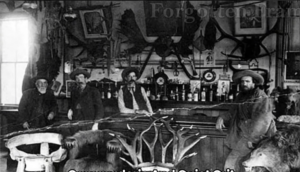
The collection also preserves quieter fragments of ordinary culture. A French woman carries bread and bottles through a street. People gather in an old California saloon. Norwegian citizens encounter bananas as an exotic new arrival. A Victorian woman sits patiently before a camera. Cyclists prepare for a race. Children play cricket. Families shop for groceries. A Spanish couple wears traditional Ibiza clothing.
None of these moments appears historically monumental. That may be their greatest importance.
History is not made only by presidents, generals, revolutionaries, and kings. It is also made by workers, children, shopkeepers, athletes, nurses, immigrants, soldiers, artists, mechanics, and parents. A newspaper boy in Mexico City, an electrician posing with colleagues in 1918, or a London child improvising a game can tell us something about an era that official documents sometimes cannot.
Even the famous faces become more human when surrounded by ordinary life.
Picasso paints Sylvette David. Sinatra stands with Judy Garland and Liza Minnelli. Martin Luther King Jr. addresses a massive crowd in Washington. Eisenhower uses an early mechanical teleprompter. Princess Fawzia appears in formal portraiture. Young Arnold Schwarzenegger demonstrates extraordinary strength. Sigourney Weaver appears in a school photograph before becoming internationally famous.
These images remind us that historical figures once existed before they became historical figures.
They had ordinary mornings. They posed for photographs. They attended schools, rehearsed, worked, traveled, argued, dreamed, and waited. The person known to later generations was not yet visible.
Perhaps the strangest photograph in the entire collection is therefore not necessarily the most dramatic one. It may be the image of an anonymous person whose name we will never know.
A young woman beside a river in 1890.
A traveler beside a lonely highway decades later.
A soldier smiling beneath a helmet.
A mother walking through a grocery store.
A child playing in a London street.

These people did not know they were becoming part of a historical archive. They were simply living.
And that is what makes old photographs so powerful. They capture people before they know what the future will ask of them.
Some would survive wars. Some would not. Some would become famous. Others would disappear almost completely from the written record. Some photographs would become iconic. Others would sit unnoticed for decades.
The camera cannot tell us everything.
It cannot reveal every thought behind a face. It cannot show what happened five minutes later. It cannot explain every political decision, every private tragedy, every act of courage, or every consequence.
But it can leave a door open.

Behind every frame is another story.
Behind every story is another human being.
And behind every familiar photograph may be a detail that historians are still trying to understand.
My personal view is that the greatest value of these images is not simply that they show us how strange the past looked. They remind us that the people inside those photographs believed they were living in the present, just as we are. They could not see the history approaching them—and neither can we always see what tomorrow will make of today.
Which photograph from this collection makes you stop and wonder what happened just outside the frame?
Some content was generated using AI tools (including ChatGPT) and edited by the author for creativity, storytelling, and historical illustration purposes. Historical facts and key details should be verified against reliable historical sources. Any AI-generated or reconstructed visuals are intended for illustrative purposes and should not be interpreted as original historical photographs or archival evidence.
Để lại một bình luận