There are moments in history when a photograph seems to say everything without uttering a single word. A damaged aircraft carrier listing toward the sea. Soldiers moving through a ruined city. Children behind barbed wire. A woman reaching for the hand of a liberating soldier. A family walking through streets that no longer resemble home. These photographs do not tell the whole story. They cannot. But together, they form something almost as powerful: a fragmented visual record of a world transformed by the Second World War. And behind every frame lies another question—what happened just before the shutter clicked, and what happened after?
In the summer of 1942, the USS Yorktown became one of those photographs that seemed to capture an entire battle in a single image. The aircraft carrier had already survived devastating attacks during the Battle of Midway. Her crew fought to keep her operational, even as the ship was badly damaged and listing. The struggle did not end when the aircraft stopped attacking. Damage-control crews continued working, and attempts were made to salvage the carrier.
For a brief time, there was still hope.

Then, on June 6, Japanese submarine I-168 reached the salvage operation. Torpedoes struck Yorktown and the destroyer USS Hammann, which was alongside the carrier. Hammann sank, while Yorktown remained afloat for another night. At dawn on June 7, the carrier finally rolled over and disappeared beneath the Pacific.
Photographs of Yorktown’s final condition therefore preserve more than the wreckage of a ship. They preserve the uncertain space between survival and loss—the moment when men were still working against an outcome they could not yet see.
That uncertainty appears repeatedly throughout the photographs of the war.

Across oceans, ships carried tanks, aircraft, ammunition, fuel, and men toward battlefields thousands of miles away. A photograph of British cruiser tanks being transported toward Egypt may look almost ordinary at first glance. Yet the machinery in the frame represents something enormous: the logistical system required to move modern armies across continents and seas.
The Second World War was not fought only by soldiers who carried rifles.
It was also fought by sailors, mechanics, engineers, railway workers, truck drivers, dockworkers, factory employees, pilots, medics, and countless civilians whose names would never appear in history books. Behind every tank photographed arriving at a distant port stood an invisible chain of people who had manufactured it, loaded it, transported it, fueled it, repaired it and eventually sent it toward combat.
That is one of the quiet truths hidden inside wartime photography.

The photograph shows the machine.
History asks us to remember the people behind it.
In Europe, another camera captured a very different scene.
On August 29, 1944, American soldiers of the 28th Infantry Division entered Paris as the city emerged from German occupation. Images of Allied troops moving through the liberated capital carried an extraordinary contrast. Only a few days earlier, Paris had been under German control. Now soldiers were moving through streets filled with civilians and celebration.
Liberation photographs can be difficult to understand without remembering what came before them.
For four years, occupation had reshaped everyday life. Then, almost suddenly, the political landscape changed.
But liberation did not mean that the war was over.
The German armies were still fighting. The front continued moving east and west. And somewhere beyond the celebrations of Paris were soldiers who would soon face another battlefield.
The camera could capture the smiles.

It could not capture the uncertainty waiting beyond the city.
Further east, the photographs become darker.
Warsaw was transformed by occupation and Nazi persecution. The construction of the Warsaw ghetto physically separated hundreds of thousands of Jews from the surrounding city. Walls became instruments of policy. Streets that had once been ordinary public spaces became boundaries enforced by power.
A photograph of the ghetto wall can appear almost strangely quiet.
There may be no battlefield in sight.
No aircraft.
No tanks.
No explosion.
Yet the wall itself tells a story.

It represents segregation made physical, persecution transformed into architecture, and a society being divided by force. The Holocaust was not created in a single moment. It developed through laws, restrictions, identification, confiscation, deportation, imprisonment and eventually mass murder.
That is why photographs of identification tags, prisoner uniforms, camp fences and children behind barbed wire are so difficult to look at.
They show the machinery of persecution becoming part of everyday life.
At Auschwitz and other camps, photographs and surviving records reveal how people were categorized, stripped of possessions, imprisoned and ultimately murdered. The scale is difficult to comprehend through numbers alone. One photograph can sometimes make that distant history painfully immediate: a child’s face, a striped uniform, a fence.
And then comes the question that photographs cannot answer.
What happened to the person standing inside the frame?
Sometimes historians know.

Sometimes they do not.
That uncertainty is one reason archival photographs must be handled with care. A caption can be wrong. A location can be misidentified. A later description can confuse one camp, battle or person with another. The image may be genuine while the story attached to it is not.
The same problem appears throughout the vast visual archive of the Second World War.
A photograph of a temporary grave near Normandy, for example, can reduce an enormous military operation to one unmistakable fact: somebody did not go home.
June 6, 1944 is often remembered as D-Day, the beginning of the Allied landings in Normandy. Military histories describe beaches, divisions, landing craft, artillery and objectives. But photographs of temporary graves tell another part of the story.
The invasion had a human cost.
Every advance was measured not only in miles gained, but in lives lost.
And while the photographs of troops landing on Normandy beaches became famous, quieter images sometimes reveal more about what followed. A grave beside a battlefield does not explain strategy. It simply reminds us that strategy was ultimately experienced by human beings.
Across the Channel, Britain had already spent years living beneath the threat of aerial attack.
Photographs of Londoners sheltering inside underground stations during the Blitz capture a strange transformation. Places designed for transportation became places of refuge. Underground platforms became temporary shelters. Ordinary citizens attempted to sleep, wait and survive while aircraft passed overhead.
Above ground, buildings burned.
Below ground, people waited.
The same war that could appear distant on a newspaper page was physically surrounding them.
One photograph described in the collection shows an athletic match continuing while German air raids were visible nearby. Whether watching sport, working in an office, repairing a telephone line or sheltering underground, civilians attempted to preserve fragments of ordinary life.
That may be one of the most revealing characteristics of wartime photography.
People do not stop being human simply because history becomes extraordinary.
They still work.
They still pray.
They still worry about their families.
They still find moments of humor.
They still watch a game.
And sometimes they simply continue because there is nothing else they can do.
The war also produced images of extraordinary military improvisation.

British soldiers trained with gas masks. Schoolchildren practiced evacuation drills. Engineers prepared for chemical warfare. Soldiers learned to move through smoke and darkness while carrying weapons.
These photographs may look strangely theatrical today.
But at the time, the fear was real.
Governments had already witnessed the use of chemical weapons during the First World War. Civilians understood that the next major conflict might bring new forms of destruction. Preparing for that possibility became part of everyday life.
The camera recorded people rehearsing for disasters they hoped would never come.
Then came the disasters they could not prevent.
In Asia, photographs of devastated cities reveal another dimension of the conflict.
Tokyo was devastated by the massive incendiary raid of March 9–10, 1945. Chongqing endured repeated Japanese bombing during the war. Across Europe and Asia, entire neighborhoods were transformed into ruins.
Photographs of burning buildings can be difficult to interpret because destruction is visually dramatic. Flames fill the frame. Smoke rises above rooftops. Streets become almost unrecognizable.
But the most important question may be what is missing.
Where were the families who had lived there?
Where did they go?
What happened to their homes?

How many ordinary objects were lost beneath the rubble?
War photographs often show destruction as architecture.
Human history reminds us that architecture is memory.
A house is not merely a building.
It is where someone kept photographs, clothing, letters, toys and furniture.
When the building disappears, pieces of a family’s private history disappear with it.
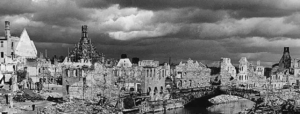
This becomes especially clear in photographs from Germany after the war.
In 1947, a German man searching unsuccessfully for his former home represented a problem experienced by millions of Europeans. Cities had been destroyed. Borders had shifted. Families had been separated. Millions were displaced.
The war had ended, but the consequences had not.
Women carrying luggage through ruined streets became symbols of a continent in motion. People searched for relatives, addresses, work and shelter.
A photograph of a ruined building therefore tells only half the story.
The other half is the person standing in front of it, wondering where to go next.
The Eastern Front produced some of the most devastating images of the conflict.
At Stalingrad, German and Soviet forces fought through a city transformed into a battlefield. The fighting became a struggle over streets, factories, buildings and individual positions. When the German Sixth Army surrendered in early 1943, photographs of captured soldiers became visual evidence of a catastrophe that had already altered the course of the war.
One image described in the collection shows an Axis prisoner after the battle.
Behind the photograph lies an enormous reversal.
Men who had marched east believing they were advancing into Soviet territory were now prisoners, moving in the opposite direction.
The photograph captures defeat.
But it also raises a human question.
What does a soldier think when the world he expected to return to has disappeared?
The photographs of prisoners throughout the war offer no simple answer.
Some show exhaustion.

Some show fear.
Some show defiance.
Others show people who appear almost numb.
And perhaps that is because captivity itself was not one experience. Conditions varied enormously according to location, nationality, time and circumstances. Some prisoners survived. Others died from starvation, disease, exposure, mistreatment or execution.
The infamous Bataan Death March in the Philippines provides one of the clearest examples of the terrible conditions prisoners could face. After the surrender of American and Filipino forces on Bataan in April 1942, prisoners were forced to march under brutal conditions. Many died.
Images associated with the prisoners therefore carry a weight far beyond military statistics.
They show people weakened to the point where carrying another person could become an act of survival.
On the opposite side of the world, another group of photographs records the harshness of naval warfare.
German U-boat crews operated in some of the most dangerous environments imaginable. Images of submariners standing on ice-covered decks off Norway reveal the physical conditions confronting crews even before enemy action began.
Cold, darkness, confinement and isolation were part of the experience.
The ocean itself became a battlefield.
Far away, American PT-boat crews operated at speed in the Pacific, often under very different but equally demanding conditions. Photographs of sailors preparing machine guns or scanning the horizon capture the constant uncertainty of small-ship warfare.
Sometimes the enemy was visible.
Sometimes the danger existed only as a possibility.
And sometimes the camera recorded the final moments of a vessel before disaster.
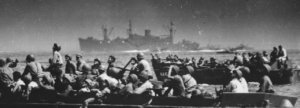
During the Allied invasion of Sicily in 1943, a U.S. ammunition ship exploded after a German air attack. In such photographs, the explosion is visually enormous, but the deeper story is logistical. Armies cannot fight without ammunition, fuel, food and equipment. Supply ships were therefore legitimate and essential targets.
The modern battlefield had expanded far beyond the front line.
Factories, ports, railways, ships and warehouses had become part of the war.
The distinction between combat zone and home front was increasingly difficult to maintain.
This was particularly evident during the strategic bombing campaigns.
B-29 bombers flying over Japan became symbols of a new era in warfare, one in which aircraft could reach deep into enemy territory and devastate urban areas from the air. The destruction of Tokyo and other cities demonstrated how profoundly industrial warfare could transform the relationship between civilians and battle.
The photographs of these raids remain among the most disturbing records of the war—not because they show every individual tragedy, but because they show entire urban landscapes changed almost beyond recognition.
Meanwhile, in Europe, Allied bombers attacked German industrial targets.

Factories became battlefields.
Railway lines became strategic targets.
Oil facilities became military objectives.
The war had become an industrial contest in which production itself could determine survival.
Yet even within this machinery of destruction, photographs continue to find individual human beings.
An Italian woman kissing the hand of an American soldier in Naples in October 1943 is almost the opposite of the images of bombing.
There is no battlefield visible.
No map.
No strategic objective.

Only a gesture.
The photograph cannot tell us exactly what the woman was thinking. It would be wrong to invent her words or emotions. But the gesture itself is visible, and its meaning can be understood within the broader context of Allied advances through Italy.
Liberation had arrived.
For someone who had lived through occupation, that moment could carry enormous significance.
But again, the photograph gives us only a fragment.
The same is true of images showing civilians kneeling in prayer after deaths during the German retreat, or people clearing rubble after bombardments.
These are not photographs of generals.
They are photographs of consequences.
And consequences are where history eventually arrives.
By 1945, the war was moving toward its final stage.
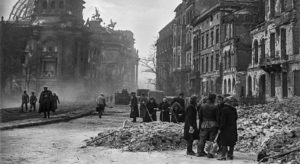
German cities were collapsing.
Berlin became a battlefield.
Photographs show civilians clearing streets, soldiers surrendering, buildings burning and exhausted men sitting among the ruins.
The photographs of Nazi Germany’s final weeks are often difficult to reconcile with images from the regime’s earlier years.
In earlier photographs, huge crowds filled public spaces. Nazi symbols dominated architecture. Hitler addressed audiences from balconies and podiums. Propaganda projected strength, unity and permanence.
Then, only a few years later, the same regime was surrounded by ruins.
The contrast is enormous.
And it reveals something important about photographs themselves.
A photograph can capture power.

It cannot guarantee permanence.
The Nazi regime had built an immense propaganda apparatus designed to shape how Germans saw themselves and how the outside world perceived Germany. Book burnings, public rallies, political ceremonies and carefully staged images all contributed to that visual world.
But eventually, different photographs emerged.
Destroyed buildings.
Prisoners.
Mass graves.
Survivors.
The camera became a witness to the consequences of the ideology that propaganda had attempted to glorify.

In June 1945, images of mass graves and liberated concentration camps confronted the world with evidence of crimes that had previously been difficult for many people to comprehend.
One photograph described in the collection shows Vidkun Quisling, the Norwegian collaborator whose name became synonymous with collaboration, near a mass grave after liberation. Such images belong to the period when Europe was beginning the painful process of confronting what had happened under Nazi occupation.
At the camps, liberated prisoners and physical evidence provided a record that could not easily be dismissed as rumor.
Shoes.
Clothing.
Barracks.
Fences.
Objects belonging to people who were no longer alive.
These photographs are among the most important visual records of the twentieth century because they transform an abstract word—persecution—into physical evidence.
The war eventually ended.
In Europe, Germany’s unconditional surrender was signed in May 1945.
But photographs of surrender did not erase photographs of destruction.

They simply began a new chapter.
In the Pacific, the fighting continued until August.
Japanese civilians listened as Emperor Hirohito announced Japan’s surrender by radio. For many, the announcement represented relief. For others, grief. For still others, uncertainty about what would come next.
Again, the camera could record faces.
It could not record every thought behind them.
And that is why the photographs of 1945 should not be reduced to a simple story of victory.
Victory for one side could mean defeat for another.
Liberation could coexist with grief.
Surrender could bring relief and humiliation.
The end of fighting could mark the beginning of displacement, rebuilding and political upheaval.
The war did not end neatly when the guns fell silent.
Its consequences continued for decades.

Perhaps that is why the most powerful photographs in this collection are not necessarily the most dramatic.
A child behind a fence.
A woman carrying luggage through ruins.
A soldier bowing his head.
A worker clearing rubble.
A grave beside a battlefield.
A sailor standing on a damaged carrier.
A civilian praying.
These images resist the language of military statistics.
They remind us that history is not only made by commanders and governments.
It is experienced by ordinary people.
And perhaps this is the greatest value of photographs.
They do not allow us to see the entire past.
They allow us to see enough of it to understand what statistics cannot.
The Second World War was fought across oceans, deserts, cities, forests and islands. It involved enormous armies and extraordinary technology. It produced battles remembered by names such as Midway, Stalingrad, Normandy and Iwo Jima.
But beneath those names were individual lives.

Some survived.
Some did not.
Some returned home to rebuild.
Some never found their homes again.
Some were photographed.
Most were not.
That final fact may be the most important of all.
The millions of photographs preserved from the war represent only a tiny fraction of what happened. The camera was never everywhere. It could not enter every home, every prison cell, every battlefield or every moment of private grief.
There are therefore countless stories that history will never be able to reconstruct completely.
A photograph is not the past.
It is a surviving piece of the past.
It is a doorway, not the entire room.

And when we look through that doorway, we should resist the temptation to invent what we cannot see.
We should ask what is documented.
We should ask what remains uncertain.
We should compare captions with records.
We should distinguish an authentic photograph from a later interpretation of it.
Because sometimes the photograph is real, but the story attached to it has changed.
And sometimes the image is incomplete precisely because history itself is incomplete.
That may be why these forgotten frames continue to matter.
They do not simply show us what happened during the Second World War.
They show us what war did to ordinary human lives.
A carrier went beneath the Pacific.
Cities became rubble.
Walls divided neighbors.
Children disappeared behind camp fences.

Prisoners crossed roads under guard.
Families carried their possessions through ruins.
Soldiers celebrated liberation while knowing the fighting was not yet finished.
And eventually, after years of destruction, the weapons fell silent.
What remained was a continent and a world forced to remember.
My own view is that the most powerful way to look at these photographs is neither with fascination for destruction nor with nostalgia for war. They should be approached as fragments of human testimony. Their value lies in reminding us that behind every military operation were people making choices, suffering consequences, protecting one another, losing loved ones, and trying to continue living.
The photographs cannot tell us everything.
But perhaps that is precisely why we should keep looking.
Because somewhere between the edges of each frame lies a part of history that the camera captured only once—and a human story that may never be fully recovered.
When you look at these forgotten photographs today, which matters more to you: what the camera actually captured, or what the missing parts of the frame make us wonder about?
“Some content was generated using AI tools (including ChatGPT) and edited by the author for creativity, storytelling, and historical illustration purposes. Historical facts and key details should be verified against reliable historical sources. Any AI-generated or reconstructed visuals are intended for illustrative purposes and should not be interpreted as original historical photographs or archival evidence.”
Để lại một bình luận