There are photographs in which history seems to pause for a single breath. A soldier shelters behind a Sherman tank while the battlefield continues around him. A ration book lies on a kitchen table, quietly measuring what an entire nation is allowed to eat. On another continent, an unknown soldier is remembered by a simple battlefield cross on the Normandy shore. None of these images can tell us everything. Yet each seems to whisper the same question: when the great events of history were unfolding, what did ordinary human beings actually see, endure, and leave behind?
The answer is scattered across photographs from more than a century of upheaval. Some belong directly to the World Wars. Others come from the years before and after them, showing the societies that entered those conflicts, survived them, and slowly changed because of them. Together, they form something more intimate than a conventional military record. They reveal how war reached beyond battlefields—into kitchens, streets, schools, factories, theaters, sporting grounds and private lives. And sometimes, the smallest detail tells us more than the grandest speech.
Consider Britain during the Second World War. The images of soldiers and aircraft often dominate our memory of the conflict, but millions of civilians experienced the war through something far less dramatic: ration books.
Beginning in January 1940, Britain introduced food rationing because wartime disruption threatened supplies. Bacon and ham, meat, butter, sugar, eggs and other essentials were restricted. The Imperial War Museums records a wartime maximum weekly ration for an adult that included four ounces of bacon or ham, two ounces of butter, eight ounces of sugar and one fresh egg, among other provisions.
On paper, these numbers look almost painfully ordinary.
But behind every number was a household decision. How much could be saved? What could be substituted? What could be grown? What would children eat? Rationing was not a battlefield, yet it was part of the same national struggle. Food imported by sea could be lost to enemy action, while ships carrying weapons and other military supplies were given priority. Civilians therefore became participants in the war through sacrifice that rarely appeared in military photographs.
That is one of the hidden truths of total war: the front line does not always have a visible border.
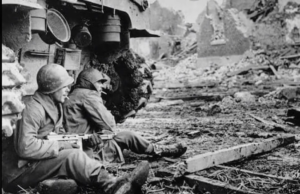
Thousands of miles away, another photograph captures the opposite side of the same conflict. Two American soldiers, Corporal James Gregory and Technician Fifth Grade Omer Taylor, take cover behind an M4 Sherman tank at Geich, Germany, on December 11, 1944. The photograph preserves a moment of extraordinary simplicity. They are not posing for history. They are simply trying to remain alive.
The tank dominates the frame, but it is the men who make the image difficult to forget.
There is something almost unsettling about how ordinary such a moment appears. Soldiers in photographs are often remembered as symbols—units, divisions, armies, national flags. Yet photographs like this reduce the scale of war to two people seeking protection behind steel.
And perhaps that is why the image remains powerful. The Sherman was a machine built for war. Gregory and Taylor were human beings who needed it as a shield.
By June 1944, similar scenes were unfolding along the Normandy coast.
The Allied invasion was not simply a movement of armies onto a beach. It was an enormous operation involving soldiers, sailors, aircraft, landing craft, medics, rescue crews and photographers. The United States Coast Guard archives preserve photographs from June 6, 1944, including the famous Omaha Beach image taken by Coast Guard combat photographer Robert F. Sargent.
Among the many images from Normandy, one of the most haunting ideas is the battlefield cross: a rifle planted vertically, a helmet resting above it, creating a simple marker for a fallen soldier.
The object is almost painfully modest.
There is no grand monument. No long inscription. Just equipment arranged to mark the absence of a person.
The original material supplied here describes such a scene as a tribute to an unknown American soldier on the Normandy shore. While individual photographic identifications should always be checked against archival captions, the wider historical reality is unmistakable: thousands of Allied troops were killed or wounded during the Normandy campaign, and Coast Guard personnel were deeply involved in the invasion and rescue operations. Official Coast Guard collections preserve extensive photographic documentation from that day.
This is where photography becomes more than memory.
It becomes evidence of absence.
A helmet tells us that someone was there.
A battlefield cross tells us that someone did not return.
And the empty space between those two facts is where much of the human story of war exists.
The war also appeared from the air, where individual human figures could disappear beneath the scale of industrial destruction. On August 4, 1944, RAF Bomber Command was conducting operations over France as the Allied campaign entered a critical phase following the Normandy landings. The RAF Museum records, among the operations of that date, the daylight raid involving Lancaster bombers against V-1 facilities at Trossy St Maximin.
The original account supplied here identifies a Lancaster of No. 514 Squadron attacking an oil installation in France and describes storage tanks erupting into smoke and fire.
Whatever the precise identification of the target photograph, the larger historical picture is clear: Allied air power increasingly focused on disrupting German military infrastructure, transportation and weapons systems as Allied armies advanced through France.
From the ground, such attacks could appear as distant flashes.
From the air, they became coordinates.

And somewhere between those two perspectives was the reality experienced by people who lived beneath them.
Yet the World Wars did not emerge from nowhere. Earlier photographs reveal a world already fascinated by military spectacle, national power, technological ambition and imperial imagery.
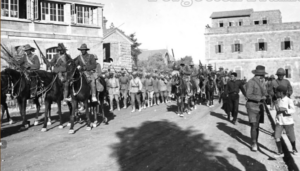
In 1918, New Zealand mounted riflemen in Palestine guarded captured German prisoners. The scene is a reminder of how geographically immense the First World War had become. It was no longer a conflict confined to the European trenches. Troops from across the British Empire and other parts of the world served in campaigns stretching through the Middle East, Africa and Asia.
The photograph is easy to overlook because nothing spectacular appears to be happening.
Prisoners stand under guard.
Soldiers watch them.
The landscape continues beyond the frame.
But that quiet scene represents something enormous: a European war had become a global conflict.
The same transformation can be seen in the story of Charles Godefroy.

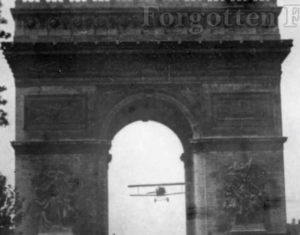
On August 7, 1919, only months after the First World War had ended, Godefroy flew his Nieuport biplane beneath the Arc de Triomphe in Paris. The official Arc de Triomphe historical site confirms the date and describes how he took off from Villacoublay at 7:20 a.m., circled the monument and passed beneath its arch.
It was an extraordinary act of aviation.
But the symbolism was equally striking.
The Arc de Triomphe represented military victory and national memory. Beneath it stood the legacy of a war that had killed millions. Above and through it flew one of the technologies that had transformed modern warfare.
The world had barely emerged from the trenches, yet aviation was already becoming part of a new age.

The photograph, therefore, is not simply about a pilot performing a daring maneuver. It captures a civilization trying to understand what the previous war had created.
That uncertainty would become even more significant in the decades that followed.
In the 1920s, a life-size chess game reportedly took place in Palace Square in Leningrad, involving members of the Soviet Navy and Red Army, with moves communicated by telephone. Whether remembered primarily as spectacle or propaganda, such events reflected the Soviet fascination with turning public space into a stage for collective discipline, strategy and ideological symbolism.
The pieces were human.
The board was enormous.
And the message was larger still.

This was a period when governments increasingly understood that power could be displayed not only through weapons, but through carefully staged images.
That lesson would become darker in fascist Italy.
Photographs of Benito Mussolini repeatedly emphasized his physical presence, gestures and association with symbols of ancient Rome. One image from 1935 places him beside a statue of Augustus, deliberately connecting modern fascism with the prestige of imperial antiquity.
Another photograph from 1926 shows Mussolini beside a bust of himself.
The contrast is difficult to miss.
Ancient Rome represented centuries of history. Mussolini’s image represented a contemporary political project seeking to borrow the authority of that past.
This was not merely vanity in the personal sense. Fascist propaganda depended heavily on spectacle, symbolism and the construction of a political image. The danger was that historical imagery could be transformed from a record of the past into a political instrument for the present.
And Europe would soon discover where that manipulation could lead.

The photographs of soldiers in World War II therefore carry a different weight when viewed against the images that preceded them.
Behind the uniforms stood governments.
Behind the governments stood ideologies.
Behind those ideologies were millions of ordinary people whose lives would be transformed by decisions made far above them.
Yet history is not only made by leaders.
It is also preserved in unexpected places.
A 1938 photograph of Times Square captures New York welcoming the New Year beneath a storm of confetti. The city was emerging from the Depression, and crowds gathered for the familiar spectacle of urban celebration.
Only a few years later, much of the Western world would be consumed by war.
That contrast is worth pausing over.
People celebrated because the future still seemed open.
They crowded into streets.
They watched lights.
They believed, as people naturally do, that tomorrow would resemble today.
History often looks inevitable only after we know how it ended.
For the people living through it, the future was invisible.

The same uncertainty appears in an entirely different setting: a 1908 San Francisco photograph showing a Victorian house being moved along Steiner Street by horse-drawn teams. The city was rebuilding after the devastating 1906 earthquake and fire, and moving buildings became part of the extraordinary effort to reshape damaged neighborhoods.
There is no battlefield here.
No uniform.
No weapon.
Yet the photograph belongs in the same larger story.
It shows people adapting to catastrophe.
The human instinct to rebuild after destruction is one of the quiet connections linking peacetime disasters with wartime societies.
After destruction, someone still has to move the house.

Someone still has to feed the family.
Someone still has to repair the street.
Someone still has to begin again.
The gold rush photographs attributed to Sarah Pollard offer another vision of hardship. Thousands of people climbing muddy cliffs in search of gold became an enduring image of labor driven by the hope of extraordinary reward.
The scene is difficult to romanticize once the human cost becomes visible.
Dreams can motivate people.
But dreams can also demand extraordinary sacrifices.
That tension would appear repeatedly throughout modern history.
Technology promised progress, yet technology could also become an instrument of destruction.
A consumer invention could transform an ordinary bicycle ride.
A military invention could transform an entire battlefield.

In the 1950s, the Huffy Radio Bicycle represented the optimistic side of postwar consumer culture, combining cycling with a built-in AM radio. It belonged to a society increasingly fascinated by convenience, entertainment and technological novelty.
The war had ended.
The machines remained.
But their meaning was changing.
The same generation that had seen aircraft become instruments of destruction now watched technology enter suburban homes and children’s lives.
That transformation is easy to miss when history is divided into separate chapters.
The reality was continuous.
The 1950s were not simply “after the war.”
They were a world shaped by the war.

The same can be said of military training.
Photographs of Marine recruits at Parris Island performing calisthenics under arms show another side of military preparation. Before combat came repetition. Before battlefield decisions came physical conditioning and discipline.
The process was deliberately ordinary.
Again and again.
Training.
Movement.
Routine.
Preparation.
War depended not only on courage at the decisive moment, but on countless hours of preparation that rarely appear in dramatic photographs.
And when those trained soldiers finally entered combat, the reality could be as simple as two men taking cover behind a tank.
History moves from ceremony to routine, from routine to crisis, and from crisis to memory.
Sometimes decades later, the photographs change meaning again.
In 1974, photographer Daniel Sorine photographed two young mime performers in Central Park. One of them was an unknown Robin Williams, years before his fame. Sorine later rediscovered the images and realized whom he had photographed. His own archive confirms the Central Park photographs from 1974.
At first glance, the images have nothing to do with war.
But perhaps they reveal something equally important.
History does not always announce the significance of a moment.

The young man in the photograph did not yet carry the identity the world would later give him.
The photograph simply captured someone performing in a park.
The future was still hidden.
That is exactly what makes old photographs so compelling.
We know what happened next.
The people inside the photograph did not.
The same feeling can be found in a photograph of two teenage girls in 1970s high-school clothing, standing beside lockers in bell-bottom jeans. The fashion is immediately recognizable as belonging to a particular era, but beneath the clothing is something larger: a generation changing its relationship with authority, identity and personal freedom.
Other photographs preserve equally strange fragments of everyday life.

A couple rides a side-by-side tandem bicycle in New South Wales in the 1930s. Children pose beside a homemade sign for a stamp-moistening device near a post-office vending machine. Jacques Plante introduces a protective mask into professional ice hockey in 1959, a decision that would help transform expectations of player safety.
These images are not military history.
But they are the world that war interrupted, reshaped and eventually handed forward.
And that may be the most important point.
World War I and World War II were not isolated periods when history suddenly became violent. They were interruptions inside ordinary human lives.
People still played games.
They rode bicycles.
They watched performers.
They went to school.

They celebrated New Year’s Eve.
They bought new gadgets.
They rebuilt houses.
They trained for war.
They waited.
And sometimes they never returned.
Even the most dramatic images become more understandable when placed beside these ordinary moments.
A soldier behind a Sherman tank was once a civilian.
A recruit at Parris Island once had a home somewhere else.
A man remembered on a Normandy beach had a family, a name and a future that the photograph cannot show us.
That missing information is what makes historical photography so powerful.
The camera records the moment.
It cannot record everything that led to it.
It cannot tell us every thought in the mind of the person standing before the lens.
It cannot reveal every consequence.

And it cannot show the future.
That limitation is important because photographs can create the illusion that we understand the past simply because we can see it.
We do not.
We see a fragment.
We reconstruct the rest through documents, archives, testimony and careful historical research.
The story of Tom Fox in 1989 demonstrates this in a different way. The supplied account describes him as being photographed shortly before his death from AIDS, but archival records provide a more precise picture: Thomas Fox was photographed by Michael Schwarz for the Atlanta Journal-Constitution’s series “When AIDS Comes Home: The Life & Death of Tom Fox.” The archive records his death on July 11, 1989, and documents photographs from his illness during that period.
That correction matters.
History is not strengthened by repeating every dramatic description attached to an image.
It is strengthened by checking what the evidence actually says.
The photograph of Fox therefore belongs to a later chapter of the same larger human story. It reminds us that suffering did not end when the guns fell silent in 1945. Different generations inherited different crises, and each generation created its own photographs of fear, uncertainty, endurance and loss.

That is also why the image of a 106-year-old Armenian woman standing guard with a rifle should be approached carefully. The photograph is striking, but without precise contextual documentation, the circumstances behind it should not be turned into a fictional narrative. What can safely be seen is an elderly woman photographed with a weapon in a period of conflict—a visual reminder that war can reach people across almost every stage of life.
Likewise, Anita Ekberg’s early photographs belong to another transformation: before she became internationally associated with the image of Mediterranean glamour created by Federico Fellini’s La Dolce Vita, she was simply a young woman photographed before worldwide fame.
History repeatedly catches people before they become famous.
Before they become symbols.
Before we know what their lives will mean.
The same is true of Tom Longboat, the Indigenous Canadian runner who won the Boston Marathon in 1907. His achievement existed within a period when Indigenous people faced discrimination and exclusion, making his athletic success part of a broader history of representation and resilience.
The pattern continues across the photographs.
A Soviet schoolgirl smiles in uniform while the political system surrounding her appears stable, yet the Soviet Union itself would eventually disappear.
A young Anita Ekberg has not yet become an international star.
Robin Williams is still a mime in Central Park.
A house is still being dragged through San Francisco.

A soldier still has both the present and the future ahead of him.
Then history intervenes.
That is why the most powerful historical photographs are rarely the ones that show everything.
They are the ones that leave something outside the frame.
The Normandy battlefield cross leaves the identity of one fallen man uncertain.
The Sherman photograph leaves us wondering what happened to the two soldiers after the shutter closed.
The ration book does not show the conversations around the kitchen table.
The photograph of Charles Godefroy cannot show how Europe was about to enter another age of political extremism and war.
The image of Mussolini cannot, by itself, explain the catastrophe that followed fascist expansion.
The camera stops.
History continues.
And perhaps that is the lesson these photographs quietly share.
The past was not populated by symbols.

It was populated by people.
People who did not know what tomorrow would bring.
People who celebrated before war.
People who endured shortages during it.
People who trained, fought, hid, rebuilt and mourned.
People who later became famous—and people whose names disappeared from the record.
When we look at photographs from the World Wars, it is tempting to search immediately for the great event: the battle, the leader, the explosion, the victory.
But sometimes the deeper story is smaller.
It is the rationed piece of butter.

The helmet resting on a rifle.
The soldier pressed against a tank.
The empty space beside a fallen man’s marker.
The photograph taken before anyone knew it would become historically important.
Those details remind us that history is not only the story of governments and armies.
It is also the story of what ordinary people were asked to endure when governments and armies collided.
My personal view is that this is why historical photographs should be treated with both curiosity and caution. Their power does not come from making the past look more dramatic than it was. It comes from allowing us to see how complicated, fragile and human that past actually was. The most unforgettable photograph may not be the one showing the largest event, but the one that quietly makes us wonder about the person just outside the frame.
When you look at these photographs, which matters more to you—the event they document, or the human life that the photograph can never fully show?
Some content was generated using AI tools (including ChatGPT) and edited by the author for creativity, storytelling, and historical illustration purposes. Historical facts and key details should be verified against reliable historical sources. Any AI-generated or reconstructed visuals are intended for illustrative purposes and should not be interpreted as original historical photographs or archival evidence.
Để lại một bình luận