Some photographs seem to show only a person, a street, a ship, or a distant landscape. Then, years later, the details begin to speak. A helicopter lifting people from Saigon. A crowd gathering beneath Nazi symbols in New York. A carrier burning off Okinawa. A chimpanzee waiting inside a spacecraft. Prisoners walking into freedom. A family facing famine. A young woman standing before a camera more than a century ago. None of these images can tell the whole story. But each preserves a fragment of a moment when ordinary life collided with forces much larger than the people inside the frame. And sometimes, the most important question is not what the photograph shows, but what happened immediately before—and after—the shutter closed.
The photograph of the Bengali famine belongs to that difficult category of images that history never allows us to look at casually. In 1943, Bengal experienced a catastrophic famine in British India. Hunger, wartime disruption, inflation, crop problems, and failures in relief and food distribution combined into a disaster that killed millions. Photographs of emaciated families became part of the historical record because they showed something statistics could not: the human body itself becoming evidence of a national catastrophe.
Yet even here, caution matters. Modern captions sometimes reduce the famine to a single explanation, describing it simply as the result of one policy or one decision. Historians have debated the relative importance of crop shortages, wartime pressures, market failures, government decisions, and the distribution of food. The photograph does not settle every part of that debate. What it does preserve is undeniable—the physical reality of people whose lives had been devastated by hunger.
That is one reason historical photographs are so powerful. They give us evidence, but they also demand questions.
Another photograph takes us in a completely different direction: three Burmese Padaung women drinking tea in London in the 1930s, their traditional brass neck rings immediately attracting attention. At first glance, the scene might look like a charming meeting between distant cultures. But photographs of colonial-era exhibitions and encounters often carried another layer. People from colonized regions were frequently displayed, photographed, or presented to Western audiences through exoticizing stereotypes.
The camera could preserve cultural traditions, but it could also preserve the unequal power relationships surrounding them.
Then comes a photograph from the opposite end of the emotional spectrum: a mother standing beside an empty uniform. The uniform represents a person who is no longer there. There is no battlefield in the frame. No explosion. No weapon. Only fabric, carefully arranged, and the people left behind.
This is one of the recurring mysteries of old photographs. The most painful part may exist outside the frame.

During the twentieth century, millions of families experienced that same absence. A uniform became a symbol. A letter became an object kept for decades. A chair remained empty. A photograph became the last physical connection to someone who had disappeared into war.
In 1945, the USS Bunker Hill provided another image of what war looked like when viewed from the opposite side. On May 11, two Japanese kamikaze aircraft struck the American carrier off Okinawa in rapid succession. The ship was packed with aircraft that were armed, fueled, and preparing for operations. The resulting fires and explosions caused enormous casualties and left the carrier heavily damaged. U.S. Navy records document the scene in photographs showing Bunker Hill surrounded by smoke as its crew fought to save the ship. (Lịch sử Hải quân)
The photograph is often remembered for the smoke.
But the more important story is what happened underneath it.
Sailors and damage-control crews continued working while the ship burned. Fires had to be contained. Wounded men had to be located. The dead had to be identified. Survivors had to keep the vessel from becoming a total loss.
The photograph freezes one moment.
The historical record continues for hours afterward.
The same contrast appears in the photographs from the evacuation of Saigon in April 1975. One famous image shows a helicopter lifting people away from a city on the edge of collapse. It has often been incorrectly identified as the roof of the U.S. Embassy. In reality, many of the rooftop evacuations associated with the famous photographs involved CIA and Air America personnel being moved from locations around Saigon.
Operation Frequent Wind began on April 29, 1975. U.S. helicopters evacuated Americans and Vietnamese civilians considered at risk as North Vietnamese forces closed in on Saigon. CIA and Air America personnel were integrated into the wider evacuation effort, and helicopters moved people from isolated locations to larger evacuation points. The U.S. Navy records that thousands were evacuated during the operation, while the final helicopter left the U.S. Embassy on April 30. (CIA)
A photograph of a helicopter can therefore be misleading if the caption is wrong.
The image itself may be genuine.

The story attached to it may not be.
That distinction matters enormously when dealing with collections advertised as “forbidden,” “secret,” or “photos they never wanted you to see.”
Some images are genuinely extraordinary. Others have simply acquired dramatic captions over the years.
The 1939 German American Bund rally at Madison Square Garden is an example where the underlying event really was extraordinary. On February 20, 1939, more than 20,000 people attended the Bund’s rally in New York. The organization promoted support for Nazi Germany and antisemitic propaganda. Nazi symbols appeared alongside American imagery, while anti-Nazi demonstrators gathered outside. The United States Holocaust Memorial Museum describes the German American Bund as the most influential pro-Nazi organization in the United States during its existence. (Bách khoa toàn thư về Holocaust)
The photograph does not mean that America as a whole supported Nazism.
That distinction is essential.
It shows that an openly pro-Nazi movement could organize a major public event in New York before the United States entered the Second World War. It also shows that Americans opposed the movement. The crowd inside Madison Square Garden and the protesters outside belonged to the same country, but they represented profoundly different political visions.
History is rarely as simple as a single photograph suggests.
The same is true of the image of a German soldier returning home to his mother in 1955. The famous photograph belongs to the broader story of German prisoners of war returning after the Second World War. By then, the war had been over for a decade, but for many families its emotional consequences had not ended.
The battlefield had disappeared.
The waiting had not.

A mother embracing a returning son could represent something that statistics could never fully capture: the strange distance between surviving an event and actually returning to ordinary life.
Elsewhere, the twentieth century produced photographs that appear almost unbelievable because technology had not yet settled into the forms we recognize today.
A man wearing an experimental helmet-mounted television in the 1960s looks like a character from science fiction. Yet the idea behind such experiments was remarkably familiar. Engineers were already imagining personal screens, portable entertainment, and technology that could follow an individual rather than remain fixed inside the home.
The same futuristic optimism appears in photographs of early aviation, experimental aircraft, unusual vehicles, mechanical parking systems, and prototype transportation.
The strange inventions were not always successful.
That is exactly why they are interesting.
History is filled with machines that seemed reasonable at the time and absurd later.
A prototype could represent the future for one afternoon and become a forgotten curiosity decades later.
The same feeling surrounds photographs of early traffic signals, subway construction, elevated railways, and giant steel structures rising above American cities. The modern city did not appear fully formed. It was assembled piece by piece.
Workers dug streets.
Engineers moved steel.
Cars multiplied.
Buildings climbed higher.
And the old city slowly disappeared beneath the new one.
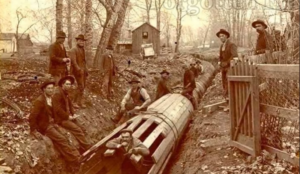
A photograph of workers digging the New York subway in 1900 therefore tells a larger story than construction. It captures the moment when underground transportation began transforming the relationship between people and the city above them.
Similar photographs show massive bridges being built, skyscrapers rising, railways bending through crowded streets, and industrial workers standing beside enormous machines.
The modern world was being constructed by people whose names were often never recorded.
Then there are photographs that seem almost trivial until we remember what they reveal.
A woman sitting behind the wheel of a car in the 1920s.
Women working in wartime factories.
A home economics classroom.
A barber cutting the hair of a soldier in a trench.
Teenagers crowded into a telephone booth.
Children watching circus rehearsals through a barrier.
A family posing for a studio portrait.
A nun skiing.
A young couple walking beside the sea.
None of these images necessarily documents a famous event.
But together they reconstruct everyday life.
And everyday life is often the part of history that disappears first.
Wars receive monuments.
Presidents receive biographies.
Battles receive maps.
But the ordinary habits of people—the clothes they wore, the machines they used, the games they played, the streets they walked—can vanish within a generation.
That is why photographs of fashion are more important than they initially appear.
Parisian clothing from the late nineteenth century reveals social expectations as much as style. Victorian hairstyles reveal how much time, labor, and cultural meaning could be invested in appearance. A 1950s Hollywood portrait tells us something about celebrity culture. A 1960s fashion photograph captures a generation moving away from older conventions.
The camera was recording cultural change even when nobody standing in front of it knew that change was happening.
The photographs become more difficult when they document prejudice.
The image of Ota Benga is among the most disturbing examples. Ota Benga, a Congolese man, was displayed at the Bronx Zoo in 1906 alongside apes and monkeys. The episode has become an enduring example of racist spectacle and the dehumanization of African people in the United States. Its historical significance is not in the curiosity of the photograph, but in what it reveals about the society that permitted such treatment.
That image should not be consumed as entertainment.
It should be remembered as evidence.
Other photographs from the same era reveal different forms of inequality: segregation, racial violence, colonial exploitation, and the unequal treatment of immigrants and indigenous peoples.
The camera sometimes captured injustice precisely because people wanted the image to be seen.
At other times, it captured injustice without understanding what future generations would see in it.
That distinction is important.
A photograph is never completely neutral.
The photographer chooses where to stand.
The editor chooses what to publish.
The caption determines how later audiences interpret it.
And social media can transform the meaning again.
One of the most famous examples is the photograph of Ota Benga. Another is the repeated circulation of images from Nazi Germany, colonial exhibitions, war zones, and famine with captions designed primarily to shock rather than educate.
The farther a photograph travels from its original archive, the more carefully its caption should be questioned.
That does not make the photograph worthless.
It makes verification more important.
The same principle applies to military images.
https://www.youtube.com/watch?v=OtYDLSYkSZE
A photograph of German and Soviet commanders standing together in September 1939 carries enormous historical weight because Germany and the Soviet Union had just entered the Molotov-Ribbentrop Pact. The two powers temporarily cooperated while Poland was partitioned between them.
But the photograph should not be used to suggest that their relationship was simple or permanent.
It was a temporary strategic arrangement.
Less than two years later, Germany invaded the Soviet Union.
A photograph captures the moment.
It does not automatically explain the entire political relationship behind it.
Other photographs show soldiers on the battlefield. American troops cross rivers in 1945. German troops read newspapers inside trenches. Soldiers warm themselves in winter. Men sit around a piano. Troops rest inside sleeping bags.
These images reveal another uncomfortable truth about war.
Most soldiers did not spend every minute fighting.
They waited.
They slept.
They ate.

They wrote letters.
They read.
They repaired equipment.
They listened to music.
They thought about home.
Those ordinary moments do not make war less terrible. They make it more human.
In one photograph, a German soldier quietly reads a magazine inside a muddy trench. The scene could almost belong to civilian life. That is precisely why it is striking. Even inside a war zone, people continued searching for fragments of normality.
The same human instinct appears in photographs of Allied soldiers gathering around a piano after liberation. Music could return to a ruined street before buildings had been rebuilt.
The world could still contain laughter even after enormous destruction.
Then there are photographs that remind us how fragile technology can be.
The Space Shuttle Challenger photograph, images of aircraft accidents, experimental vehicles, early aviation machines, and nuclear-era technology all carry the same underlying theme: human beings repeatedly push beyond what they already understand.
Sometimes the result is progress.
Sometimes it is failure.
Sometimes it is tragedy.

The photograph of Ham, the chimpanzee launched into space in 1961, belongs to this complicated history. Ham was launched on January 31, 1961, aboard Mercury-Redstone 2. During his brief flight, he traveled roughly 157 miles from Earth. The mission helped researchers study how a living organism could respond to the stresses of spaceflight and helped prepare the way for human missions. Smithsonian records describe the role of chimpanzees in testing acceleration, weightlessness, and task performance before human Project Mercury flights. (Bảo Tàng Bưu Điện Quốc Gia)
Looking at Ham’s photograph today, it is tempting to see only a cute animal inside a small capsule.
But the image also raises difficult questions about experimentation, scientific progress, and the ethical limits of using animals in the pursuit of human achievement.
History does not always provide comfortable answers.
Sometimes it simply preserves the evidence and leaves us to confront the contradiction.
The same can be said of nuclear photographs.
A model wearing an atomic-themed hairstyle while holding an image of a mushroom cloud may appear bizarre today. Yet the nuclear age produced exactly this strange mixture of fear, fascination, fashion, advertising, science fiction, and popular culture.
The mushroom cloud was terrifying.
It was also becoming a symbol.
People saw it in newspapers, magazines, films, advertisements, school exercises, and political propaganda.
The atomic age changed not only military strategy but imagination itself.
And then nature reminded humanity that it remained capable of creating destruction without weapons.
The 1883 Krakatau eruption was one of the most powerful volcanic events recorded in modern history. The U.S. Geological Survey notes that the eruption produced enormous quantities of volcanic debris and caused catastrophic destruction, with more than 36,000 deaths associated with the event. Its atmospheric effects were observed far beyond Indonesia. (USGS)
Photographs of disasters therefore belong beside photographs of wars.
A ruined city after an earthquake.
A landscape after a volcanic eruption.

A flooded highway.
A fallen bridge.
A devastated coastline.
The image may show destruction, but behind it is a story of adaptation.
People rebuild.
They reopen stores.
They repair roads.
They bury the dead.
They photograph what remains.
And eventually, another generation walks through the same place without knowing what happened there.
Perhaps the most powerful photographs in these collections are therefore not the strangest ones.

They are the ones in which ordinary people stand at the edge of extraordinary events.
Consider the Little Rock Nine.
On September 25, 1957, nine African American students entered Central High School in Little Rock, Arkansas, under federal troop escort. President Dwight Eisenhower had ordered the 101st Airborne Division into Little Rock and federalized the Arkansas National Guard after resistance and violence surrounding school integration. The nine students were finally able to attend their first full day of classes under federal protection. (Dịch vụ Công viên Quốc gia Hoa Kỳ)
There is no need to exaggerate the photograph.
The historical facts are already extraordinary.
Nine teenagers walked into a school while the federal government deployed troops to protect their constitutional rights.
The photograph preserves a moment when a question about education became a national confrontation over law, citizenship, and equality.
The same pattern appears in photographs of the women’s suffrage movement, civil-rights demonstrations, anti-war protests, and workers demanding better conditions.
A person holding a sign may look small.
A crowd may look ordinary.
But history often changes because ordinary people decide that something cannot continue as before.
That does not mean every protest produces the same result.
It means photographs can preserve the moment when society is visibly negotiating its future.
Other images preserve stories that could easily have disappeared entirely.

Fanny Cochrane Smith, a Tasmanian Aboriginal woman, recorded songs and speech on wax cylinders in 1899 and 1903. Those recordings are regarded as the only known sound recordings of original Palawa/Tasmanian Aboriginal song and speech, giving them extraordinary cultural significance. (USGS)
A photograph of Fanny is therefore more than a portrait.
It belongs to a record of memory.
The camera preserved her face.
The recording preserved her voice.
Together, they created something that written documents alone could not.
And that is perhaps the deepest reason we continue looking at old photographs.
We are not really looking at the past.
We are looking at evidence that the past was once present.
The people in these images woke up in the morning. They worried about money. They went to work. They fell in love. They went to school. They boarded trains. They built machines. They crossed oceans. They fought wars. They lost people. They celebrated. They waited. They hoped.
Then the shutter opened.
For a fraction of a second, their lives became visible to the future.
But there is another lesson hidden inside collections like this one.

Not every viral caption deserves to be believed.
Some photographs are genuinely rare. Others have been incorrectly dated. Some names are misspelled. Some events have been combined. Some famous photographs have acquired fictional stories through repeated social-media sharing. And some descriptions deliberately use dramatic language because “unknown” sounds more exciting than “ordinary.”
Historical research begins when curiosity meets skepticism.
A photograph should make us ask questions, not stop asking them.
Who took it?
When?
Where?
Who is actually in it?
What happened before?
What happened afterward?
What archive preserves it?
And does the caption describe the photograph—or merely the story someone later attached to it?
That final question may be the most important.
Because the past does not need invented mysteries.
The real past is already astonishing.
A carrier burning off Okinawa.
Thousands gathered beneath Nazi symbols in New York.
A helicopter evacuation from a collapsing Saigon.
A chimpanzee entering space.
A famine-stricken family waiting for food.
A teenager entering a segregated school under federal protection.
A voice preserved on a wax cylinder more than a century ago.
A city destroyed by an earthquake.
A volcano changing skies across the world.
A mother embracing a returning son.
A soldier reading a magazine inside a trench.
These moments do not belong to fiction.
They belong to human memory.
And perhaps that is what makes the oldest photographs so difficult to forget. They remind us that history was never simply made by presidents, generals, inventors, or famous artists. It was also made by mothers, workers, children, soldiers, students, migrants, prisoners, engineers, nurses, protesters, and people whose names never entered the textbooks.
The photograph gives them one more chance to be seen.
The responsibility of the person looking at it is to see carefully.
My own view is that the greatest value of historical photographs is not their ability to shock us. It is their ability to make distant history feel human without changing what actually happened. A dramatic caption may attract attention for a few seconds, but an accurate story can remain meaningful for generations.
So when you encounter an old photograph that seems impossible, mysterious, or almost too strange to be true, perhaps the best response is not to believe it immediately.
Look closer.
Ask another question.
https://www.youtube.com/watch?v=okDFwcnWHmg
And then ask what the photograph has been trying to tell us all along.
What forgotten moment in history do you think deserves to be looked at again—not because it is sensational, but because understanding it might change the way we see the past?
Some content was generated using AI tools (including ChatGPT) and edited by the author for creativity, storytelling, and historical illustration purposes. Historical facts and key details should be verified against reliable historical sources. Any AI-generated or reconstructed visuals are intended for illustrative purposes and should not be interpreted as original historical photographs or archival evidence.
Để lại một bình luận