There are photographs that need no sound of gunfire to make us feel the presence of war. A crowd cheering in the streets of Washington in November 1918. A Soviet female pilot preparing to take off into the night. A German soldier sitting motionless among the ruins. Survivors staring through barbed wire at Auschwitz. A warship burning at Pearl Harbor. And in the middle of a crowd performing the same Nazi salute, one man standing with his arms folded.
These images do not form a single story in the conventional sense. They come from different years, countries, and circumstances. Yet when placed beside one another, they resemble scattered pages from a vast historical file — the story of a twentieth century in which humanity achieved extraordinary advances while also witnessing two world wars, dictatorships, genocide, colonialism, economic collapse, and profound social transformation.
And perhaps the most remarkable detail is not always found in the largest photograph.
Sometimes, it is hidden in a very small gesture.
In November 1918, Washington was overflowing with people. Newspapers were held high above the crowds. Streets filled with cheering citizens. The First World War had ended. After more than four years of fighting, Europe lay exhausted. Millions had been killed or wounded, and societies that had once believed the war might be short had been forced to confront an entirely different reality.
The joy visible in those photographs was real.
But history rarely ends at the moment when people begin to celebrate.
A war can end on the battlefield without disappearing from people’s lives. Soldiers return carrying memories. Families mourn those who never came home. Cities must be rebuilt. Empires change. Treaties are signed. And beneath the appearance of a new peace, tensions remain — tensions that would contribute to another global crisis only two decades later.
Before that happened, however, photographs from the years between the wars captured a world changing at extraordinary speed.
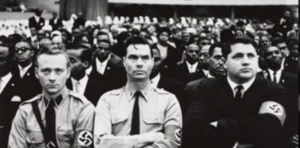
In 1936, at a gathering in Hamburg, Germany, a large crowd of workers stood during a ceremony associated with the Nazi regime. Most people in the photograph raised their arms in the prescribed salute. But toward the right side of the crowd, one man stood with his arms folded.
The photograph of that man became one of the most famous images associated with individual resistance under Nazi rule. He is often identified as August Landmesser. Yet historians and archival sources remain cautious: the man’s identity has not been conclusively proven, and some sources have suggested that he may have been another man, Gustav Wegert.

That uncertainty makes the photograph worth examining even more carefully.
Its significance does not necessarily depend on knowing exactly who the man was.
What can be seen is simpler.
One person in the crowd did not perform the gesture being made by those around him.
A small gesture.
A small distance.
Yet under a regime increasingly demanding conformity, that distance could carry a meaning far greater than its physical appearance suggested.
During the same period, Germany was rearming. Huge political rallies, symbols, military formations, and monumental architecture projected an image of a nation determined to recover its power.
In 1935, Ferdinand Porsche presented Adolf Hitler with a model associated with the Volkswagen project. The idea of an affordable automobile for ordinary people later became an important part of automotive history, but within the political context of the time, the project was also connected to Nazi propaganda and the regime’s political objectives.
Only a few years later, the factories, railways, and technical systems developed during the rearmament period would no longer serve civilian life alone.
They would become part of a war machine.
On September 1, 1939, Germany invaded Poland.
The Second World War had begun in Europe.

The photographs from the years that followed show that war was not decided only by generals in headquarters. It was shaped by soldiers in trenches, pilots in the sky, workers in factories, sailors aboard ships, and civilians living in cities that were no longer safe.
On the Eastern Front, the conflict rapidly became a war of extraordinary scale and destruction.
Among the most remarkable images are those associated with the Soviet female pilots commonly known as the “Night Witches.”
The 588th Night Bomber Regiment was formed from Soviet women pilots and carried out nighttime bombing missions on the Eastern Front. The aircraft they flew were not modern machines by today’s standards. Yet their repeated night missions gave the unit a distinctive reputation. The National WWII Museum records that the regiment flew more than 24,000 combat sorties during the war.
At night, the sound of an engine could be the only warning that an attack was approaching.
The pilots flew through darkness.
They reached their targets.
They released their bombs.
Then they searched for a way home.
There is no need to exaggerate the story to understand how dangerous the work was.
Simply carrying out repeated nighttime missions under conditions of limited visibility, using relatively simple aircraft while facing enemy air defenses, reveals the extraordinary risks involved.
But the story of these female pilots has another significance.

War forced many societies to challenge gender boundaries that had previously seemed fixed. Women who had been restricted to certain civilian roles entered factories, hospitals, logistics organizations, and military services.
Not because war had become more humane.
But because war demanded enormous numbers of people.
Elsewhere, women were also entering industries that supported the war effort. Photographs of American women participating in wartime labor, including campaigns encouraging fuel conservation and civilian contributions, reveal how deeply war altered everyday life even for those far from the front lines.
Then came December 7, 1941.

Pearl Harbor.
One of the most haunting images from the Pacific War shows the forward superstructure of the USS Arizona engulfed in flames. Other photographs captured Japanese aircraft on their carriers before the attack began.
The contrast requires almost no explanation.
On one side was deliberate preparation.
On the other was the moment a nation realized that war had reached its own shores.
After Pearl Harbor, the United States entered the Second World War on a massive scale.
From that point onward, the conflict was no longer merely a European war.
It had become a global war.
Across North Africa, Europe, the Atlantic, and the Pacific, millions of people were drawn into an enormous industrial system of warfare. Transport ships, bombers, submarines, landing craft, and tanks became part of a conflict fought on a scale previously unimaginable.
A photograph of the USS Spencer shows depth charges exploding in the water behind the vessel during anti-submarine operations in the Atlantic.
Another shows B-24 bomber crews resting in the oppressive heat of Darwin in 1943.
At first glance, that is simply a photograph of men resting.
But moments like this remind us that war did not always happen amid explosions.

There were hours of waiting.
There were hurried meals.
There were brief periods of sleep.
There were men sitting quietly before the next mission began.
Those quiet moments are often forgotten when war is reduced to numbers and battles.
In Europe, the war entered an even more brutal phase.
Stalingrad became one of the defining symbols of the Eastern Front. Photographs of the ruined city, Soviet soldiers moving through shattered buildings, and troops fighting through snow reveal a battlefield where urban terrain became a maze of survival.
Yet behind the fighting was an enormous humanitarian catastrophe.
Images of German soldiers and dead animals in the freezing conditions reveal how completely the winter and encirclement could destroy an army’s ability to survive.
By the winter of 1944, the land war in Europe was still far from over.
The Battle of the Bulge unfolded in the freezing Ardennes. American soldiers moved through snow carrying heavy equipment and fighting in one of Germany’s final major offensives on the Western Front.
Nothing in those photographs resembles the grandeur of the political rallies of the prewar years.
There are only exhausted faces.
Snow.
Forest.
And soldiers trying to move forward.
Elsewhere, another kind of war was unfolding.
A war against civilians.

In Nanjing in 1937, Japanese forces carried out a large-scale massacre involving civilians and prisoners of war. The surviving photographs and documents form part of the historical record of wartime atrocities committed in China.
This is where particular caution is necessary when examining historical photographs.
A photograph can be invaluable evidence.
But the caption attached to it is not always accurate.
Images circulating online are sometimes given a location, date, or identity that the original evidence cannot establish.
So when looking at such photographs, the important question is not only what we feel.
It is also:
What exactly does this photograph document?
Who took it?
Where?
When?
And what source allows us to know that?
Those questions become especially important when examining photographs connected to the Holocaust.
In 1945, Soviet forces reached Auschwitz.
Survivors were photographed behind barbed wire. Their faces, captured at the moment of liberation, became some of the most powerful visual records of the concentration and extermination camp system established by Nazi Germany.
Here, photography was no longer simply art.
It became a record.
A silent witness.
Not everything that happened during the Holocaust was photographed. Most of those who were murdered left no photographs behind. But the surviving evidence helps later generations understand that this was not a myth or an abstract symbol.
It was history created by real people.
Real families.
Real names.
And real decisions.
In the final months of the war, Allied forces advanced deep into Germany. Structures once built to display the power of the regime began to become ruins.
The enormous rally grounds at Nuremberg were gradually abandoned.
A place designed to project the image of permanent strength became a silent structure surrounded by nature.
It is one of history’s great contradictions.
Regimes that claim they will last for a thousand years can disappear.
Slogans that once covered entire squares can be erased.
Monuments that appear permanent can become ruins.

But the consequences they leave behind do not disappear nearly as easily.
In April 1945, American soldiers discovered artworks looted by Nazi Germany and hidden in a European church. This formed part of a much larger system in which the Nazi regime systematically plundered cultural property across occupied territories.
War does not only take lives.
It takes homes.
Property.
Works of art.
Family records.
Memory.
And sometimes an entire sense of the world that existed before the war.
Then Berlin fell.
A cap associated with Hitler was found abandoned in the area of the Führerbunker.
An ordinary object.
But in that setting, it became a symbol of collapse.
Not because the object itself possessed any special power.
But because the man who wore it had led a regime built around war, racial persecution, and repression — and ultimately witnessed that regime’s destruction.
The war in Europe ended in May 1945.

But in the Pacific, the fighting continued.
Photographs of Japanese kamikaze attacks, the Battle of Okinawa, and amphibious operations show that the conflict still had no easy ending.
In April 1945, a Japanese aircraft plunged toward the USS Missouri off Okinawa.
The frozen instant is often viewed as a symbol of the desperation of the final months of the Pacific War.
But it also reminds us of something larger: by the final stage of the conflict, both sides had already paid an enormous human price.
On August 15, 1945, Japan announced its acceptance of the terms of surrender.
The Second World War was over.
But the world of 1945 was not the world of 1939.
Europe had been devastated.
Millions of people had been displaced.
Cities needed to be rebuilt.
European empires were beginning to weaken.
The United States and Soviet Union emerged as superpowers.
And a new confrontation — the Cold War — gradually took shape.
The survivors also had to return to a world that had changed.
A photograph described as showing a German soldier sitting among the ruins in 1946 evokes one of the least visible consequences of war: war can end on paper before it ends in the minds of those who lived through it.
There were homes that no longer existed.
Families that would never return.
People who survived but did not know where to begin again.
And people who carried memories they would never fully describe.

Years later, another generation began to look at war differently.
In 1969, John Lennon and Yoko Ono appeared with the message “War Is Over” in New York, during a period when the anti-war movement was growing strongly in the United States.
That moment was more than half a century removed from the trenches of the First World War.
Yet the connection remained.
In 1918, crowds celebrated the end of war.
In 1945, people celebrated again as another global conflict ended.
By 1969, a new generation was asking whether humanity had truly learned how to prevent war.
Perhaps that is why historical photographs still possess such power.
A photograph cannot tell the whole story.
It cannot explain every cause, every decision, or every consequence.
But it can preserve a moment that time might otherwise erase.
A crowd celebrating.
A female pilot before a night mission.

A soldier resting in the heat of Darwin.
A destroyed city.
A Holocaust survivor looking through a fence.
A burning ship at Pearl Harbor.
A man standing with his arms folded.
These images should not be treated as fragments to be assembled into sensational stories.
They should be treated as doors.
Each door leads to another question.
How did humanity arrive at war?
Why did societies that once believed in peace become caught in conflicts of global scale?
Why did some people conform while others resisted?
How could civilizations capable of extraordinary technological achievements also create systems capable of destroying human beings on an unprecedented scale?
And after the guns fell silent, who would have to live with the consequences?
History rarely offers simple answers.
There is rarely a single person to blame, a single moment that explains everything, or a single photograph capable of telling the whole truth.
But the surviving images give us something more valuable.

They force us to remember that behind the numbers were human beings.
Behind an army were soldiers with families.
Behind a bombed city were people who had once lived ordinary lives in ordinary homes.
Behind a factory were workers.
Behind an evacuation were children.
Behind a victory were people who never returned.
And behind every decision recorded in history books were countless human beings who had to live with its consequences.
Perhaps that is why one of the most memorable images is not a battle photograph at all.
It is simply a man standing in a crowd.
No weapon.
No speech.
No victory.

Just two arms folded across his chest at a moment when conformity was being expressed by hundreds of raised arms.
We should not turn that image into a legend beyond what the evidence can support. The man’s identity remains disputed. But that uncertainty itself offers a lesson in how history should be examined: what we know must be separated from what we want to believe.
History does not need to be made more dramatic with details that are not true.
What actually happened is already extraordinary enough.
Two world wars.
Millions of lives.
Destroyed cities.
Fallen regimes.
Survivors returning home.
And an entirely different world built from the ruins.
When we look back at these old photographs, perhaps the most disturbing thing is not that they show us how terrible war can become.
It is that they show us how war begins with very human forces: ambition, fear, belief, power, obedience, political decisions, and the choices made by people in each generation.
And it is those same human beings who must find a way to live after everything is over.
That is why these photographs remain.
Not so that we can admire war.
Not so that suffering can become entertainment.
But so that we remember that behind every page of history was a world that once truly existed.
And perhaps the question left for us today is not which photograph is the most haunting, but this:
If we could look back at all the choices that led humanity into two world wars, what would we understand differently about the responsibility of human beings toward history?
Some content was generated using AI tools (including ChatGPT) and edited by the author for creativity, storytelling, and historical illustration purposes. Historical facts and key details should be verified against reliable historical sources. Any AI-generated or reconstructed visuals are intended for illustrative purposes and should not be interpreted as original historical photographs or archival evidence.
Để lại một bình luận