There are photographs that take only a few seconds to make us realize we are looking at a moment that can never be recovered. A father standing beside his son’s field grave. A burning warship off Okinawa. Soldiers marching through a city that has just been liberated. A family facing one another before a painful farewell. A child wearing a gas mask far too large for a small face. And sometimes, simply a group of people standing in the street, unaware that decades later, their faces would become part of history. Yet the most unsettling thing about old photographs is not always what the camera captured. It may be what was written beneath them. A wrong name. A wrong date. A mistaken location. A story repeated so many times that it eventually becomes accepted as fact. That is why forgotten frames do not merely need to be seen again. They need to be read again.

In May 1945, on the island of Okinawa, the Second World War had entered one of its final and most devastating stages. In one photograph circulated through historical collections, an American officer stands beside a field grave. If the commonly repeated caption is correct, it shows Colonel Francis Fenton beside the grave of his fallen son. But even when a famous photograph carries a moving story, viewers should remain cautious about details that have not been firmly established by archival records. What is certain is that Okinawa had become a battlefield where death was no longer an abstract idea. It could appear directly in front of a father, a commander, or a fellow soldier.
Other photographs from Okinawa reveal an entirely different side of the campaign. USS Bunker Hill, an American aircraft carrier, was struck by two kamikaze aircraft in rapid succession on May 11, 1945. The ship was operating off Okinawa, and its flight deck was crowded with aircraft that had been fueled and armed. The two attacks came within a very short period of time. Images of Bunker Hill burning, with thick black smoke rising into the sky, became some of the most recognizable photographs of the Pacific War. According to the U.S. Naval History and Heritage Command, 396 people aboard the ship were killed or missing after the attack.
Yet a photograph like this cannot tell us everything that happened inside the ship. It shows the smoke. It does not show the confusion of men trying to rescue their shipmates, fight the fires, and keep the vessel afloat. It does not show the thousands of small decisions made within minutes. That is one of the fundamental limitations of historical photography. A camera can preserve a moment. It cannot explain the entire moment by itself.
In 1950, another photograph moves us to the Korean Peninsula. An American tank travels through a village street behind prisoners of war. One frame contains several layers of modern warfare: armored vehicles, captured soldiers, civilians caught in the conflict, and a battlefield where the front could shift rapidly. The people in the photograph were no longer simply marks on a military map. They were human beings pushed into circumstances they may never have imagined before the war.
Six years earlier, on August 29, 1944, Paris witnessed a completely different scene. Soldiers of the U.S. 28th Infantry Division marched down the Champs-Élysées as the city emerged from German occupation. Paris had been under German control since 1940. Its liberation in August 1944 became one of the most recognizable symbols of the Allied advance through Western Europe.
But photographs of liberation can make viewers forget the months and years that came before them. A liberated city did not mean that all suffering disappeared overnight. Buildings were damaged. Families were separated. People who had collaborated with the occupation authorities faced consequences. Those returning from battle carried memories that no camera could record. A military parade down a famous avenue could therefore represent both victory and the beginning of a long and difficult recovery.
If Paris in 1944 represents the relief of liberation, Wounded Knee in 1890 reminds us of another painful chapter in American history. On December 29, 1890, U.S. soldiers and Lakota people confronted one another at Wounded Knee Creek. Hundreds of Lakota were killed. The dead were later buried in a mass grave. The event has long been remembered as a symbol of violence and coercion during the expansion of U.S. power over Native peoples.
A photograph of the grave does not need many words. It does not require an inflammatory caption. Its silence is already heavy enough. The people in the photograph could no longer tell their own stories. The responsibility therefore passes to those who look at the image. History is not only the story of those who won and whose records survived. It is also the story of people whose voices were lost.
Decades later, photography confronted another form of danger. Not war, but speed.
In 1966, at Monza, racing cars tore around the circuit at speeds that can be difficult to imagine in an era of modern safety standards. A photograph from the race can make everything look beautiful: sweeping curves, polished metal, crowds, and cars seemingly flying across the track. But behind that beauty was an era in which the safety standards of motor racing were very different from those of today.
That is an important point when looking at historical photographs. We often view the past through modern standards. Something once considered normal may now appear dangerously reckless. Something once regarded as modern may eventually become evidence of how much society had yet to learn.
The same idea appears in photographs of fashion and beauty.
Marilyn Monroe visited a children’s hospital in Atlantic City in 1952. By then, her image was becoming part of American popular culture. A hospital visit could have involved both genuine charity and publicity, and a photograph alone cannot reveal every personal motivation. But what the camera captured still matters: a rising actress entering a room filled with young patients while her own fame was rapidly growing.
Elsewhere in Hollywood, Max Factor brought beauty closer to the language of engineering. Facial-measuring devices, proportions, and carefully studied features reveal how the film industry began treating appearance as something that could be analyzed, adjusted, and standardized. Hollywood did not simply create stars. It also created a visual language for what a face was supposed to look like.
In 1947, women in Berkeley protested the fashion trend known as the New Look, with its longer skirts and emphasized hips. The photograph was not simply about clothing. It reflected a society emerging from war and debating the image and role of women in peacetime. During the war years, women had entered industrial jobs on a much larger scale. After the war, social expectations began shifting again. A dress could therefore become part of a much larger debate about women’s place in society.
During the war years, another object appeared in countless photographs: the gas mask.
British infants were fitted with masks so large that they almost covered their entire heads. The images can look so strange to modern eyes that they may seem staged. Yet they reflected genuine fears about chemical warfare and aerial attack. Civil defense had reached the nursery. Children had become part of wartime preparation.

In San Francisco, another image reveals how people tried to reduce danger through engineering. During construction of the Golden Gate Bridge, a massive safety net was suspended beneath the unfinished structure. The Golden Gate Bridge Highway and Transportation District records that the $130,000 net saved 19 workers, who became known as the “Halfway-to-Hell Club.” Even so, 11 workers died during construction.
A photograph of workers standing on the unfinished bridge is therefore not merely an image of engineering. It is also an image of changing attitudes toward workplace safety. A structure can be built through ambition. But it becomes a lasting achievement only when people begin asking another question: how do we get the people who built it home safely?
Then war appears again.

An A-1E Skyraider releases white phosphorus over Vietnam in 1966. A photograph like this can easily be turned into a simple symbol of war. But history is more complicated than one frame. It exists within military strategy, weapons technology, human decisions, and consequences that continued long after the photograph was taken.
In Europe, photographs from Bosnia decades later confront viewers with another problem: personal memory inside a larger war. A soldier discovering that members of his family have been killed is not merely a “war story.” It is the destruction of a private world. Conflicts are often recorded through numbers of casualties, destroyed cities, or troop deployments. But a photograph can force us to remember that every number once represented a family.
During the twentieth century, cameras also became instruments for recording faces that later generations would never forget.
In 1969, Charles Manson appeared in a police booking photograph following the Tate-LaBianca murders. The face in the photograph does not explain the crime. Court records, testimony, evidence, and the judicial process created the history of the case. This is another example of the distance between an image and its meaning. A mugshot can become a cultural symbol, but it is not the whole story.
Similarly, David Bowie’s police photograph following his 1976 marijuana arrest in Rochester has often been viewed as part of the mythology surrounding his style and composure. But the history of a person cannot be determined from a facial expression alone. A calm face does not prove what someone was feeling internally.
Other photographs show people trying to make the world move faster.
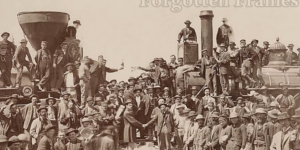
In 1869, at Promontory Summit, Utah, the Central Pacific and Union Pacific railroads were connected, completing the first transcontinental railroad in the United States. The people standing beside the tracks may not have understood all the long-term consequences of the moment they were witnessing. But the railroad transformed the movement of people, goods, and information across the continent.

Before that, inventors had experimented with steam-powered vehicles shaped like carriages. Eventually, automobiles became part of everyday life. In New Jersey in 1949, Americans sat inside their cars to watch films at drive-in theaters. The drive-in was more than a cinema. It combined automobiles, movies, families, dating, and postwar consumer culture.
In Chicago, mechanical parking systems attempted to solve another growing problem: cities had more cars and less available space.
At the same time, businesses were trying to make eating faster. In 1940, brothers Richard and Maurice McDonald opened a restaurant in San Bernardino, California. Their operating model emphasized simplification and standardization. What began as a particular way of running a restaurant later became an important part of the history of fast food.
Not every revolution begins with a spectacular invention.
Sometimes it begins with a paper box, a counter, a railroad, a small screen, or a seat.

In 1961, a chimpanzee named Ham became part of the history of spaceflight. Ham was launched into space on January 31, 1961, aboard Mercury-Redstone 2. The flight lasted roughly 16 minutes and was designed to test the ability to perform tasks under spaceflight conditions. The Smithsonian records that the mission helped pave the way for crewed Mercury flights.
A photograph of Ham may make us smile. But behind it lies a serious question about the use of animals in scientific programs designed to prepare humans for spaceflight. An image that looks charming can therefore lead to a much more complicated scientific and ethical story.
Elsewhere, another technological dream ended in disaster.
The Hindenburg represented a future in which people believed they could cross the Atlantic in luxurious airship cabins. The LZ 129 made numerous transatlantic flights beginning in 1936. But on May 6, 1937, while landing at Lakehurst, New Jersey, the airship caught fire. Smithsonian records that 35 of the 97 people aboard died, along with one member of the ground crew. The disaster contributed to the end of passenger airship travel.
Photographs of the Hindenburg before the disaster and photographs taken afterward almost belong to two different worlds. One represents the future. The other represents the collapse of confidence in that future.
History often works that way.

People see a technology and imagine what it might accomplish. Only after an accident, a war, or a failure do they recognize the risks they had not considered.
Another photograph takes us back to 1918. People in Philadelphia stand before a large map of Europe, watching the changes taking place as the First World War came to an end. The German, Austro-Hungarian, Ottoman, and Russian empires had been transformed by the conflict. New borders would be drawn. New states would emerge. And unresolved disputes would continue to shape the twentieth century.
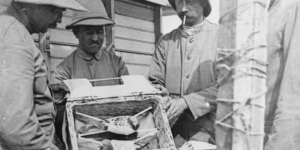
During wartime, information is precious. French soldiers carried messenger pigeons in small wicker baskets. When telephone lines could be destroyed, a bird could become an important means of communication. A photograph that initially looks strange therefore becomes meaningful: modern technology and ancient methods could exist side by side on the same battlefield.
Elsewhere, soldiers experimented with machine guns mounted on motorcycles. Others moved on horses or camels. In 1917, the Australian Camel Corps operated in Sinai and Palestine. Modern warfare did not immediately eliminate older forms of transport. Instead, machines and traditional methods existed together during a period of rapid transition.
The First World War also left photographs of ordinary life. A soldier receives a haircut in a trench. Another reads a magazine. A group of soldiers gathers around a piano. A mother says goodbye to her son.

Such photographs are often less famous than images of combat. Yet they may help us understand war more clearly. War was not a continuous sequence of battles. Between attacks, people ate, slept, wrote letters, read newspapers, laughed, missed home, and waited.
In 1914, a Serbian wife said goodbye to her husband as he left for the front. There is no strategic map in the photograph. No general. No tank. Only two people facing a separation whose length they could not know.
That may be one of the things photography does best.
It brings history back from numbers to faces.
Another photograph of women working in a factory in 1943 reveals one of the social transformations accelerated by the war. As millions of men entered military service, women took industrial jobs on a much larger scale. Welders, production workers, technicians, and logistical employees became part of the wartime economy. After the war, women’s roles became the subject of renewed debate. But the factory photographs remain, proving that these women had actually done the work.
At the Golden Gate Bridge, workers stood on steel structures hundreds of feet above the ground.

In Connecticut, a woman worked as a welder.
In New York, workers raised skyscrapers.
In Idaho, laborers assembled a massive water pipeline.
These photographs have something in common. They record the people who built the modern world but who rarely appear in the central version of the story.
Then there are photographs that have almost nothing to do with war and yet reveal something equally important: people have always looked for ways to entertain themselves.
In 1930, couples participated in dance marathons in Chicago. During the Great Depression, endurance competitions became a form of entertainment and income for some participants. They kept dancing while audiences watched. Today, the images may look strange. But in the economic circumstances of the period, they reflected a society searching for ways to survive, earn money, and find entertainment during hardship.

At Bondi Beach in 1900, Australians gathered along the shore in bathing clothes that look remarkably conservative by modern standards. In London in 1955, customers stood among shelves of records and musical instruments. At a New Jersey drive-in, families watched movies from their cars. In the bedrooms of teenagers during the 1980s, posters and magazines covered the walls.
There is no battlefield in these photographs.
But they are history too.
Because history is not created only on the days when nations declare war. It is also created by what people wear, hear, eat, buy, watch, and dream about.
Some photographs show us something even more difficult: how people looked at one another.
In 1936, August Landmesser became associated with a famous photograph in which he appears to stand with his arms crossed while many people around him raise their arms in a Nazi salute. The story is often told that he refused because his fiancée was Jewish. That identification and the exact circumstances of the photograph have been widely discussed, but specific details should be distinguished from what historical documentation can firmly establish. What matters more is how the photograph has become a symbol of an individual standing within a crowd and not joining the same gesture.
Another photograph, taken at Madison Square Garden in 1939, shows a crowd of more than 20,000 people attending a rally organized by the German American Bund, an organization that openly supported Nazism and antisemitism. American flags appeared alongside Bund and Nazi symbols. Outside the venue, protesters gathered as well. The United States Holocaust Memorial Museum records that the rally took place on February 20, 1939, and was one of the most prominent public events organized by the Bund in the United States.

The image matters because it reminds us that history does not always happen somewhere far away. Extremist ideas can appear publicly within societies, organize demonstrations, attract crowds, and leave photographic evidence behind.
And then the war ends.
In 1945, soldiers laughed when they heard that peace had arrived. Faces accustomed to tension suddenly became lighter. Yet peace did not mean that everything immediately returned to normal.
Some people went home.
Some never did.
Some returned with permanent injuries.
Others carried memories that no photograph could record.
On December 7, 1941, USS Arizona was struck at Pearl Harbor. An explosion in the forward ammunition area devastated the ship. A total of 1,177 sailors and Marines aboard Arizona were killed. More than 900 remain entombed within the wreck in Pearl Harbor.
A photograph of Arizona burning is therefore not simply a photograph of a ship. It is an image of a day that transformed American history.

Nearly four years later, another weapon opened a new era.
On August 9, 1945, the plutonium implosion bomb code-named Fat Man was dropped on Nagasaki. It was the second atomic bomb used in warfare. Humanity had crossed another technological and moral boundary.
Some photographs do not need to appear on the page for us to understand that the world changed. The date alone can carry enormous weight.
But history also contains much smaller moments.
A soldier receives a cup of cider from a French woman.
A child meets an animal at a zoo.
A mother repairs the family car while her husband serves overseas.
A man leans from an aircraft to inspect an engine.
A group of workers stands beneath a new skyscraper.
A girl looks into a music shop window.
A family shops inside a supermarket.
These moments may have seemed unimportant on the day they occurred.
Decades later, they become pieces of the puzzle that helps us imagine the past.
That is why collections presented as “Forgotten Frames” are both fascinating and dangerous.
A historical photograph can easily make viewers believe they are seeing the entire story. But they are not.
The camera does not know the name of the person in the frame.
It does not know the exact date.
It does not know who was standing outside the frame.
It does not know what the smiling person had experienced only minutes earlier.
And it cannot distinguish on its own between a staged moment, a spontaneous moment, or an image that was later given the wrong story.
That is why some popular captions need to be checked.
An aircraft may be assigned the wrong location.
A person may be given the wrong name.
A protest may be connected to the wrong cause.
A wartime photograph may be placed in a battle it never witnessed.
Even famous numbers can change depending on how a source defines the population being counted.
But that does not make the photographs less valuable.
It makes them worth looking at more carefully.
A photograph is not complete history.
It is a doorway.
Behind that doorway are archives, letters, diaries, maps, testimony, newspapers, military records, and memories.
The photograph simply tells us where to begin.
It can take us from a field grave on Okinawa to the story of a family. From a burning aircraft carrier to hundreds of people caught in the final stages of the Pacific War. From soldiers entering Paris to the years of occupation that came before. From a steel bridge to questions about workplace safety. From a chimpanzee named Ham to the history of human spaceflight. From the Hindenburg to the transformation of transportation technology. From a rally at Madison Square Garden to the question of how extremist ideas once appeared publicly within American society.
And finally, from strangers in a photograph to ourselves.
Perhaps that is the most remarkable thing about historical photographs.
They do not make the past look distant.
They make it look frighteningly close.
The people in these photographs once thought about dinner.
They wrote letters.
They fell in love.
They were afraid.
They laughed.
They believed tomorrow might look like today.
Then history arrived.
A war.
A crisis.

An invention.
A policy.
An accident.
A decision.
And an ordinary moment became a moment that people would still be looking at decades later.
Perhaps that is why old photographs never truly die.
The colors may disappear.
The paper may turn yellow.
Names may be forgotten.
But a glance, a hand, a gesture, or a street can survive.
And when we look at them, we are not simply looking at the past.
We are looking at people who once lived inside it.
I believe the greatest value of historical photographs is not how shocking they can be. It is their ability to make us slow down, examine the story behind the frame, and remember that history was made by real people. A photograph may carry a wrong caption, but that makes verification even more important. When we look back at the past, curiosity should always travel with caution.
If you could preserve only one photograph from this entire collection for future generations, which moment would you choose — and what story behind it would make you want to learn more?
Some content was generated using AI tools (including ChatGPT) and edited by the author for creativity, storytelling, and historical illustration purposes. Historical facts and key details should be verified against reliable historical sources. Any AI-generated or reconstructed visuals are intended for illustrative purposes and should not be interpreted as original historical photographs or archival evidence.
Để lại một bình luận