Before the smoke, before the ruins, before the names became statistics, there were ordinary faces looking into cameras. A soldier preparing a weapon. A child reading among the rubble. A family waiting for someone who might never return. These photographs do not explain World War II by themselves. They do something more unsettling: they leave us staring at moments that seemed ordinary until history revealed what came next. Behind every frame is another question—what happened after the shutter closed, and what did the people inside it understand that we can only discover now?

In 1939, the world had not yet fully understood how completely the coming conflict would transform everyday life. In New York, thousands gathered inside Madison Square Garden for a rally organized by the German American Bund. The event was public, political, and unmistakably connected to the atmosphere surrounding Nazi Germany. Across the Atlantic, Adolf Hitler had already transformed Germany into a dictatorship, while his government was preparing the country for expansion and war.
A photograph can make such moments look strangely distant. People stand beneath banners. Uniforms appear carefully arranged. The crowd watches. Yet the disturbing question is not simply what the photograph shows. It is what the people in that crowd believed the future would bring.
Europe was already carrying the memory of the First World War. The generation approaching another conflict had grown up among memorials, veterans, political instability, and economic hardship. In 1939, Albert Einstein was photographed with his sister Maja, a quiet family moment occurring while Europe moved toward catastrophe. Such images remind us that history does not announce itself equally to everyone. One person may see an approaching war; another may simply be sitting with family.
Then came September.
Germany invaded Poland, and the conflict that would become the Second World War began in Europe. Within months, borders that had seemed permanent were being crossed by armies. In 1940, German soldiers appeared beneath the Eiffel Tower after France’s defeat. Another photograph from June 1940 captures a Frenchman apparently weeping as German troops entered Paris.

The contrast between those two images is difficult to ignore. One side stands beneath a monument. The other watches. Neither photograph needs dramatic narration. The occupation is already visible.
For civilians, war was not only fought on battlefields. It entered streets, homes, shops, schools, and kitchens. London experienced the Blitz. A child photographed sitting among the rubble of a bomb-damaged bookstore while absorbed in a salvaged book offers a particularly powerful counterpoint to the destruction surrounding him. The building could be destroyed. The city could be attacked. Yet the child was still reading.

That small act raises a larger question: how does ordinary life survive when everything around it becomes extraordinary?
Women also adapted to the changing demands of wartime society. A photograph described in the source shows women painting dark lines on their legs in Britain in 1942, imitating stockings during wartime shortages. It seems almost playful until the larger context is understood. Material shortages had become part of daily life. Even clothing had become connected to the global war.
Elsewhere, British women worked in wartime workshops producing dummy heads intended to help expose enemy snipers. Behind the unusual appearance of such work was an important reality: modern warfare depended on deception, manufacturing, observation, engineering, and countless tasks that rarely appeared in dramatic battlefield photographs.
The war was becoming industrial.

And nowhere was that more obvious than in the weapons being produced and deployed.
The enormous German Dora gun represented one extreme of military engineering. Its gigantic size was itself a statement about the industrial resources being committed to destruction. In another image, the German Tiger II tank appears in Budapest in 1944, an imposing machine designed around heavy armor and firepower.
But photographs of giant weapons can create a dangerous illusion. Machines have no fear. Machines do not mourn. Machines do not write letters home.
The people operating them did.
In March 1945, American soldiers William E. Thomas and Joseph Jackson were photographed writing humorous messages on artillery shells. The scene appears almost casual. Yet the shells were instruments of war, and the men writing on them were living inside a conflict where humor could coexist with danger only because ordinary psychological boundaries had been stretched by years of combat.

The same contradiction appears in a photograph of Sergeant J. Dickinson of Canada and Sergeant F. Gilks of Trinidad laughing together in 1943 before a bombing raid over Hamburg. The moment is human precisely because it is not heroic theater. Two servicemen smile before entering an environment from which many would not return.
Soon afterward, Hamburg itself would become one of the clearest visual reminders of what industrial war could do to a city. Photographs of the ruins left by the July 1943 bombing raids show enormous areas of destruction. Buildings became skeletons. Streets disappeared beneath debris. The scale was almost impossible to comprehend from the ground.
Yet the destruction of cities was not confined to Germany.

In the Pacific, the geography of war was completely different. American troops fought through islands, jungles, beaches, and fortified positions. In 1944, troops preparing for combat landings in New Guinea faced an environment as dangerous in its own way as any European battlefield.
At Makin Atoll in November 1943, American troops came ashore under fire. Photographs of amphibious operations reveal an uncomfortable truth about Pacific warfare: the sea itself could become part of the battlefield.
Then came Iwo Jima.
The wreckage of American vehicles lay across the volcanic landscape in March 1945. The island’s black sand, damaged equipment, and fortified terrain created a landscape unlike the European battlefields many people imagine when they hear the words “World War II.”
One of the most famous photographs of the entire war shows five Marines and a Navy corpsman raising the American flag on Mount Suribachi.
The image became a symbol almost immediately.

But the photograph itself contains only a few seconds of history. It does not show everything that came before or everything that followed. It does not show the exhaustion, the uncertainty, or the men who would never leave the island.
Another photograph from Iwo Jima shows an American Marine flamethrower operator moving toward a Japanese position. Here the war looks completely different. There is no ceremonial symbolism. There is only equipment, terrain, movement, and danger.
The distance between these photographs is the distance between memory and reality.

One frame became an enduring symbol of victory. Another reveals the brutal mechanics required to reach that moment.
And while soldiers fought, civilians continued to live inside the war.
A Chinese father and daughter were photographed eating rice amid the ruins following a Japanese air raid on Singapore. The simplicity of the scene is almost shocking. Around them was destruction. In front of them was food.
The image does not need an invented speech or dramatic reconstruction. Their presence says enough.
Civilian suffering was one of the defining characteristics of the Second World War. Millions of people were displaced, imprisoned, starved, bombed, or murdered. In Warsaw in 1941, photographs from the sealed Jewish ghetto reveal people living under conditions of systematic deprivation. Another haunting image from Warsaw in 1943 shows Jewish civilians being forced from hiding by armed German troops.
These were not isolated accidents of battle. They belonged to a much broader system of persecution and mass murder.
In 1941, a photograph associated with Vinnytsia records the terror surrounding mass executions there. Across Nazi-occupied Europe, German authorities and their collaborators carried out mass shootings, deportations, starvation policies, forced labor, and extermination.

At Auschwitz, photographs of camp personnel can be especially difficult to look at because they appear so ordinary. Staff members pose for a camera. They smile. They stand together.
The disturbing element is precisely that ordinary appearance.
Behind the photograph existed a camp system in which people were imprisoned and murdered on an enormous scale. The contrast forces a question that history repeatedly asks: how can ordinary human routines exist beside extraordinary cruelty?
The answer is uncomfortable. Systems of violence do not always look chaotic from the inside. They can involve schedules, uniforms, paperwork, buildings, transportation, supplies, guards, administrators, and people performing assigned tasks.
That is part of what makes the photographs so important.
They show that atrocity was not created only by monsters in some distant world. It was also enabled by systems in which individuals performed roles and institutions continued functioning.
The photograph of Lepa Radić brings the story back to one person.
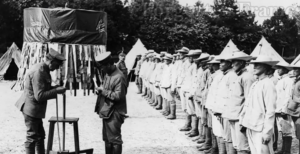
At only 17 years old, Radić became a Yugoslav Partisan resistance fighter. She was captured and executed by German forces in 1943. The surviving image of her before her execution has become associated with resistance because of the composure with which she faced the moment.
Her story is not important because one photograph can explain an entire resistance movement. It cannot.
It matters because enormous historical events are ultimately experienced one person at a time.
The same principle can be seen in the Soviet mother photographed beneath portraits of her seven sons, all lost during World War II. The exact details surrounding individual family photographs require careful verification, but the broader reality is beyond dispute: the Soviet Union suffered an enormous human loss during the war, and millions of families experienced bereavement on a scale difficult for later generations to imagine.
War statistics can tell us how many died.
A family photograph can make us wonder who they were.
The Allied war effort was itself global. Soldiers and workers came from many countries and communities. African-American soldiers served in the segregated American military, including in the European theater. Photographs of Black American soldiers operating heavy weapons in the winter of 1944 remind us that the struggle against Nazi Germany existed alongside racial segregation within the United States.
That contradiction became part of the war’s larger legacy.
Men could fight for democracy abroad while facing discrimination at home. The war did not erase those contradictions. But military service, industrial work, and the broader transformation of American society contributed to pressures that would continue into the postwar civil rights era.
The war also depended on people whose contributions have often received less attention.
Chinese laborers had supported Allied infrastructure during the First World War, establishing an earlier pattern of global manpower. During the Second World War, colonial troops and laborers again formed part of the vast networks sustaining imperial and Allied military systems.
World War II was therefore never simply a story of a few European and Pacific armies.
It was a global conflict involving soldiers, workers, sailors, nurses, engineers, mechanics, civilians, prisoners, resistance fighters, and forced laborers from an extraordinary range of societies.
At sea, the war became a battle over supply.
In 1943, the USCGC Spencer attacked the German submarine U-175 while protecting an Allied convoy. The photograph of a depth charge exploding above the submarine captures a moment when a single ship’s survival could be connected to the movement of food, fuel, ammunition, and troops across the Atlantic.

The Atlantic war was a contest over whether Britain and the Allies could keep their supply lines open.
In Europe, another kind of struggle was underway.
By 1944, Allied armies were returning to Western Europe. The wounded of D-Day were photographed beneath the cliffs near Omaha Beach in June 1944. Their injuries are part of the historical record, but even here the deeper story is larger than the battlefield itself.
D-Day was not simply one morning on a beach.

It was the opening of a campaign that would push German forces backward across France and eventually toward Germany.
A French veteran of the First World War was later photographed greeting Canadian soldiers from the South Saskatchewan Regiment in Normandy. The image connects two generations of conflict. The men in 1944 were fighting in a war their predecessors had hoped the First World War would prevent.
That is one of history’s cruelest repetitions.
The First World War had been called the war to end wars.
It had not.
On August 29, 1944, American troops from the 28th Infantry Division marched down the Champs-Élysées in Paris. The liberation of the capital was a turning point not because it immediately ended the war, but because it demonstrated how dramatically the balance in Western Europe had changed.

Photographs from liberated France show something that battlefield images rarely capture: relief.
In Strasbourg, a French woman welcomed an American liberator shortly after the city’s liberation. The emotion visible in such photographs is difficult to reduce to military terminology. For civilians who had lived under occupation, liberation could mean something as simple and enormous as being able to imagine tomorrow differently.
Yet even liberation brought difficult questions.
What would happen to collaborators?
What would happen to prisoners?
What would happen to the people who had disappeared?
What would happen to cities that had been destroyed?

And what would happen to a continent that had spent years living with violence?
In April 1945, American and Soviet troops met near the Elbe River at Torgau. Lieutenant William Robertson and Lieutenant Alexander Silvashko were photographed shaking hands.
The image became one of the clearest visual symbols that Nazi Germany was approaching its final collapse.
But the war was not yet completely finished.
In Europe, Soviet forces entered Berlin. Germany surrendered in May. In the Pacific, however, fighting continued.
The USS Bunker Hill was heavily damaged near Okinawa in May 1945, and wounded sailors were transferred to the USS Wilkes-Barre. The image belongs to the final months of a war that had already consumed years of lives and resources.
By then, the Japanese homeland was under enormous pressure. The war’s final stages brought the use of atomic bombs against Hiroshima and Nagasaki, followed by Japan’s announcement of surrender.

On September 2, 1945, the formal surrender was signed aboard USS Missouri in Tokyo Bay.
Aircraft passed overhead.
The ceremony was brief compared with the scale of the conflict that preceded it.
Four years of American involvement in the war had produced a generation of photographs: soldiers landing, families waiting, cities burning, prisoners being liberated, ships damaged, flags raised, and survivors staring silently at cameras.
But the photographs did not end with surrender.
They became evidence.
At Nuremberg, leading Nazi figures were placed on trial. The proceedings attempted to establish individual responsibility for crimes committed under the Nazi regime. The photographs from the courtroom would become part of the visual record through which later generations encountered the defeated leadership of the Third Reich.

Elsewhere, the destruction of Nazi camps exposed another dimension of the war. Survivors photographed after liberation showed faces that could not be reduced to numbers. Among those remembered from Auschwitz was Elie Wiesel, whose later life would make him one of the most prominent witnesses to the Holocaust.
The photographs of survivors changed the meaning of the war.
Before liberation, many crimes had been reports.
After liberation, they could be seen.
American soldiers also discovered looted European artworks hidden in places such as the Merkers salt mine in Germany in 1945. Paintings and cultural treasures had been removed from museums, collections, and private owners under Nazi rule.
The recovery of art revealed another layer of the conflict: the Nazis had not attempted only to control territory and populations. They had also sought cultural power and material wealth.
Then came the ruins.
Robert Capa photographed Warsaw in 1948, after the war had ended. The city was still carrying its scars. This is one of the most important distinctions in historical photography: the end of fighting does not mean the end of war’s consequences.
Buildings can be rebuilt.
Families cannot always be restored.

A generation cannot simply return to 1939.
Across Europe, displaced people searched for homes. Former prisoners attempted to rebuild lives. Children grew up without parents. Veterans returned with memories that photographs could never completely record.
In London, Paris, Warsaw, Hamburg, Berlin, Normandy, Iwo Jima, Okinawa, and countless places whose names became symbols of suffering, the physical war eventually disappeared from the streets.
But it did not disappear from people.
That may be the deepest message contained within these forgotten frames.
A photograph of a giant tank tells us about engineering.
A photograph of a soldier tells us about military service.
A photograph of a ruined city tells us about destruction.
But when those photographs are placed beside a child reading in the ruins, a father sharing rice with his daughter, a soldier laughing before a mission, a survivor looking from a barracks, or a family waiting at home, the meaning changes.
The war becomes human.
And perhaps that is why old photographs remain so powerful.

They freeze seconds, but history continues beyond the frame.
The smiling people at the 1939 rally could not see the ruins of 1945.
The Frenchman watching German soldiers enter Paris could not know when liberation would come.
The Marines raising the flag on Iwo Jima could not know how the photograph would eventually become a symbol known across the world.
The wounded on Omaha Beach could not see the liberation of Paris.
The soldiers meeting at the Elbe could not yet see the formal surrender aboard USS Missouri.
And the survivors photographed after liberation could not simply return to the lives they had before the war.
That missing information is what makes these photographs feel almost haunted.
We know what happened next.

They did not.
The photographs therefore give us something that statistics cannot: a confrontation with uncertainty.
World War II was shaped by decisions made by governments and military leaders, but it was lived by individuals. Some fought. Some resisted. Some were persecuted. Some worked in factories. Some hid. Some waited. Some survived. Millions did not.
The final lesson, in my view, is not that every photograph contains a secret waiting to be sensationally uncovered. The deeper lesson is quieter. Every photograph contains a human moment that history later gave a much larger meaning.
That is why these images deserve careful preservation and careful interpretation. Their power does not come from exaggeration. It comes from what really happened after the shutter closed.
And when we look at these faces today, perhaps the most important question is not simply, “What happened in World War II?” but something much more personal: If you could step into one of these photographs for just a few seconds, which moment would you want to understand—and what would you ask the people inside it?
Some content was generated using AI tools (including ChatGPT) and edited by the author for creativity, storytelling, and historical illustration purposes. Historical facts and key details should be verified against reliable historical sources. Any AI-generated or reconstructed visuals are intended for illustrative purposes and should not be interpreted as original historical photographs or archival evidence.
Để lại một bình luận