Vilnius 1941: The Shadow of Silence – Chronicle of a Disappearance
Before the Nazi occupation in 1941, Vilnius, the capital of Lithuania, throbbed with a unique energy. It was known as the “Jerusalem of the North.” Its cobbled streets echoed with the chants of Talmudic schools, the voices of merchants, and the passionate discussions of intellectuals in cafés. The city was home to one of the largest and most vibrant Jewish communities in Eastern Europe, a spiritual and cultural center of unparalleled richness. But on the eve of World War II , this beating heart would be silenced by the terror of Nazism , in a tragedy that history has never ceased to whisper: the Holocaust in Lithuania .
The arrival of the shadows
June 1941. German tanks rolled into Vilnius, bearing the promise of death. Within days, the city’s face was transformed: swastika flags replaced shop signs, and orders in German drowned out the sounds of the market. Fear became the only common language. Very quickly, the first anti-Semitic measures were imposed: mandatory wearing of the yellow star, prohibitions on practicing certain professions, and confiscation of property.
The Jewish inhabitants, more than 100,000 in number , understood that they had become targets. But no one yet imagined the scale of the genocide that was about to unfold.
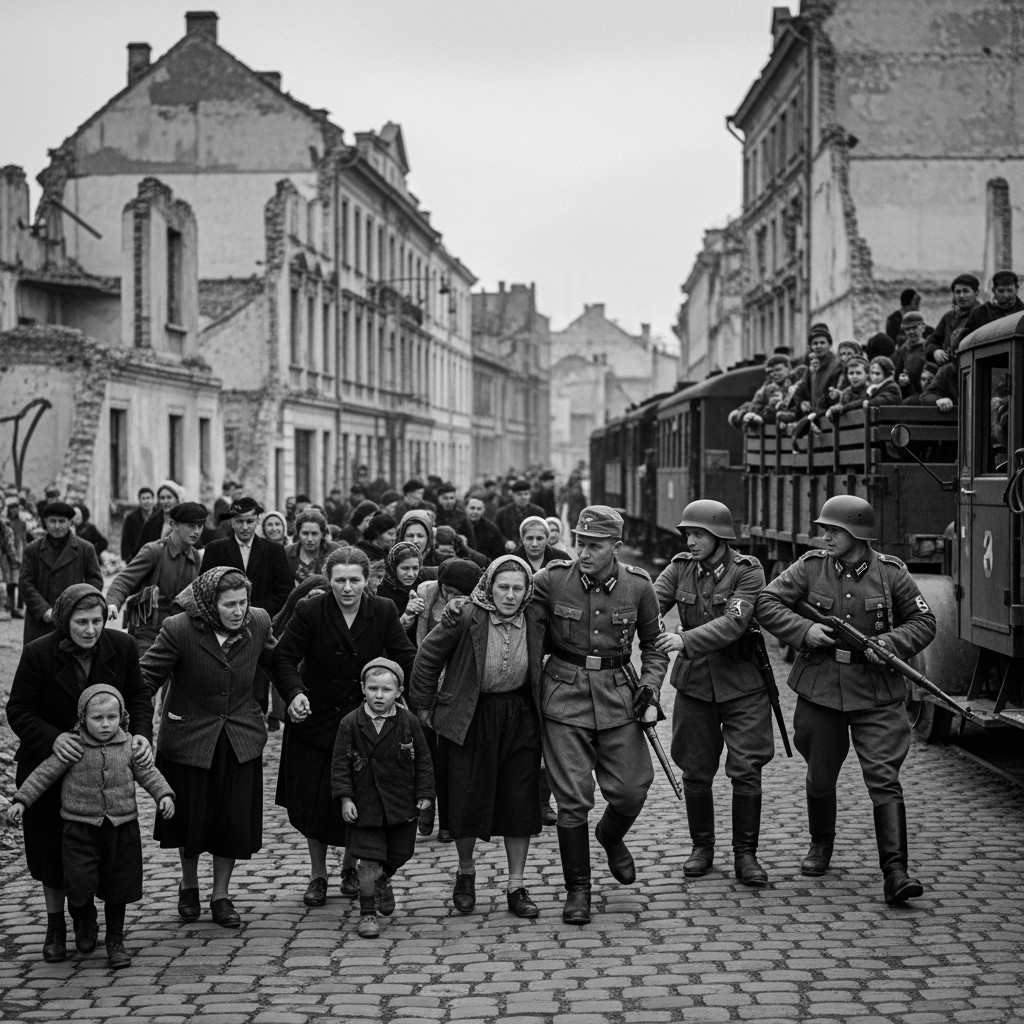
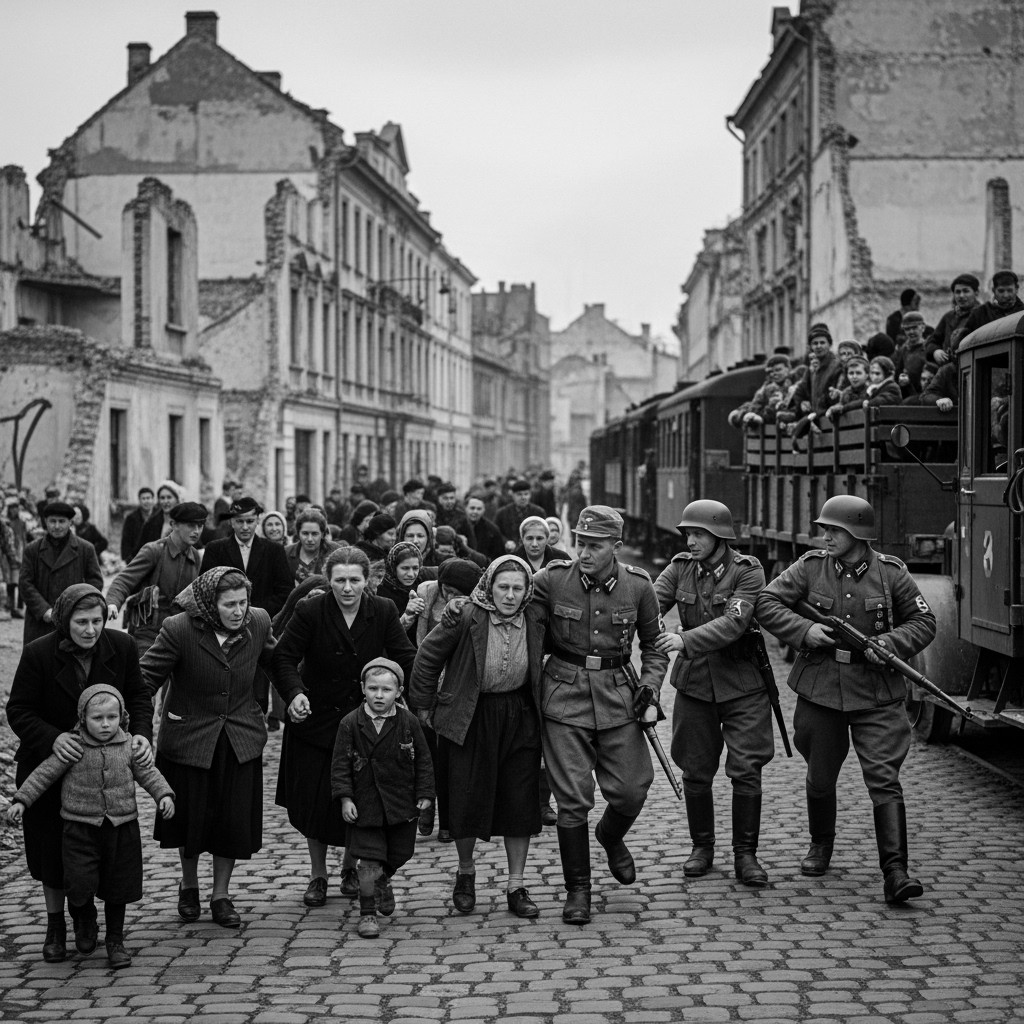
In the streets, families walk in silence, clutching light suitcases, believing it’s simply a transfer to a “new neighborhood.” Wehrmacht soldiers and SS units stand impassively guarding the procession. Behind every step, a life is forever changed. Trains stand idle, black and cold, ready to swallow hundreds of men, women, and children. Deportation becomes a daily occurrence. With each departure, a piece of Vilnius vanishes.
Ponary: the forest of stifled cries
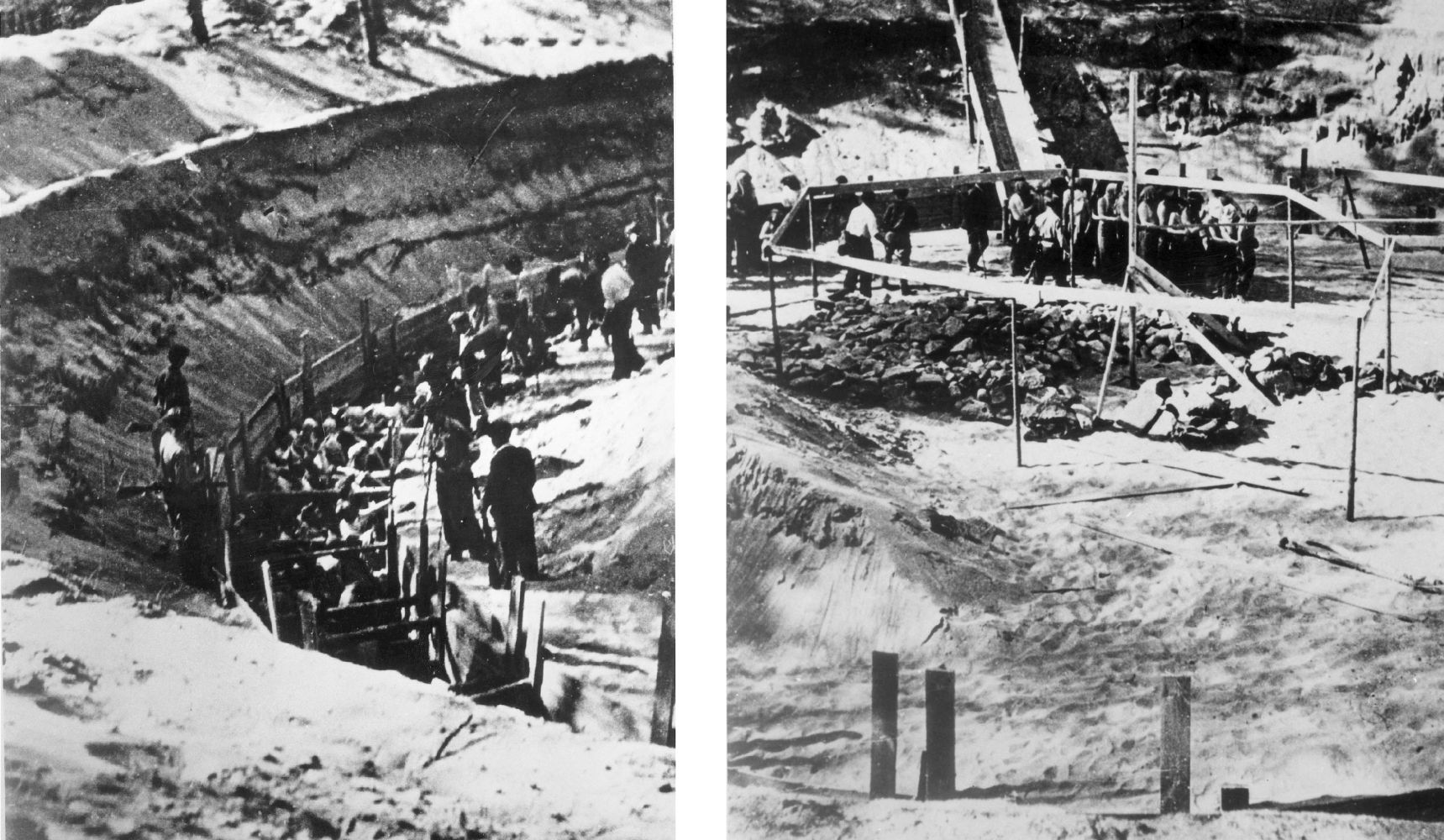
The Nazis quickly chose a site for their executions: the Ponary forest , a few kilometers south of the town. What had been a peaceful place for walks and pine trees became an abyss of horror. Day after day, trucks unloaded entire groups of Jews, lined up at the edge of the pits. Witnesses recount the screams, the prayers, and then the silence.
It is estimated that between 70,000 and 80,000 Jews were murdered at Ponary. Entire families disappeared there, without headstones, without names, erased in the dust of the paths. German bullets and the complicity of some Lithuanian collaborators made this place one of the most terrifying symbols of the Holocaust in Eastern Europe .
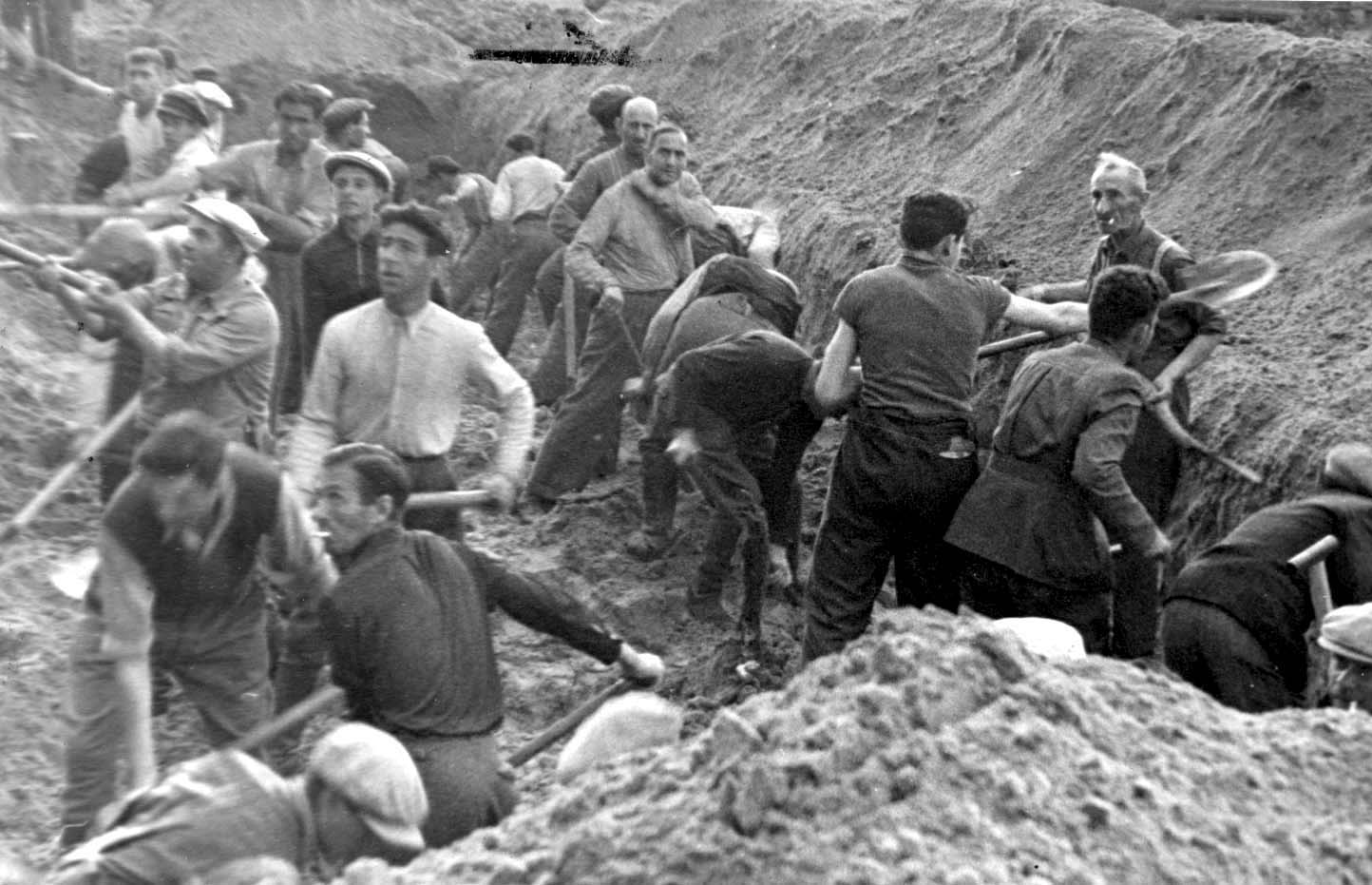
This massacre was not limited to physical death: it aimed at the very erasure of memory. The Nazis burned the bodies, destroyed the archives, and erased all traces. Yet, despite the flames and the earth, fragments of stories survived, carried by those who managed to flee or hide in the ruins of the city.
The Vilnius ghetto: between resistance and despair
At the end of the summer of 1941, the Nazis established two ghettos in Vilnius, separating families, isolating the sick, and controlling food supplies. The ghetto became a closed world, where life clung to the slightest spark of hope.
Children still attended clandestine classes there. Musicians played in the alleyways at night. And in the darkness, a breath of resistance was born: that of the young people of the FPÖ – Fareynikte Partizaner Organizatsye , the United Partisan Organization. These men and women decided that if death was to come, it would not come without a fight.
They made homemade bombs, established links with Soviet partisans in the forests, and transmitted messages of hope through the ghetto walls.
“We will not march like sheep to the slaughter,” wrote Abba Kovner, one of the leaders of the Jewish resistance. These words, etched in the memory of Vilnius, still resonate as a cry of dignity.
But the Nazis, ruthless, reduced the ghetto to nothing in the autumn of 1943. Those who were not shot on the spot were sent to the concentration camps of Majdanek , Treblinka or Auschwitz . Very few returned.
The silence after the storm
When the Soviets liberated Vilnius in July 1944 , almost nothing remained of the Jewish community. Of the 100,000 pre-war Jewish inhabitants, barely 5,000 survived.
The synagogues lay in ruins, the Talmudic schools emptied, and the once-bustling streets plunged into an unbearable silence. The spiritual heart of the “Jerusalem of the North” had ceased to beat.
And yet, in the rubble, some survivors return. They search for names, faces, memories. Some find buried objects: a photograph, a prayer book, a ring. These relics become proof of life, testimonies against oblivion.
But the pain of what has been lost remains immeasurable. The memory of the Holocaust in Vilnius is one of total disappearance, of a programmed erasure.
Witnesses of the Invisible
Even today, the stones of the old town seem to bear witness to this memory. Every alleyway, every facade saw the columns of deportees pass by, the convoys to their deaths, the stifled cries of mothers.
In the Ponary forest, visitors walk in silence. The wind in the pines seems to whisper the names of the missing. Where the earth was turned over a thousand times to hide the bodies, wildflowers grow. Perhaps this is the only possible victory against oblivion: life that is reborn despite everything.
Every year, commemorative ceremonies recall these events. Survivors still recount their stories, their voices trembling but resolute, so that the Holocaust will never become just another page of history. For to forget is to allow the shadow to return.
The duty to remember
In an era where Holocaust denial is resurfacing and hatred sometimes takes on new forms, remembering Vilnius 1941 is an act of resistance.
It is not simply about honoring the dead, but about understanding what barbarity can do to a people, a city, a culture.
The Holocaust is not a distant past: it is a warning. The Shoah in Vilnius shows the depths to which inhumanity can sink when fear and fanaticism replace reason.
Memory, however, is a gentle weapon. It illuminates, educates, humanizes. In Lithuanian schools, students today visit the ruins of the ghetto, read the diaries of the missing children, like that of Yitzhak Rudashevski, a fifteen-year-old boy shot in 1943.
His diary, found after the war, recounts with heartbreaking clarity daily life in the ghetto, the hunger, the dreams, the stolen laughter. He writes:
“We live in the shadows, but our hearts refuse to be extinguished.”
These words traverse time like a fragile flame, a memory of light in the heart of the night.
Vilnius today: between oblivion and rebirth
Modern Vilnius is beautiful, vibrant, and European. Its cafes overflow with youth, its streets resonate with music. But behind this vitality, invisible scars remain.
Commemorative plaques mark the sites where synagogues, schools, and the homes of vanished families once stood. The Vilnius Holocaust Museum preserves the archives, photographs, and letters—fragments of lives cut short.
In a world saturated with images and information, there is a great risk that memory will fade once again. Yet, every photo, every testimony, every word spoken on behalf of the missing is a victory over silence.
Conclusion: Light beneath the ashes
Vilnius 1941 is not merely a tragedy of the past; it is a universal lesson. It reminds us that even the most refined civilization can descend into barbarity when humanity remains silent.
It teaches us that the duty to remember is not a ritual, but a vital necessity.
And above all, it tells us that behind every number in the Holocaust, there was a face, a laugh, a name.
Today, walking through the restored streets of Vilnius, one might think the city has forgotten everything. But listen closely. Beneath the sound of footsteps, there is a whisper. It is the whisper of those who were here before us. Those whose lives were stolen but whose memory persists, like an eternal breath: “Do not forget us.”
Note: Some content was generated using AI tools (ChatGPT) and edited by the author for creative reasons and suitability for historical illustration purposes.
Để lại một bình luận