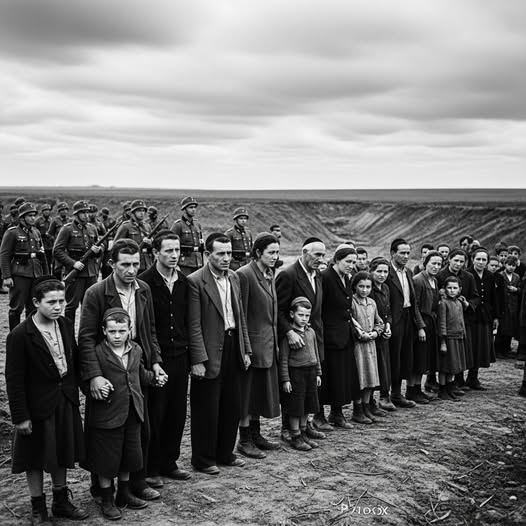
The Kamenets-Podolsk Massacre – The First Shadow of the Holocaust

August 1941.
The Ukrainian summer still lingers, heavy and silent, as if reluctant to end. The hills surrounding Kamenets-Podolsk are covered with dry grass that the wind struggles to stir. In the distance, the dust kicked up by military trucks can be seen. On this day, however, it is not soldiers on the march who are being transported, but entire families—Jewish men, women, and children gathered under the scorching sun, led out of the city toward a ravine that will become their grave.
This place, chosen with chilling precision by the Nazis, lies on the outskirts of the city, at the edge of a seemingly bottomless chasm. The inhabitants murmur. They don’t know yet, or perhaps they refuse to understand. The convoys keep arriving. Their faces are vacant, their hands trembling. Some still carry their house keys in their pockets—as if, after all this, they could go home.
But there will be no going back.
Between August 26 and 28, 1941, approximately 20,000 Jews were executed here in Kamenets-Podolsk , western Ukraine , by the Einsatzgruppen , the Nazi mobile killing units that advanced behind the front lines. This massacre, long overshadowed by the great atrocities of the Holocaust, was nevertheless one of the first mass genocides perpetrated by the Hitler regime on Soviet soil. Even before the extermination camps, before the gas chambers, here, in the silence of a ravine, lay the first machinery of industrial death.
Witnesses recount the rumble of trucks, the cries of children, the metallic clatter of German rifles. Nazi soldiers—aided by Hungarian and Ukrainian collaborators—ordered the victims to undress, to leave their suitcases at the edge of the ditch. The people obeyed, incredulous. Some prayed in hushed tones, others whispered lullabies to their children to shield them from their fear. Then came the moment when the soldiers lined them up. The bursts of gunfire erupted, sharp and mechanical. The bodies fell in a cascade, one upon another, until they formed a nameless sea of flesh.
The Kamenets-Podolsk massacre is not merely a crime; it is a signal. It is the moment when the Nazi policy of persecution transforms into a policy of extermination. There, in that Ukrainian soil, the Holocaust takes shape. The Einsatzgruppen , armed with their machine guns and meticulous ledgers, record everything. Every bullet fired, every body felled, every life erased. The crime becomes procedure. Murder, an administration.
In the days that followed, the town remained frozen in time. The inhabitants, paralyzed, avoided the roads leading to the ravine. The stench, it was said, permeated the air for miles. Stray dogs dug in the loose earth. And the soldiers, methodical and deliberate, hastily covered the graves before heading east again. Silence fell once more, a silence heavier than death.
This tragedy, orchestrated with bureaucratic precision, unfolds according to an implacable logic: that of the Nazi genocide , which, from the summer of 1941 onward, transformed Eastern Europe into a killing field. As the German army advanced, SS units followed, repeating the same scenario in other cities—Babi Yar, Riga, Vilnius. But Kamenets-Podolsk remained the first open wound, the very source of evil.
Why this place? Why these people?
Because Nazi ideology left nothing to chance. The Jews of Central Europe, fleeing Polish ghettos and seeking refuge in Ukraine, were declared “undesirable.” For the German and Hungarian authorities, their mere existence represented a demographic and racial threat. So, in the offices of Berlin, the decision was made to “transfer” them. A cold, bureaucratic word that concealed the reality: extermination.
Contemporary documents, recovered after the war, reveal the scale of the crime. SS General Friedrich Jeckeln oversaw the operation with terrifying composure. In his report, he noted that “the action was carried out in an orderly and disciplined manner.” Not a word about the screams, the faces, the earth trembling beneath the bodies. Only numbers. 23,600 people, he wrote. For him, this number represented a success. For humanity, it represented an abysmal defeat.
And yet, few people know Kamenets-Podolsk . In textbooks and documentaries, they talk about Auschwitz, Treblinka, and Majdanek. But before these camps, there were these ravines. These mass graves dug hastily, these fields turned into cemeteries. The Kamenets-Podolsk massacre was the silent prelude to the Holocaust by bullets, a method of extermination that would claim the lives of more than a million Jews in Eastern Europe. Here, the executioners looked their victims in the eyes before firing. The crime was intimate, personal, direct. No gas, no barbed wire. Just men killing other men in the name of an ideology.
Even today, on the site of the massacre, the wind blows across a gray plain. A simple stele, erected there in the 1990s, bears witness to the erased names. Nothing else. The earth itself holds the memory. Sometimes, after the rain, fragments of bone resurface. The earth, they say, does not want to forget.
This place has become a symbol, a warning. The Kamenets-Podolsk massacre is not merely an episode of the past; it poses a question to our present. How could ordinary men have participated in this? How could a cultured, educated people transform hatred into a duty? These questions still resonate today, at a time when other acts of violence, elsewhere, are using the same justifications.

In the archives, one finds photographs: rows of civilians, children holding their parents’ hands, and behind them, soldiers in uniform. The vast sky looms over the scene. These images don’t just show death; they show the moment before —the moment everything changes. It’s not the horror that strikes you most, but the banality. The faces are calm, almost resigned. Humanity, at that moment, seems suspended.
The French historian Raul Hilberg , a specialist in the Holocaust, said that the extermination of the Jews of Europe was a “perfect administrative process.” In Kamenets-Podolsk , this process began. It was the first step toward the industrial logic of death, toward Auschwitz, Sobibor, Belzec. But here, on this plain in Ukraine, the victims still had a name, a voice, a prayer. Perhaps that is the difference: the proximity of the crime. The killers could hear the cries.
Today, as we talk more and more about artificial intelligence , technological advances, and digital memory, it is vital to remember that the first modern mass genocide was committed at point-blank range by men convinced they were doing their duty. The Nazi genocide , in its cold, methodical way, began here, under an August sky.
And if we forget Kamenets-Podolsk , then we forget the first lesson of history: that barbarity never begins with the camps, but with indifference.
That is why, every year, survivors, descendants, and researchers come to this silent ground. They leave a stone, a flower, a prayer. The wind then whispers among the hills, as if to say that the memory lives on. The names have been lost, but the memory persists. And as long as there is a voice to tell the story of the Kamenets-Podolsk massacre , oblivion will not prevail.
Note: Some content was generated using AI tools (ChatGPT) and edited by the author for creative reasons and suitability for historical illustration purposes.
Để lại một bình luận