The photography that saved memory

In a small convalescence camp near Munich, where the ashes of war gave way to new beginnings, life moved slowly, as if afraid to disturb the silence of tragedy. Holocaust survivors—people rescued by fate from hell—gathered here to regain strength and meaning. In the shade of the trees, between the barracks, where the smell of soup mingled with the smell of smoke, whispers of the past could still be heard. Each of them carried within them a story that could not be told in a single breath.
On one such day, aid workers arrived at the camp. They brought crates full of photographs—photos found in the ruins of ghettos, in abandoned houses, on streets that no longer exist. These were fragments of life ripped from time, the last evidence that once existed a world full of laughter, family dinners, children’s games, and tender glances. Now these photographs became a bridge between past and present, between life and memory.
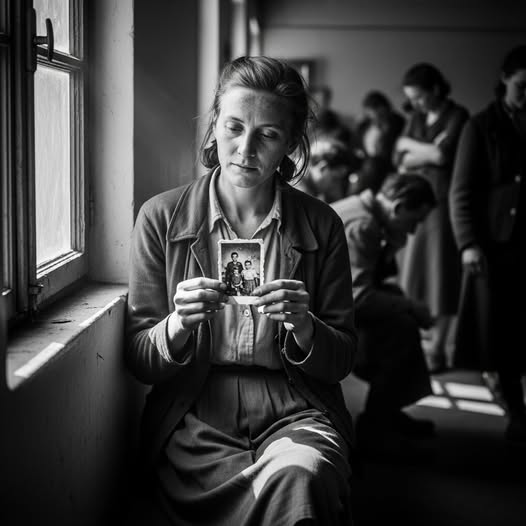
Among the people who came that day was a young woman named Elizabeth. She was thirty, but her face bore the lines of pain that added decades to her age. Her hands were delicate yet strong—the hands of someone who had seen too much and endured despite it all. When the volunteer handed her a small photo with yellowed edges, Elizabeth held her breath.
In the photograph, she saw herself from years ago—in a white dress, with a bow in her hair. Behind her stood her parents, and beside her, her little brother, Marek, holding a wooden horse. It was a photo taken in their garden in Krakow, a few months before the outbreak of World War II. She remembered that day well: the smell of the sun, the sound of laughter, her father calling out to them for a moment. No one suspected it would be their last carefree day together.
Elizabeth closed her eyes. For a moment, she thought she heard her mother’s voice again, saying, “Don’t be afraid, everything will be alright.” But the world she knew shattered. The Holocaust had taken her family, her childhood, her name, which she had been forced to hide to survive. In the concentration camp, they called her a number. Just a number.
Now, holding the photograph in her hands, she felt as if she held her entire world. Her fingers trembled as she traced the faces of her parents and brother. Warm tears streamed down her cheeks, and a whisper escaped her lips:
“Only I am left…”
The words hung in the air like a prayer. But after a moment, she added, more quietly but powerfully:
“They will live because of me.”
For Elżbieta, this photograph became more than a memento. It became a testament to a life the war sought to erase. In an era when entire families vanished without a trace, this single photograph was proof of existence—her personal archive of love and suffering. In the camp, she began telling her story to other survivors. With every word, with every memory, she brought back to life those she had lost. And though tears flowed often, Elżbieta knew that memory was the only way to overcome oblivion.
In the weeks that followed, she began working as a translator for humanitarian organizations. She helped others locate their loved ones, searched for names in registers, translated letters, and wrote messages. She often witnessed people years later discover a single photograph—the only trace of their former lives. Each of these moments felt like a quiet miracle, like a return to a world that had once seemed lost forever.
But at night, when the lights went out and the camp fell silent, Elizabeth would sit by the window and take out her photograph. She held it close to her heart, as if afraid it, too, might disappear. Then she would whisper names—her mother, her father, her brother—as if summoning spirits that had never truly left her.
Photography was her refuge. At a time when the trauma of war consumed the souls of survivors and memories burned like embers, this small piece of paper gave her meaning. She felt that if she preserved this photograph, she would also preserve herself. It was her personal struggle against nothingness—against an emptiness waiting to swallow the past.
Years passed. The survivor camps emptied, and people emigrated—to America, to Israel, to a new life where no one knew their pain. Elizabeth decided to remain in Germany, working for the Red Cross. Her task was to catalog war memorabilia, identifying photographs that could help others find their loved ones. For her, each photograph was living proof—not just a historical document, but a testament to humanity.
One day, while sorting through another batch of photos, she came across a portrait of a little boy with familiar eyes. On the back was the inscription: “Marek Kowalski, Kraków, 1939.” Elżbieta’s heart skipped a beat. It was her brother—a photo of him she’d never seen before. How had it survived? Who had saved it? She never knew. But in that moment, she understood that fate can be mysterious—that memory, once written down on paper, can outlive even death.

That evening, she returned to her room and placed the two photographs side by side. She stared at them for a long time, silently, as if comparing two worlds: the one before the war and the one after. Both were hers—both real. She reflected that the Holocaust had taken her family, but it hadn’t been able to take away her love.
Elżbieta began writing. First, short memoirs, then longer stories, and finally entire books. She wrote about life after the war, about memory, and how photographs can heal souls. Her first book, “The Photo That Survived ,” became a symbol of hope for survivors and their children. She wrote:
“A family photo isn’t just a snapshot of the past. It’s a bridge to the future, where memory becomes light. When I look at their faces, I see not only loss but also victory—because love endured against all odds.”
Her story spread throughout Europe. People who had themselves been through the camps came to her with their own photographs. Each photo had its own story, each person carried their own war within them. Elżbieta listened, wrote, and created a chronicle of memory that grew year by year. She knew this was her mission—to save from oblivion what the war had tried to destroy.
When she visited Poland years later, she stood before the ruins of her former home. She found only fragments of brick and the smell of wet earth, but there were no tears in her eyes. She had two photographs in her purse—the only things left of her past. She placed them on the doorstep and whispered,
“I’m back.”
Then she lifted her head, and the wind blew through her hair. For the first time in a long time, she felt peace. She knew that the memory of her family would endure, that their lives would not fade into the oblivion of history. Because the photograph she held in her hands that day in Munich had become not only a symbol of her survival, but also proof that even in the darkest of times, humanity can persevere.
Note: Some content was generated using AI tools (ChatGPT) and edited by the author for creativity and suitability for historical illustration purposes.
Để lại một bình luận