The line that never came back
(Hiver, 1943 – Auschwitz-Birkenau)

They were told it was a “selection.” A banal, almost bureaucratic word, uttered with the icy neutrality of a military doctor. Yet, in the morning silence, that word tolled like a death knell. It promised neither justice nor a future, but simply a division between those who would still “serve” and those whose breath was no longer worth anything.
Helena, the former schoolteacher from Krakow, knew the power of words. She had made it her profession, before words themselves became dangerous. She knew that behind that word— selection —lay an irrevocable verdict. Beside her, Mira, the seamstress from Łódź, gritted her teeth. Her fingers trembled, not from the cold, but from an instinct that whispered that this time, the line would not return.
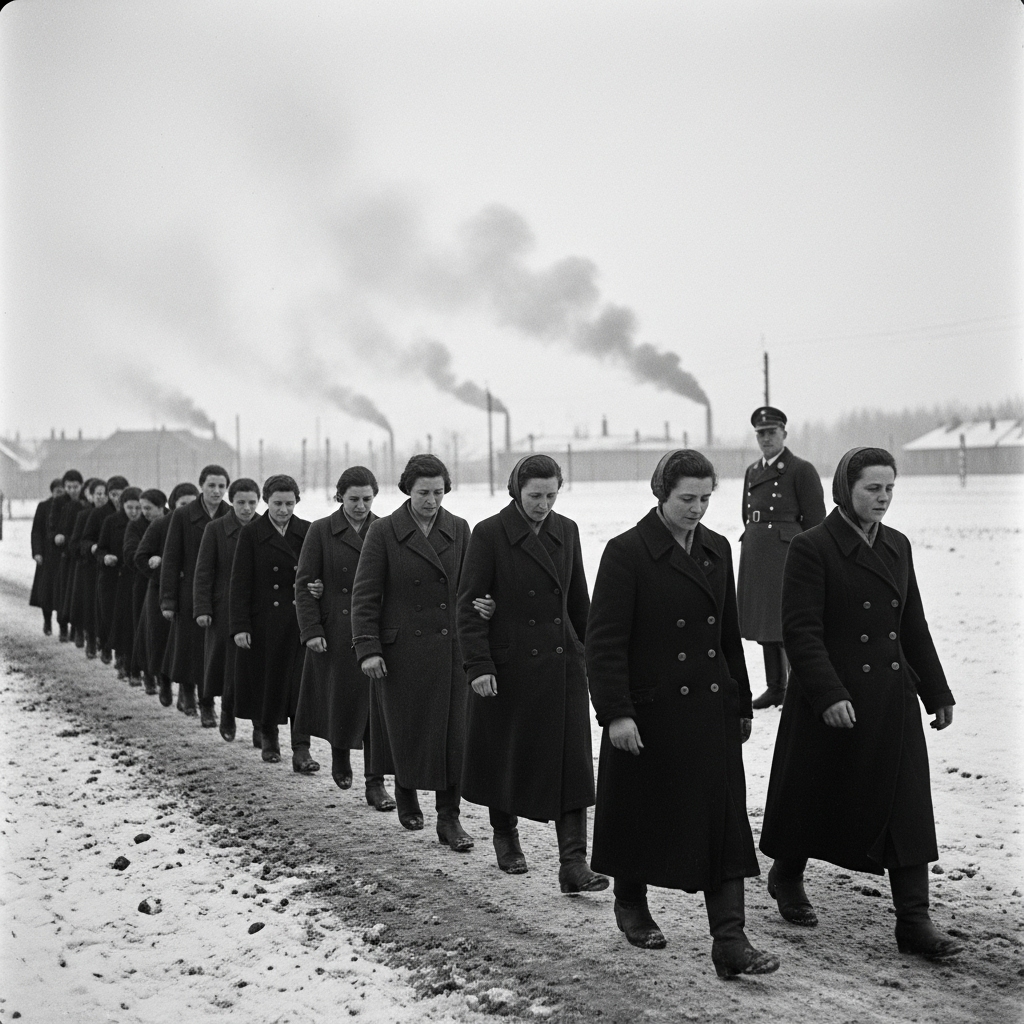
The snow fell on Auschwitz like a shroud, muffling sounds, absorbing cries. The barracks, lined up like wooden tombs, seemed to wait, resigned. In the distance, the chimneys smoked, black, thick, almost alive, as if they were breathing in place of those they had devoured.
The women walked in single file, arm in arm, under the impassive gaze of a German officer. His silhouette stood out against the white sky: his long coat, his gleaming boots, and the notebook in which he jotted down figures—numbers, not names. The cold bit at their skin, but there was a strange dignity in their gait, an almost majestic slowness.
Helena still remembered the sound of chalk on the blackboard, the autumn light on the desks. She recalled the voice of a student, the youngest, asking, “Miss, why do we learn history?” And she, in a burst of naive idealism, had replied, “So we don’t have to repeat it.” The
terrible irony: it was precisely because others had forgotten history that Helena found herself here, in this place where memory turned to ashes.
Around her, some wept silently. Others murmured prayers, or simply names: that of a husband, a child, a vanished village. These words floated in the icy air like wounded birds. Mira, however, said nothing. She walked on, holding Helena’s arm, her gaze fixed straight ahead.
The guards would sometimes shout a short order: “Schneller!” But the line maintained its rhythm, stubborn. They knew there was nowhere to go but toward the unknown, which smelled of soap and smoke.
A light wind had sprung up. It swept across the snow, raising white swirls that erased the footprints almost instantly.
Behind the barbed wire, life went on. Trains came and went, disgorging bewildered crowds, while in the offices, papers were stamped and arrivals were recorded. A perfect organization, a system so well-oiled it became monstrous.
And yet, within this machinery of death, sparks of humanity remained—fleeting, indestructible.
A Polish nurse assigned to the camp risked her life every night to slip a piece of bread under the floorboards of the barracks. A kapo would sometimes look away when he saw a hand steal a potato. Even in hell, there were still acts of kindness.
Helena called them her “little acts of resistance.”
When the line stopped in front of the door, an absolute silence fell. It was as if even the wind held its breath. The officer raised his hand. His face was impassive, almost bored. To his right, another man, dressed in a medical coat, observed the women with an analytical gaze. He nodded to the left, then to the right, alternating as if he were directing a ballet.
Helena felt Mira’s hand tighten on hers. For a moment, she thought of France, where she had studied before the war, in Paris, in the Latin Quarter. She saw again the Seine, the students laughing under the plane trees, the bookstores full of free-spirited words. And she wondered if anyone, somewhere, would still think of those anonymous women walking through the snow toward their oblivion.
The lines split.
Some were sent to the work barracks – where exhaustion would finish the job of the weapons. Others, to the showers. The snow fell harder, as if the sky itself wanted to hide what was to come.
Helena and Mira were directed to the left. They exchanged a glance – just one – and in that glance, there was everything: fear, love, fatigue, and that final tenderness that precedes silence.

Later, witnesses would recount that on that day, the snow covered the camp so quickly that it seemed as if the earth refused to swallow any more ashes.
The days passed indifferently. The next convoy arrived. More lines formed. More women marched, heads held high, toward the same end. History seemed to repeat itself, each day identical, each face dissolved in the same mist.
And yet, one tiny detail survived.
A small metal box, hidden under a floorboard in Block 25, contained hastily scribbled scraps of paper.
Names. Thoughts. Fragments of poems.
Among them, a single word, written in Helena’s hand:
“Remember.”
This was the word that Soviet soldiers found in January 1945, when they opened the gates of Auschwitz.
The paper was almost illegible, but the word itself remained.
And this word became a promise.
For although Helena and Mira’s path never returned, their memory has endured.
Every winter, every snowflake that falls on the ruins of Auschwitz seems to echo their footsteps.
And in museums, in books, in schools, their names are still whispered—not always spoken aloud, but present, like a persistent breath.
The history of the Second World War is full of figures, statistics, and battle names. But behind these figures are faces and voices. And it is these voices, those of the deported women, that we must continue to listen to.
They did not ask for glory, only to be remembered.
Even today, when visiting the Auschwitz-Birkenau camp, one can walk the same path they walked. The ground seems still, but it resonates for those who know how to listen.
The invisible line of these women—this line that never returned—traverses time like a scar in the snow.
And perhaps that is the true miracle:
in a place created to erase humanity, seventy years later, traces of light still remain.
A whispered prayer. A glance.
A word hastily written: Remember.
Note: Some content was generated using AI tools (ChatGPT) and edited by the author for creative reasons and suitability for historical illustration purposes.
Để lại một bình luận