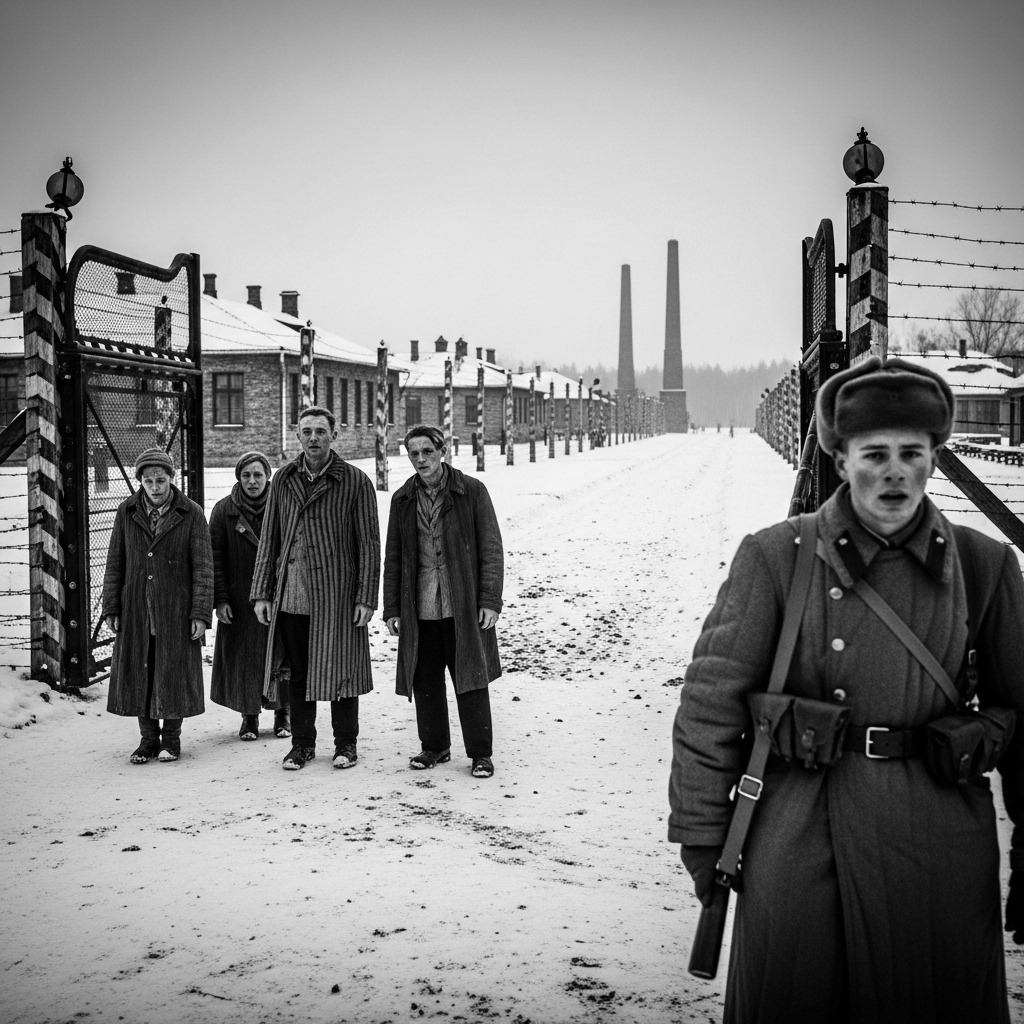
“After the smoke” – Auschwitz, January 1945

The wind blew across the barbed wire, whipping up small waves of gray snow. There were no more shouts, no more orders, no more hurried footsteps. Just this silence—so profound it seemed to have absorbed even the memory of noise. The camp gates had been open for only a few hours. Yet no one dared believe it. Was this truly the end? Or another illusion, a trap, yet another irony in this theater of suffering that Auschwitz had become?
Helena stood by the gate, her blue hands pressed tightly to her chest. Beside her, two men, thin as shadows, stared at the horizon. They still wore the same striped pajamas, the same numbers tattooed on their skin. In front of them, a young Soviet soldier, his face reddened by the cold, trembled. He was barely twenty. In his eyes, one could read something that even the war had not yet managed to harden: astonishment. He held his rifle, unsure what to do with it. Then, slowly, he dropped it into the snow and brought a hand to his face. And there, beneath that white sky, he wept.
No one would ever forget that image. Not Helena, not the survivors, not even that young man in uniform who had just discovered that victory could taste of ashes. For before him lay not a battlefield, but a cemetery without graves.
The waiting hours
In the deserted barracks, the bunk beds still bore the imprints of those who were no more. A pungent odor hung in the air, a mixture of smoke, burnt wood, and oblivion. The released prisoners wandered between the buildings, unable to leave. They searched for a face, a name, a memory. Some called out softly—a whisper, a first name lost on the wind. Others remained motionless, as if each step risked awakening the dead.
The word freedom seemed too grand for this place. Too heavy, too foreign. How could one be free when everything that made up a life had been swallowed by the smoke of the crematoriums? Helena knew: liberation was not a miracle, but a threshold—a fragile passage between the nightmare and a world she no longer recognized.
The smoke-free sky
The chimneys, black and silent, still raised their columns toward the sky. For years, they had swallowed souls and spat out silence. Now, they were cold. And this coldness seemed to be their last breath. Helena looked up. She remembered the days when the sky was no longer visible, hidden beneath a gray veil. Today, it was clear, almost blue. And yet, she could not rejoice in it. The silence of the open sky was not a song; it was an absence.
The young Soviet soldier came back to them, his lips trembling. He tried to speak, to say something like, “You are free.” But the words remained stuck in his throat. Helena looked at him, then nodded slowly. She understood what he meant, even without words. Because after Auschwitz, words had no place. They were too small.
Prayer without a church
As evening fell, the survivors gathered near a collapsed wall. No one had told them to. It was instinct, a necessity. Each held a piece of fabric, a scarf, a bandana, a scrap of clothing. Helena took hers—a small square of threadbare wool—and laid it on the snow. Others did the same. Within minutes, the ground was covered with these humble offerings. No priest, no speeches, not even the sign of the cross. Only silence. It was their wordless prayer. Their way of saying: we are still here .
Some wept silently. Others stared fixedly at the ruins of the crematoria, as if defying death. The wind carried away the tears and made the scarves lying on the ground shiver. There was no music, no lamentations. Just this presence, naked, human, indestructible.

The weight of memory
In the days that followed, the Soviets photographed everything: the barracks, the tracks, the piles of shoes. They didn’t yet know that these images would later become evidence, fragments of truth for a world that would one day dare to doubt. But for Helena and the others, these photographs were not symbols. They were scars.
Each survivor carried within them an invisible camp. A memory that would never heal. They would be asked questions later: What was it like? And they would answer, each in their own way, but always with the same hesitation. For how can one recount the unspeakable? How can one put words to a place where language had ceased to exist?
The impossible return
When the trucks arrived to evacuate them, some refused to leave. Helena hesitated too. To leave would be to admit it was over. But how could she leave a place where so many loved ones lay buried? She stayed until the very last moment, her eyes fixed on the barbed wire. Then she took a step, just one, out of the camp. That step, she would remember all her life. It didn’t lead to freedom, but to a form of survival—slower, more painful.
On the road, the soldiers talked amongst themselves. They said words like victory , justice , future . Helena listened, uncomprehending. For her, those words had lost their meaning. She didn’t want a future, not yet. She wanted to remember. And remembering was already a battle.

Memory and humanity
Years later, historians would call it the liberation of Auschwitz . Documentaries would focus on the numbers: 1.1 million dead, the Holocaust, Nazi barbarity, the end of the nightmare. But no statistic could truly capture what that January morning meant to those who were there. It wasn’t just the end of hell. It was the rediscovery of humanity, fragile and broken.
Helena almost never spoke of that day. She would simply say: It was after the smoke. And that single word— after —contained the entire distance between death and life. She later wrote in a notebook:
“Freedom came in silence. It did not shout victory, it barely breathed.”
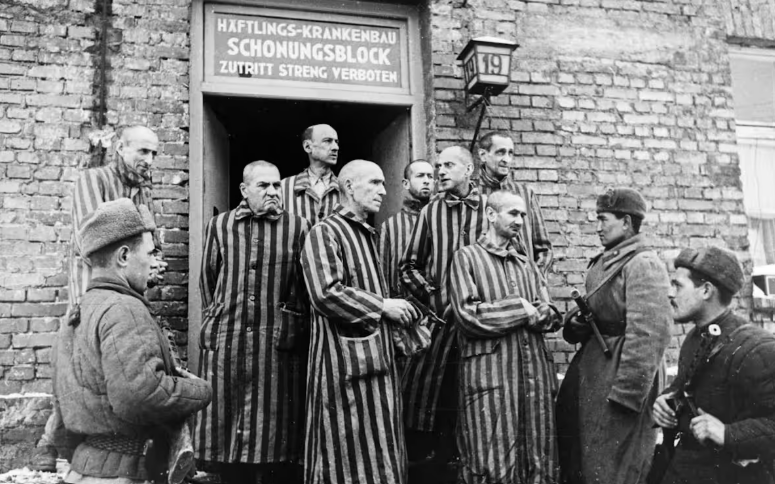
Note: Some content was generated using AI tools (ChatGPT) and edited by the author for creative reasons and suitability for historical illustration purposes.
Để lại một bình luận