The Lidice Massacre – The annihilation of a village and the immortality of its memory

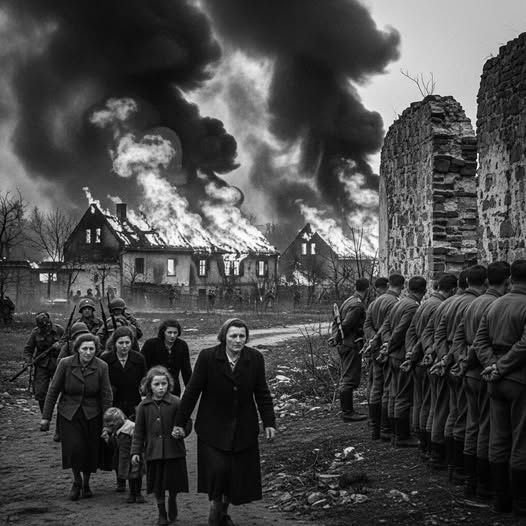
June 1942. The summer over Bohemia had been warm, but the sky over Lidice was heavy and gray as the sun sank over the burning houses. Smoke rose in thick, black columns, mingling with the smell of earth, gunpowder, and fear. Women clutched their children tightly as they were led away by German soldiers—men in uniform whose faces seemed like stone. No one spoke. No one dared to breathe.
The Lidice massacre was not a spontaneous outburst of violence. It was a carefully planned act of retribution, a symbol of the Third Reich’s total power, intended to demonstrate what would happen to anyone who dared to resist. The name Reinhard Heydrich still lingered in the background – the “Butcher of Prague,” one of the most brutal architects of the Final Solution , the systematic murder of millions of Jews and other innocent people.
Heydrich’s death, caused by Czechoslovak resistance fighters on May 27, 1942, deeply shook the German leadership. For Adolf Hitler, it was not just an assassination—it was an affront to the regime’s power. And like any affront, it had to be met with an example. In a fit of rage, Hitler ordered the destruction of a village. Lidice was chosen. A name that would soon become synonymous with Nazi crimes , war crimes , and human tragedy.
The night Lidice died
On the evening of June 9th, German units surrounded the village. No lights were allowed to be on, no one was permitted to leave their house. Women whispered prayers while children wept in the darkness. Some men knew what was coming; they had seen it in the soldiers’ eyes – that empty gaze that knew no mercy.
As the sun rose over the fields, the systematic extermination began. Over 170 men—fathers, sons, brothers—were led to the barn walls. No trial, no verdict, no attempt at explanation. Only the sudden, cold silence before the machine guns opened fire.
The sound echoed across the hills, reaching the women trapped in their homes. Some fell to their knees. Others screamed until their voices broke. Then the trucks arrived. Women and children were separated—the most horrific moment of all. One mother watched as her son was dragged into another truck while she herself was taken away, without a last word, without a final touch.
The women of Lidice were deported to the Ravensbrück concentration camp . Many died there – from hunger, disease, or in the medical experiments conducted by the camp doctors. Some children, deemed “racially suitable,” were adopted by the SS to be “Germanized.” The others – and they were the majority – were taken to extermination camps like Chelmno and murdered there.
The village disappeared – but the memory remained.
After the deportation, German pioneer units began the complete destruction of Lidice. The houses were blown up, the church burned down, even the cemetery was razed to the ground. They didn’t just want to kill the people – they wanted to erase the memory.
The roads were leveled, the rivers diverted. Lidice was supposed to have never existed. Even the name was erased from maps. But what the Nazis didn’t understand was that you can destroy stone and wood, but not the memory of a people.
Even during the war, news of the Lidice massacre reached the world. Radio stations in Great Britain, the USA, and the Soviet Union reported on the atrocities. In Mexico, a new neighborhood was named “Lidice.” In Chile, Cuba, Venezuela, Great Britain, and even the USA, memorials were erected, and schools and streets bore the name of the destroyed village. The small Bohemian village became a universal symbol of resistance—against fascism, against oppression, against forgetting.
Lidice after the war: Rebirth from the ashes
When the Second World War ended in 1945, only a few women returned from Lidice. Of the more than 500 villagers, fewer than 100 survived. Many never saw their children again. The homecoming was not a celebration, but a silent march through what had once been their home – an empty hill, overgrown with grass, without any trace of the past.

But they decided to do the impossible: to rebuild Lidice. Not as an act of revenge, but as a symbol of life. In the 1950s, the new Lidice was built about a kilometer from the old site. In the middle of the green hill, a memorial was erected – a group of 82 bronze figures created by the sculptor Marie Uchytilová. They represent the children of Lidice who were murdered in the extermination camps. Their faces are serious, serene, yet in their eyes lies the indelible echo of a lost future.
Every year on June 10th, people from all over the world come to Lidice to light candles. They bring flowers, lay down stones, and some sing softly – the same songs that once echoed in the barracks of Ravensbrück. It is a place of remembrance , a space of silent resistance against forgetting.
The significance of Lidice today
In the 21st century, at a time when the last witnesses of the Holocaust and the Second World War are slowly disappearing, Lidice remains a warning. It reminds us how easily humanity can lose its humanity when fear and ideology control the heart.
In a world where wars, displacement, and hatred persist, the story of Lidice is not just the past—it is the present. The village was destroyed because it was chosen as a symbol to spread terror. Today, it stands as a symbol of courage, survival, and the power of memory.
When you visit the site of old Lidice, you hear nothing but wind and birdsong. But beneath the earth lie the traces of history. You can feel them as you walk along the silent paths. Every stone, every flower, every bronze statue tells the same story: You can destroy a village, but never the truth.
A legacy of humanity
The Lidice massacre is an unforgettable part of European history , a chapter that shows what hatred and ideology are capable of – but also how powerful compassion and remembrance can remain. In textbooks, museums, and memorials, this story is passed on so that future generations understand what happens when the voice of humanity is silenced.
Today, thousands visit the Lidice Memorial Museum every year . There, one sees photographs of the villagers – happy faces, taken at weddings, festivals, and in the fields. These images serve as a reminder that the victims are not abstract numbers, but people with dreams, with families, with lives.
The name Lidice appears today on monuments in over 40 countries. It represents more than just an event – it represents the obligation not to forget the past, but to learn from it.
And so Lidice remains – not as ashes, but as a flame.
Final thought
Looking today at the charred ruins and the bronze figures of children, one understands why the story of Lidice must never be forgotten. It is a whisper from the depths of time, warning us:
“Never again.”
Note: Some content was created using artificial intelligence tools (ChatGPT) and edited by the author for creative reasons and historical illustration.
Để lại một bình luận