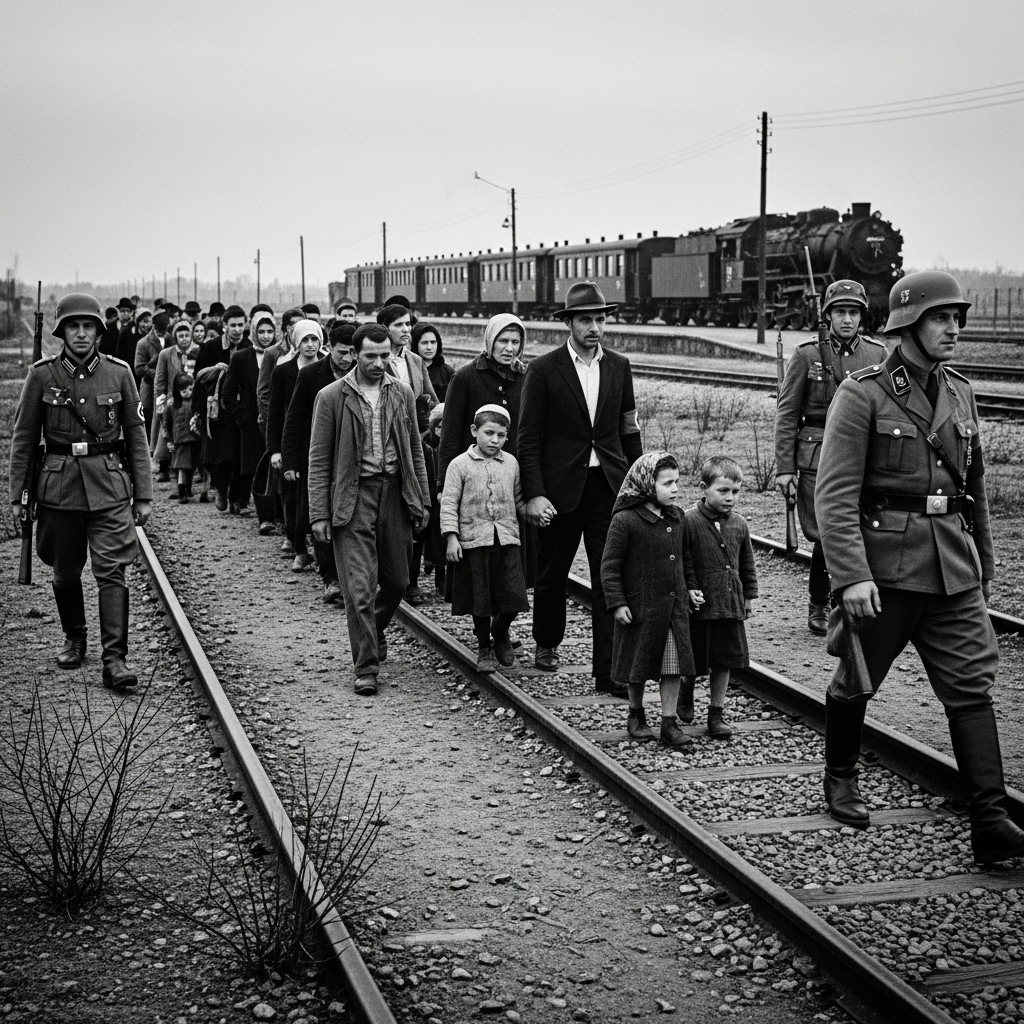
The evictions of Westerbork – a story of shattered hopes

On the edge of the Dutch moors, in Westerbork , a tragedy unfolded that remains one of the most painful chapters in the history of the Holocaust . Initially, this site was a refugee camp built by the Dutch authorities in 1939 to house Jews fleeing rising antisemitism and persecution in Germany. Ironically, it was here that, a few years later, the Nazis established the Westerbork transit camp – a gateway to death, to Auschwitz , Sobibor, and Bergen-Belsen.
In July 1942, the systematic deportation of Jews from Westerbork began, transforming this quiet corner into one of the most important logistical hubs of the genocide in Western Europe. Every Tuesday at dawn, a train departed: long, heavy, and packed with hundreds of people. Each wagon became a narrow passage between hope and death. In total, more than 107,000 Jews were deported from Westerbork. Most never returned.
Between illusion and despair

Life at the Westerbork camp was paradoxical. Unlike typical concentration camps, a semblance of order prevailed. Prisoners worked, children went to school, concerts and theatrical performances were organized, and even a newspaper was published. It was, as they said, ” the false face of the Nazi system ,” created to lull vigilance and maintain a glimmer of hope.
Many believed their stay at Westerbork was merely a temporary stop before their “relocation” elsewhere. The Nazis, with cynicism, employed euphemisms: the word ” transport” sounded almost technical, devoid of emotion. Yet, for those who understood its meaning, it was a death sentence. Transport meant death.
In reality, Westerbork was a meticulously orchestrated psychological machine. Daily life was designed to distract, to divert attention from the truth: each day could be the last. Wednesday, the day after the train departed, was dreaded because everyone knew that at any moment, they could find themselves on the list for the next “transport to the unknown.”
Funeral transports on Tuesday
Tuesday mornings in Westerbork were marked by a grim ritual. Even before dawn, the metallic clanging of train cars opening and the shouts of SS guards could be heard. Families were forced to pack their belongings hastily, often into simple suitcases, as if for an ordinary journey. Mothers cradled their children, trying to calm their trembling hands. The elderly prayed silently, while the young searched for their loved ones to say goodbye.
The trains slowly pulled away, rolling towards Auschwitz , Sobibor, Bergen-Belsen, or Theresienstadt. Each wagon glided along the tracks like an indelible mark on history. Some prisoners tried to leave letters, slipping notes into the slots, begging to be remembered. Most of these messages never reached their recipients, but a few, having survived, remain to this day poignant testaments to despair and courage.
In Westerbork itself, a suffocating atmosphere of waiting reigned. The weeks, days, and hours were counted. Everyone who remained after a transport knew their turn would come. And although some tried to maintain hope, a nagging question hung in the air: when will I be?
In the shadow of the Holocaust – everyday life that is no longer normal
The Westerbork camp was a microcosm of the entire tragedy of the Holocaust . The violence and humiliation were as real as the warmth of human solidarity that sometimes arose among the prisoners. They helped one another, shared food, and comforted the children. The women strove to preserve what little dignity they had left by taking care of their clothes, combing their hair, and singing songs that evoked a sense of home.
Many prisoners came from Amsterdam, the same streets Anne Frank walked before her deportation. Westerbork was also the final destination for her and her family. Their story, now known worldwide, is one of thousands that began here.
The Nazis, aware of the importance of propaganda, allowed the illusion of “order” to be created. Officials visited the camp and filmed it, presenting it as a “model work center.” These films aimed to conceal the truth about Nazi crimes and deceive public opinion.
The price of hope
In Westerbork, hope was a rare commodity. It sometimes appeared at the most unexpected moments: in a child’s smile, the smell of bread, the news that another week had passed without deportation. But even hope could be cruel, for it only prolonged the suffering.
There were times when prisoners asked to be put on the transport list, unable to bear the tension and waiting any longer. This testifies to the extent of the psychological terror that reigned in the camp.
Some, like doctors and craftsmen, were temporarily protected by their work. But survival in Westerbork was always precarious. Eventually, they all ended up on a train.

An echo in history
After the war, Westerbork was liberated on April 12, 1945, by Canadian troops. Approximately 850 people were discovered in the camp: disoriented, emaciated, and terrified. For them, time had stood still, suspended between life and oblivion. A silence reigned around them, a silence difficult to comprehend, a silence following the millions of voices silenced by the ashes of Auschwitz and Sobibor.
Today, the Westerbork camp is home to the Westerbork National Memorial , where preserved railway lines seem to stretch into the horizon. Annual ceremonies are held there, during which descendants of the victims and witnesses to history pay tribute to those murdered.
This place is not only a memorial cemetery, but also a warning. At a time when voices denying the truth about the Holocaust are increasingly being heard, Westerbork reminds us that silence is complicity.
The memory that binds
The story of Westerbork is not just a fragment of Dutch history ; it is a mirror of humanity. It reveals the thin line between civilization and barbarism. The modern world, saturated with information and technology, must remember that behind every number, behind every statistic, lies a human being, with their dreams, their family, and their love.
Today, as we look at these black and white photographs—children bundled up in their coats, women clutching their suitcases, men with faces contorted by fear—we must not forget that these were not just victims. These were people whose futures had been stolen.
The Westerbork deportations remain a symbol of shattered hopes and the brutality perpetrated by the Nazi regime . But they also bear witness to the strength of the spirit, of memory, and of the resistance to forgetting. As long as we remember, history will not repeat itself.
Note: Some content was generated using AI tools (ChatGPT) and modified by the author for creative purposes and to suit the historical illustration.
Để lại một bình luận