
Ponary – a forgotten hell near Vilnius

In the shadow of World War II, among the many execution sites scattered across occupied Europe, stands one that remained silent for decades: Ponary. Located just a few kilometers from Vilnius, the current capital of Lithuania, Ponary was the site of one of the most horrific and systematic extermination campaigns in the history of the Holocaust. Between 1941 and 1944, more than 100,000 people perished there—primarily Jews, but also Poles, Soviet prisoners of war, and members of Vilnius’s intelligentsia. Their deaths were not the result of chance, but of a coldly orchestrated killing machine, where the criminal decisions of Nazi Germany were intertwined with the grim reality of local collaboration.
The beginning of the tragedy
In June 1941, after the launch of Operation Barbarossa, German troops entered Lithuania, driving out the Red Army. They were accompanied by special units— the Einsatzgruppen —whose objective was not only to seize control of the occupied territories, but above all to exterminate the Jewish population and all those deemed “undesirable.” In Vilnius, then in occupied Poland, a new and dark chapter began.
Ponary, a wooded area near the city, once used by the Soviets as a fuel depot, became an ideal location for mass executions. After the Germans captured Vilnius, the area was cordoned off and prepared for “cleansing” operations. Soon, trucks full of people began arriving: first Jews from Vilnius and the surrounding area, then Poles, members of the Home Army, and Soviet prisoners of war.
The mechanism of crime
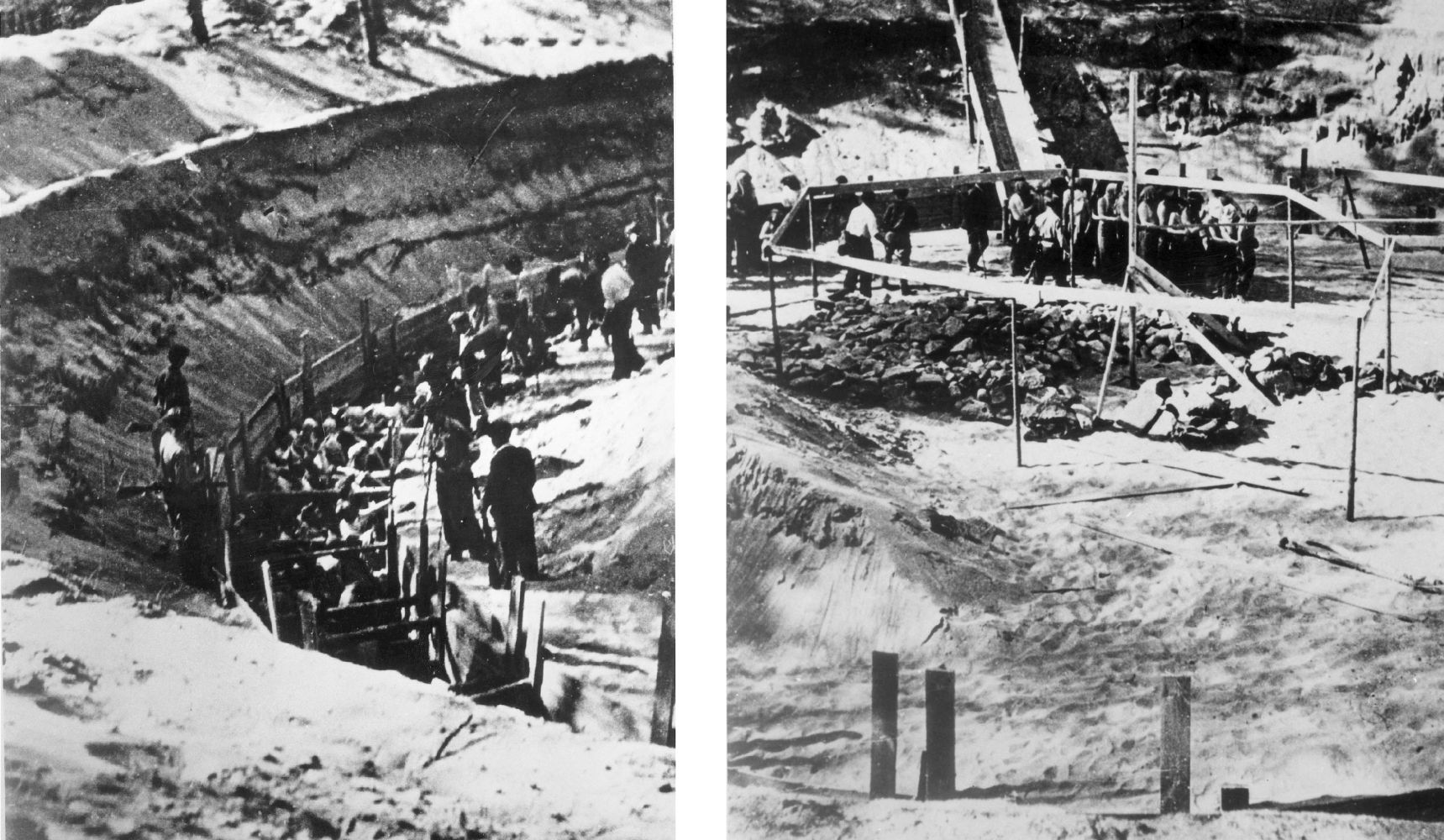
The crimes at Ponary were carried out with the precision and brutal efficiency typical of the Germans. Prisoners were brought from the town under the pretext of resettlement or work. Upon arrival, they were ordered to undress, and their valuables, documents, and personal belongings were often confiscated. They were then led to the edge of deep pits—dug by the Soviets before the war—and shot. The executions took place almost daily. The shots were fired in bursts, and the screams of the victims were lost in the dense forest.
Many of them died hand in hand, a final act of humanity in the face of an inhumane system. Their bodies, often still quivering, were thrown into mass graves. Successive groups were forced to fill in the graves of their predecessors. Later, they themselves suffered the same fate.
The massacres were perpetrated not only by units of the German Einsatzkommando 9, but also by Lithuanian collaborationist groups, primarily the Ypatingasis būrys . It was the Lithuanians, operating under German command, who played a decisive role in carrying out the crimes. Their participation remained taboo for a long time, both in postwar Lithuania and throughout the Eastern Bloc, where official discourse omitted or downplayed the issue of local collaboration.
Testimonies and memories
Although Nazi Germany attempted to erase the evidence of the crimes—in 1943, it ordered the exhumation and cremation of the bodies to obliterate all traces—the memory of Ponary endured thanks to a few survivors. Among them were Rachela Margolis, who wrote her memoirs after the war, and Wacław Sobaszek, a Polish prisoner who managed to escape from the execution site. Their poignant testimonies bear witness to the reality of the Holocaust and the German occupation in the Vilnius region.
From their accounts emerges the image of Ponary as a place where death had become a daily occurrence and humanity, the most precious of surviving treasures. Witnesses described how people prayed, sang hymns, and held hands. How mothers shielded their children with their own bodies and how elders begged to be killed first. These images remain forever etched in the memories of the survivors.
Polish trace in Ponary
Ponary is not only a tragedy for the Jewish population. For Poles in the Vilnius region, this place has become a symbol of martyrdom and the struggle for freedom. After the extermination of the Jews in 1943, the Germans began mass executions of members of the Home Army, teachers, students, and independence activists. Approximately 20,000 Poles perished, victims of both the German occupiers and their Lithuanian collaborators.
It was in Ponary that the sister of the famous poet Krzysztof Kamil Baczyński perished, along with many resistance fighters from Vilnius. For Poles, this place has become as symbolic as Katyn: a symbol of betrayal, suffering, and the memory of those who did not die anonymously, but in the name of freedom.

After the war – silence and truth
After World War II, Ponary was incorporated into the Lithuanian Soviet Socialist Republic. For years, the communist authorities avoided addressing the truth about the events that had taken place there. Official documents described it as a “victim of fascism,” without specifying the nationality, the perpetrators, or the extent of the crimes. It was only after 1990, with Lithuania’s regaining of its independence, that the involvement of Lithuanian collaborators began to be openly discussed. This was a painful but necessary process of purging the nation’s memory.
Today, Ponary is a place of national remembrance for Jews and Poles. Monuments stand there, bearing inscriptions in several languages: Hebrew, Polish, and Lithuanian. Every year, commemorative ceremonies are held there in tribute to the victims. Despite the passage of time, the land of Ponary still echoes those tragic days: the cries, the prayers, the silence after the gunshot.
Ponary in the consciousness of contemporary people
Contemporary Polish and Lithuanian history increasingly evokes Ponary as a shared, albeit tragic, part of the heritage of Central and Eastern Europe. At a time when the Holocaust is often downplayed and war crimes forgotten, the memory of Ponary serves as a warning. For younger generations, it is a lesson about the fine line between civilization and barbarity.
In documentaries, reports and books – from Kazimierz Sakowicz’s “Pony Diary” to contemporary historical studies – the question keeps coming up: how could man have organized industrial death in the heart of Europe?
Ponary remains a place where words fail. There, every tree, every stone bears witness to history. It is a forest that forgets nothing.
Heritage and responsibility
Today, as the world increasingly forgets the lessons of the Second World War, it is essential to speak of Ponary not only as a site of crime, but also as a symbol of responsibility. It is impossible to understand the history of the Holocaust without understanding the role of places like Ponary. It was not only a genocide that took place there, but also a moral reckoning for entire societies.
Commemorating Ponary is not only a duty for historians; it is a moral imperative for anyone who believes in truth and justice. For silence in the face of crime is a form of complicity. And remembrance is a form of resistance.
Note: Some content was generated using AI tools (ChatGPT) and modified by the author for creative purposes and to suit the historical illustration.
Để lại một bình luận