The American West did not disappear in a single moment. It was transformed slowly—one railroad track, one mining camp, one ranch, one military outpost and one photograph at a time. Behind the familiar legend of cowboys and open plains was a far more complicated world of labor, migration, Native survival, technological change and human ambition. These photographs preserve that world before it vanished.
On January 19, 1891, a camera recorded the camp of the Seventh Cavalry at Pine Ridge Agency, South Dakota. The Library of Congress identifies the image by W. R. Cross and records the tents, horses and wagons of the military camp. The date is striking because it came only weeks after the massacre at Wounded Knee. (Library of Congress)
Nothing about the photograph appears dramatic at first.
White tents stretch across the landscape. Horses stand quietly. Wagons remain in position. Soldiers occupy the camp.
Yet history had already changed the meaning of that landscape.
The photograph does not show the violence at Wounded Knee, nor does it explain the thoughts of everyone who stood inside the camp. It simply records the military presence at Pine Ridge at a moment of profound tension between the United States government and Lakota communities.
That distinction matters.
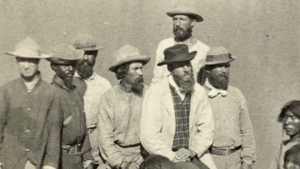
Historical photographs can show us what existed, but they cannot automatically explain why every person was there or what each individual believed. The silence of the image is therefore part of its power. We are forced to look beyond the tents and ask what had happened before the shutter opened—and what would happen after it closed.
Elsewhere, another scene reveals a very different side of the frontier.
A cowboy restrains a calf inside an open corral while another prepares a heated branding iron. Branding was a practical method of identifying livestock, but the photograph also captures the physical reality behind the romantic image of the American cowboy.
There was nothing effortless about ranch work.
Animals had to be controlled. Herds had to be managed. Equipment had to be maintained. Long distances had to be crossed.
The open range may have looked limitless, but ranching depended upon organization.
And the same was true underground.
At mining sites such as Warren in Idaho, workers posed near excavations surrounded by rail carts, wooden structures and rough supports. Their world was built around extracting valuable material from difficult terrain. Before modern machinery transformed mining, much of the work depended upon muscle, timber, simple transport systems and relentless repetition.
The photographs leave one question hanging in the air:
How much labor was hidden behind the promise of gold?
The answer appears again in the snow.
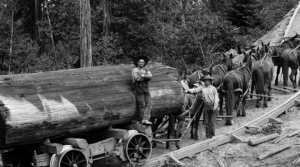
During severe winters in the Colorado mining country, snow could bury homes almost completely, leaving only roofs and chimneys visible. Such photographs can look beautiful from a distance. But for the people living there, the snow was not scenery. It was an obstacle that affected transportation, supplies, work and survival.
Men had travelled into the mountains looking for precious metals.
Now the mountains demanded something in return.
Farther north, the gold rush became even harsher.
In Alaska and the Yukon, miners worked with sluice boxes, pans and other simple equipment, washing gravel in the hope that heavier gold would remain behind. The process was repetitive and physically demanding. Every shovel of earth contained possibility, but most contained very little.
That uncertainty helped drive the gold-rush imagination.
A person could spend months searching and find almost nothing.
Or one discovery could change everything.
The photograph could capture the equipment.
It could capture the miner.
But it could never capture the exact moment when hope turned into disappointment—or fortune.
Transportation was another constant struggle.
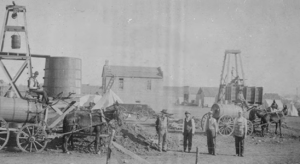
A leaking boat on a Yukon river might look like a minor inconvenience to someone living in a modern city. In the nineteenth-century North, it could become a serious logistical problem. Supplies had to move across waterways, and isolated settlements depended upon fragile networks of boats, animals, trails and later railways.
The overturned boat therefore tells a larger story.
The gold rush was not simply about gold.
It was about everything required to reach the gold.
Food.
Tools.
Clothing.
Fuel.
Animals.
Boats.
Shelter.
And people capable of moving all of them.

Even the miners who succeeded economically depended upon this enormous system.
Inside a rough cabin near Nome, Alaska, two men could weigh gold nuggets and dust on a scale. The scene looks modest, but the scale represented a transformation.
Gold taken from the earth was becoming money.
The tiny particles on the table were no longer merely pieces of rock. They represented wages, debts, investment, risk and the possibility of another journey.
The frontier economy was taking shape around objects that were surprisingly simple.
A pan.
A shovel.
A scale.
A wagon.
A railroad.
Together, they connected remote landscapes to a much larger world.
On ranches and farms, another transformation was underway.
Workers at Stockdale Ranch in California used a pulley system to stack alfalfa hay. Animal power and simple machinery allowed people to handle loads that would otherwise have required far more manual effort.

This was the West in transition.
The old methods had not disappeared.
The new methods had not yet completely arrived.
Instead, both existed together.
Horses pulled equipment.
People operated machines.
Wooden conveyors and lifting systems increased productivity.
Agriculture was becoming increasingly organized and mechanized, but the transformation remained dependent upon human and animal labor.
The same pattern appeared in mining.
Workers and draft animals operated around coal and mineral extraction sites, moving material through landscapes that were rapidly becoming part of a national industrial economy.
What looked like isolated work in the photographs was actually connected to something much larger.
Coal supplied industry.
Mining supplied metals.
Railroads moved both.
Towns grew around the tracks.
And the tracks changed the towns.

But perhaps the most revealing photographs of this transformation are those showing Chinese railroad workers.
Between 1865 and 1869, Chinese laborers played a crucial role in constructing the Central Pacific Railroad across the Sierra Nevada and Nevada desert. The National Park Service describes Chinese immigrants as a major part of the workforce building the Central Pacific portion of the transcontinental railroad. (National Park Service)
Their camps could appear almost temporary—rows of tents beside the advancing railroad.
But the work was anything but temporary.
The railroad required grading, track laying, construction, transportation and enormous amounts of physical labor. NPS historical material notes that by 1867, the Central Pacific had about 12,000 Chinese workers on its payroll, representing roughly 90 percent of its workforce. (National Park Service)
That figure changes how we should look at photographs of the railroad.
The tracks were not simply symbols of American technological progress.
They were the product of thousands of human hands.
Workers crossed mountains.
They cut into rock.
They endured dangerous conditions.
They built a connection that would transform the geography of the United States.

Yet the public memory of the transcontinental railroad often focuses on the famous ceremonial completion rather than the workers who made it possible.
That is precisely why these camp photographs matter.
They put the workers back into the picture.
A Chinese camp at Brown Station, Nevada, shows the practical reality of railroad construction: temporary dwellings, personal belongings and people living beside the line they were helping to build.
The railroad was moving west.
The workers moved with it.
Behind them, the completed tracks remained.
Ahead of them, there was still more work.
Nearby, an engineering crew of the Deadwood Central Railroad posed with surveying instruments and measuring rods. The Library of Congress identifies the 1888 photograph as a group portrait of railroad engineers working with surveying equipment in the Black Hills. (Library of Congress)
Their clothing looks formal.
Their expressions are controlled.
But the instruments in front of them reveal what they were actually doing.
They were measuring the future.
Every line drawn across the landscape could determine where the railroad would go.
Every slope mattered.
Every measurement had consequences.

The West was being transformed from a landscape of distance into a landscape of connection.
Stagecoaches had already been doing part of that work.
Photographs of Deadwood coaches show passengers and vehicles crossing rough bridges. In Denver, the Holiday Overland Mail and Express Company operated stagecoach services connecting people and mail across difficult western routes.
But stagecoaches had limits.
Railroads did not simply make travel easier.
They changed the scale of movement itself.
Goods could travel farther.
Settlements could grow faster.
Mining communities could receive supplies.
Farmers could reach markets.
People could move into territories that had once been extremely difficult to access.

And with every mile of track, the meaning of the frontier changed.
The frontier was no longer simply a distant place.
It was becoming connected to the rest of America.
That connection accelerated settlement.
In Oklahoma Territory, photographs surrounding the 1893 land run show wagons, tents, temporary buildings and people establishing new communities with extraordinary speed.
A settlement could appear almost overnight.
But settlement required more than land.
It required water.
The photograph of water infrastructure work in Perry, Oklahoma Territory, illustrates this basic reality. Wagons and large tanks represented the practical side of creating a community.

Before there could be a permanent town, there had to be enough water to support it.
The romantic frontier story often begins with someone claiming land.
The practical story begins with someone asking where the water will come from.
That same practical logic appears everywhere in the photographs.
At Fort Verde, a mule-drawn wagon carries a large wooden water barrel.
On ranches, wagons transport supplies.
On mining sites, animals haul equipment.
In Alaska, sled dogs provide transportation.
In the mountains, pack animals carry photographic equipment.
The frontier depended upon logistics.
Without transportation, even the richest mine was useless.
Without water, even the most promising settlement could fail.
Without food, no railroad camp could survive.

And without people willing to perform the work, none of the great expansion projects could move forward.
This is where Native history becomes impossible to separate from the story of western expansion.
The photographs preserve Native families, leaders, police officers and communities living through a period of enormous political and territorial change.
At Standing Rock Agency, photographs show Native people gathering for government-distributed supplies. The scene reflects the growing importance of the reservation agency system and the dependence created by federal policies.
The image can appear orderly.
People gather.
Supplies are distributed.
Officials manage the process.
But beneath that order was a much larger transformation.
Native nations had lost control over enormous portions of their traditional territories.
Their economies were disrupted.
Their movements were increasingly restricted.
Government agencies became deeply involved in everyday life.

A photograph of people receiving supplies therefore carries a meaning far beyond the visible scene.
It shows survival inside a system created by policies that had profoundly altered Native independence.
Other photographs show Native people wearing Western clothing, government uniforms or traditional garments.
The combination can be confusing if we expect history to divide neatly into “traditional” and “modern.”
Real people did not live that way.
They adapted.
They negotiated.
They resisted.
They incorporated new objects into existing cultures.

They preserved traditions while living under new political conditions.
The Cheyenne Indian Police are an especially revealing example.
Photographs of Native police officers in uniform demonstrate how Native communities participated in institutions created within the reservation system. Their role cannot be reduced to a simple symbol of assimilation. They occupied a complicated position inside a changing political order.
They were Native men.
They were also officers.
Both facts mattered.
The same complexity appears in photographs of Native leaders and families.
Chief Iron Bear at Fort Berthold appears in traditional clothing and objects associated with identity and status.
Other photographs preserve Cheyenne, Comanche, Shoshone, Nez Perce, Paiute, Navajo and Apache people.

The names and captions attached to some historic photographs can vary between collections, and individual identifications should therefore be checked against the original archive.
But the larger evidence is unmistakable.
These communities were not merely disappearing figures in someone else’s frontier story.
They were living communities navigating profound change.
A photograph of a family beside a tipi does not represent the end of a people.
It represents a family at a particular moment.
A woman sitting at the entrance of a dwelling is not simply a symbol of a vanished past.
She was a person living her life.
That human scale matters.
It is easy to turn historical photographs into symbols.
It is harder—and more honest—to remember that every face belonged to someone.
The same principle applies to settlers.

A pioneer family standing outside a wooden house in California looks almost peaceful.
Adults stand together.
Children remain nearby.
The house is simple.
The surrounding forest appears enormous.
But the image captures the uncertainty of frontier life.
The building had to be constructed.
Food had to be secured.
Weather had to be endured.
Animals had to be managed.
Distance had to be overcome.
A frontier family was not simply “living in the West.”
They were constantly adapting to it.
Mining camps faced similar problems.
A cabin with a sod roof in Utah or the Yukon might look primitive compared with modern housing, but its construction represented practical knowledge.

Materials were limited.
Weather was severe.
Transport was expensive.
People built with what was available.
The result was architecture shaped by necessity rather than fashion.
Even the smallest structures reveal something about the environment.
A sod roof suggests the availability of local material.
A log cabin reflects nearby timber.
A canvas tent reflects mobility.
A wooden commercial building indicates permanence.
The frontier can therefore be read through architecture.
Temporary settlements became permanent towns.

Temporary cabins became abandoned ruins.
Railroad camps moved forward.
Mining settlements expanded and sometimes disappeared.
The camera caught many of these transitions before they were forgotten.
Then there were the people who documented the transformation itself.
William Henry Jackson stands among the most important photographers of the nineteenth-century American West. In 1871, he joined Ferdinand Hayden’s geological survey of the Yellowstone region, carrying photographic equipment into difficult terrain. The National Park Service notes that his photographs helped convince Congress and the public of Yellowstone’s significance, contributing to its designation as a national park in 1872. (National Park Service)
But taking those photographs was an extraordinary logistical task.
Jackson used wet-plate photography, which required glass plates, chemicals, water and a portable darkroom. Pack animals carried much of the equipment through rugged country. (National Park Service)
Today, a photograph can be taken in an instant.
Jackson’s process was nothing like that.
The image had to be prepared.
The glass plate had to be handled carefully.
Chemicals had to be transported.
The exposure had to be made.

The plate then had to be developed.
A single mistake could destroy the image.
And yet Jackson continued.
His photographs helped Americans far from Yellowstone see landscapes they had previously known only through descriptions.
Photography was changing the relationship between distance and knowledge.
A mountain thousands of miles away could suddenly appear on someone’s wall.
A canyon could become a national symbol.
A landscape that seemed almost mythical could become visible evidence.
But there is an irony here.
The same cameras documenting the wilderness were also recording the expansion that would reshape it.
Railroads crossed the landscape.
Mining altered mountainsides.
Ranches occupied open land.
Towns appeared.
The frontier was being photographed precisely as it was disappearing.
That may be the hidden thread connecting all these images.

They are not merely photographs of the Old West.
They are photographs of a world in transition.
A locomotive winds through Elk Canyon.
A stagecoach crosses a wooden bridge.
A wagon train moves across dusty roads.
A mine expands.
A farm becomes more mechanized.
A railroad camp follows the advancing tracks.
A settlement becomes a town.
The process seems unstoppable when viewed backward.
But the people living through it could not know the outcome.
For them, the future was uncertain.

The miner did not know whether the next pan would contain gold.
The railroad worker did not know what the completed line would eventually mean.
The settler did not know whether the new town would survive.
The Native family did not know exactly how the policies surrounding them would reshape their descendants’ lives.
The photographer did not know which image would become historically important.
That uncertainty is what gives these photographs their strange emotional power.
We know the future.
They did not.
Look at a cowboy in a formal portrait.
He appears confident.
The clothing is practical.
The hat is wide.
The belt and equipment reflect his occupation.
But the photograph cannot tell us whether he expected the cattle industry to change dramatically within his lifetime.

Look at the saloon storefront.
The sign advertises goods and services.
Men stand outside.
The town appears permanent.
But many frontier businesses disappeared as economic conditions changed.
Look at the railroad.
The tracks appear solid.
The locomotive seems powerful.
Yet the technology itself would continue evolving.
The West was never frozen.
The photographs simply make it appear that way.
Perhaps the greatest mistake we can make is to treat these images as evidence of a single romantic era.
There was no single “Old West.”
There were many Wests.
The West of Native nations.

The West of Chinese railroad workers.
The West of Black ranch workers.
The West of miners.
The West of women managing isolated households and camps.
The West of engineers.
The West of farmers.
The West of soldiers.
The West of merchants.
The West of settlers.
The West of explorers.
All existed at the same time.
And their experiences were not the same.
Some people gained opportunities.
Others lost land.
Some became wealthy.
Others remained poor.
Some built businesses.
Others worked for wages.
Some travelled freely.
Others faced restrictions.
Some celebrated expansion.

Others experienced it as displacement.
A serious reading of these photographs has to hold all of those realities together.
That is what makes the images more valuable than nostalgia.
They show a society being constructed through work, movement, conflict and adaptation.
They show technology arriving before everyone had time to understand its consequences.
They show communities trying to preserve identity while the world around them changed.
And they show ordinary people performing ordinary tasks in extraordinary circumstances.
Perhaps that is why the image at Pine Ridge should remain at the beginning of this story.
The tents are quiet.
The landscape is wide.
Nothing appears to happen.
But everything is already happening.
The United States is expanding.

Native communities are under immense pressure.
The Army is present.
Railroads are crossing the continent.
Mining camps are growing.
Towns are appearing.
New immigrants are arriving.
Old economies are being transformed.
The camera captures one moment, but the history surrounding it is enormous.
That is the challenge of historical photography.
A photograph gives us a window.
It does not give us the whole house.
To understand what we are seeing, we have to investigate the people, the dates, the places and the circumstances behind the image.
Sometimes the original caption is accurate.
Sometimes later retellings add details that the archive does not support.
Sometimes names are misspelled.
Sometimes locations are uncertain.

And sometimes an image survives while the story of the person inside it has almost disappeared.
That uncertainty should not make the photographs less fascinating.
It should make us more careful.
Because the real mystery is not something invented by the storyteller.
It is already there.
Who were these people?
What happened to them?
What did they experience after the photographer left?
What did they think about the world changing around them?
And what parts of their lives never made it into the historical record?
Those questions cannot always be answered.
Perhaps that is why the photographs continue to haunt us.
They stop just before the answer.
The American West that appears in these images was built through extraordinary effort. Railroads crossed mountains. Miners dug into the earth. Farmers harvested enormous fields. Ranchers moved cattle. Explorers carried fragile cameras into remote landscapes. Merchants opened stores. Settlers built homes and towns.
At the same time, Native nations confronted territorial dispossession and policies that transformed their political and economic lives.

Both stories are real.
Neither should be erased to make the past more comfortable.
The West was a place of opportunity for some.
It was a place of profound loss for others.
It was a landscape of innovation, but also exploitation.
It was a story of movement, but also forced restriction.
It was a place where people built new lives while other communities struggled to preserve old ones.

And the photographs captured pieces of all of it.
My personal view is that these images are most valuable when we resist the temptation to turn them into a simple legend. The American West was neither purely heroic nor purely tragic. It was human—messy, unequal, ambitious, inventive and often deeply painful. The people in these photographs were not characters created for a Western film. They were real people living through changes whose consequences reached far beyond their own lifetimes.
Perhaps the most important question is therefore not what the Old West looked like, but whose life do you think history has left outside the frame?
Some content was generated using AI tools (including ChatGPT) and edited by the author for creativity, storytelling, and historical illustration purposes. Historical facts and key details should be verified against reliable historical sources. Any AI-generated or reconstructed visuals are intended for illustrative purposes and should not be interpreted as original historical photographs or archival evidence.
Các chi tiết kiểm chứng nổi bật gồm trại Seventh Cavalry tại Pine Ridge ngày 19/1/1891, đoàn kỹ sư Deadwood Central Railroad năm 1888, vai trò của lao động Trung Hoa trong Central Pacific Railroad, và công việc nhiếp ảnh của William Henry Jackson trong đoàn khảo sát Yellowstone năm 1871. (Library of Congress)
Để lại một bình luận