On September 16, 1893, thousands of people waited for a signal that would transform the landscape of Oklahoma. When the Cherokee Outlet opened, riders, wagons, horses, trains, and people on foot surged forward in what became the largest land run in Oklahoma history. More than 100,000 people competed for roughly 40,000 homesteads and town lots. Yet photographs from this era reveal something the famous race alone cannot explain: behind every claim, mine, railroad, ranch, and new town stood another story—of labor, displacement, survival, ambition, and communities struggling to preserve their identity.
The image of riders charging across Oklahoma captures the extraordinary energy of the moment, but it also leaves an uncomfortable question hanging in the air. What did “opening” the land mean to the people whose histories were already written across it? The Cherokee Outlet had been part of lands held by the Cherokee Nation, and its opening followed federal pressure and a land agreement that transferred the territory for settlement. The race represented opportunity for many newcomers, but the photograph cannot show the older history beneath their wheels.

That same tension appears farther north at Pine Ridge. A photograph dated January 19, 1891, shows the camp of the Seventh Cavalry at the Pine Ridge Agency, with tents, horses, and wagons spread across the South Dakota landscape. The Library of Congress identifies W. R. Cross as the photographer, correcting an earlier attribution to John C. H. Grabill. The picture looks orderly and almost quiet. Yet its date places it within a period of profound conflict and transition for the Lakota. What happened beyond the frame is part of what makes such photographs so difficult to read at a glance.
Other photographs from the reservations show Native families, leaders, camps, food preparation, horses, homes, and ceremonies. Some depict people wearing traditional clothing; others show individuals dressed in European-American styles. These images should not be reduced to a simple story of one culture disappearing and another replacing it. They reveal adaptation, pressure, diplomacy, survival, and choices made under circumstances that were often not freely chosen. Behind every formal portrait stands a much larger question: what parts of identity could remain when land, government policy, economy, and daily life were changing so rapidly?

The West was also being transformed by people searching for something buried beneath the ground. In Nevada, miners worked underground with picks, carts, rails, and limited light. In South Dakota, hydraulic mining used powerful streams of water to break apart hillsides and expose valuable material. In Alaska, prospectors worked remote ground where cold, distance, and transportation could be as formidable as the search for gold itself.
Gold created towns almost as quickly as it created fortunes. Skagway filled with travelers heading toward the Klondike. Deadwood became associated with mining, commerce, transportation, and a rapidly changing population. Camps appeared beside trails, rivers, mines, and rail stations. A small store could become a lifeline. A blacksmith shop could become essential infrastructure. A stage station could determine whether mail, passengers, tools, or food reached an isolated settlement.

But the photographs also reveal something less glamorous. The frontier depended on an enormous amount of physical labor. A prospector carrying equipment by pack animal, a miner pushing a cart underground, a blacksmith working beside a temporary shop, and a ranch hand wrestling with livestock all belonged to the same expanding economic system. The West was often celebrated through images of freedom and adventure, but its development depended just as heavily on exhaustion, repetition, maintenance, and transportation.
Nowhere was that more visible than on the railroads.
The Union Pacific and Central Pacific transformed distances that had once seemed almost impossible. A locomotive standing at Green River Station in Wyoming could appear strangely modern beside the rough landscape surrounding it. Suddenly, steel tracks connected places that had previously depended on wagons, horses, mules, oxen, rivers, and human endurance.

Yet the railroad itself carried a story that was often overlooked. Chinese workers became a major part of the Central Pacific workforce. By 1868, more than 11,000 Chinese laborers were employed on the railroad, working as graders, tracklayers, masons, cooks, and in other positions. Their labor helped overcome the Sierra Nevada and Nevada desert, even as they were paid less on average than European or European-American workers.
Photographs of Chinese workers beside railroad cuts, tunnels, camps, and mining equipment therefore represent more than technical progress. They show the human infrastructure behind the physical infrastructure. Before passengers could admire a finished railway, someone had to cut through mountains, move earth, transport materials, survive difficult working conditions, and repeat the same demanding tasks day after day.
And then there were the people who documented this transformation.
William Henry Jackson carried heavy photographic equipment through some of the most difficult terrain in the American West. In 1871, he joined Ferdinand Hayden’s geological survey of Yellowstone, using photography to record landscapes that many Americans had previously known only through descriptions. Jackson’s equipment included fragile glass plates, and pack animals carried the necessary supplies through remote country. His images helped give the wider public visual evidence of landscapes that had seemed almost unbelievable.
The importance of those photographs went beyond scenery. The Hayden expedition combined scientific observation, photography, and art, helping build public interest in Yellowstone. Congress ultimately established Yellowstone National Park in 1872. The photographs were therefore not merely souvenirs of an expedition. They became part of a larger process through which Americans began to see, classify, and preserve parts of the landscape.

Elsewhere, the camera followed settlers, ranchers, hunters, railroad crews, families, merchants, and travelers. Covered wagons crossed rivers. Stagecoaches stopped to change horses. Ox teams rested beside wooden storefronts. Cowboys ate beside chuck wagons while horses and cattle waited nearby. Families posed outside sod or log houses that represented years of work rather than instant prosperity.
These photographs are especially revealing because they show how quickly temporary settlements could become communities. A canvas tent could become a wooden shop. A blacksmith working outdoors could eventually operate inside a permanent building. A rough trail could become a railroad route. A livery stable could stand beside a restaurant, hotel, social hall, or general store. The transformation was gradual in real life, but photographs compress those years into moments.

Yet the process was never equally beneficial to everyone.
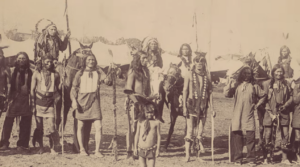
Native nations experienced the expansion of settlement, railroads, mining, ranching, and federal administration from very different positions. Photographs of Lakota, Cheyenne, Crow, Apache, Comanche, Ute, Paiute, Navajo, Shoshone, and other communities show people negotiating a rapidly changing world. Some images show formal delegations and leaders. Others show families, hunters, women preparing food, children, camps, and everyday activities.
The temptation is to look at these photographs only as evidence of a vanished past. But that can be misleading. The people in them were not simply relics waiting for history to move on. They were living communities making decisions, preserving traditions, adapting to new circumstances, and navigating political relationships with an expanding United States.

Even the formal portraits contain uncertainty. A person may sit perfectly still for the camera, but the photograph cannot tell us everything about what happened before or after the exposure. It records clothing, posture, objects, architecture, and faces. It does not automatically reveal private thoughts. That silence is important because historical storytelling becomes dangerous when we fill every missing space with imagined emotions.
The same caution applies to the settlers. A photograph of a family outside a sod house can suggest hardship, but it cannot tell us whether they felt hopeful, frightened, proud, exhausted, or all of those things at once. A mining camp can look energetic while hiding accidents, poverty, debt, or disappointment outside the frame. A crowded saloon can appear lively without revealing what happened when the doors closed.
This is why these photographs matter.
They do not give us the entire West. They give us fragments.

A railroad station. A mine entrance. A wagon crossing water. A family beside a cabin. A Native leader facing the camera. A blacksmith beside his tools. A prospector crouched over a pan. A group of workers standing together after completing another difficult stage of construction.
Individually, each image seems small. Together, they reveal a continent undergoing extraordinary transformation.
The most striking part is perhaps the contradiction. The same era that produced railroads and industrial mines also depended on horses and oxen. Scientific expeditions carried sophisticated instruments while traveling through landscapes where people still relied on traditional survival skills. Growing towns advertised restaurants and entertainment while just beyond their streets were camps, trails, mines, and unsettled country.

Progress did not arrive as a single event.
It came unevenly, carrying opportunity for some and profound disruption for others.
That is the hidden power of these old photographs. They do not simply show what the American West looked like. They show what people had to build, carry, dig, cross, defend, adapt to, and sometimes leave behind before the modern landscape could emerge.

My personal view is that the greatest value of these photographs lies not in the romantic image of the “Wild West,” but in the contradictions they preserve. They remind us that history is rarely a simple story of heroes, pioneers, or progress. It is a collection of human lives moving through circumstances they could not always control. The more carefully we look, the more questions appear—and perhaps that is exactly what a historical photograph should do.
When you look at these images today, do you see the beginning of a new America, or the traces of worlds that disappeared along the way?
Some content was generated using AI tools (including ChatGPT) and edited by the author for creativity, storytelling, and historical illustration purposes. Historical facts and key details should be verified against reliable historical sources. Any AI-generated or reconstructed visuals are intended for illustrative purposes and should not be interpreted as original historical photographs or archival evidence.
Để lại một bình luận