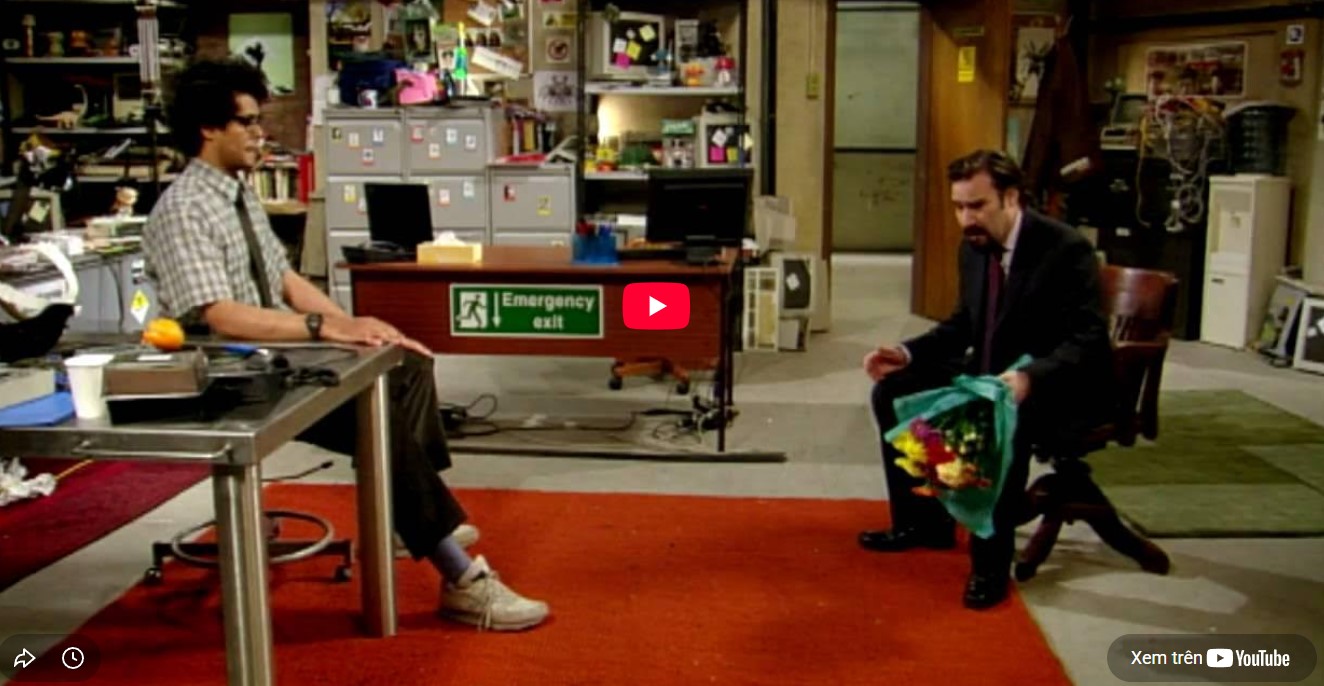
In the cramped, overheated basement of Reynholm Industries, where the fluorescent lights never quite stopped flickering and the air always carried the faint scent of melted plastic and stale coffee, Roy Trenneman reached a breaking point that felt both inevitable and completely unexpected. The IT Crowd never needed celebrity Hollywood red carpets or carefully curated vintage culture photography to create unforgettable tension. It simply let a man who had answered one phone call too many finally say the quiet part out loud, then freeze as if the words themselves had shocked him into stillness.
Fans of the series know the rhythm of these moments. Roy, with his perpetual five-o’clock shadow, mismatched layers, and the permanent expression of a man who has seen too many “my computer is broken” tickets, usually absorbed the daily absurdity with a mixture of sarcasm and quiet despair. But there are limits. And on this particular day, the limit arrived in the form of a single phone call that should have been routine. The caller’s voice, the nature of the complaint, the absolute refusal to listen to any actual technical advice—these elements stacked themselves into a perfect storm. Roy listened. He tried the usual scripts. He offered the classic “have you tried turning it off and on again.” And then something inside him simply stopped cooperating.
The line that followed was not shouted. It was not theatrical. It was delivered in the flat, exhausted tone of a man who has finally decided that politeness is a luxury he can no longer afford. Every word landed with the precision of a well-aimed dart. There was no exaggeration, no cartoonish rage. Just pure, undiluted truth spoken into a telephone receiver that suddenly felt heavier than it should. And the moment the final syllable left his mouth, Roy froze.
Not a dramatic collapse. Not a storming out of the room. Just a complete cessation of movement. The hand holding the phone remained raised. The shoulders stayed locked. The eyes stared at a point somewhere beyond the opposite wall. It was as if the act of finally saying what everyone in the IT department had thought a thousand times had short-circuited the part of his brain responsible for continuing the conversation. The freeze was absolute. And in that freeze lived everything the series had been building toward for seasons.
This is the exact point where most sitcoms would cut away or fill the silence with music or a reaction shot. The IT Crowd, at its sharpest, refuses that safety net. It holds on Roy’s face long enough for the audience to feel the weight of what has just been released into the air. The words are still hanging there. The caller on the other end of the line is presumably still listening. And Roy himself seems momentarily stunned by his own honesty. The comedy does not come from the insult alone. It comes from the sudden, almost photographic stillness that follows it—a stillness that turns a simple phone call into something that feels closer to a quiet detonation.
What makes the sequence so effective is how little it relies on external spectacle. There are no celebrity Hollywood cameos, no elaborate set pieces, no women’s lifestyle magazine-style soft lighting. The basement remains the same cluttered, slightly depressing space it has always been. The only change is internal. Roy has crossed a line he cannot uncross, and the freeze is the physical evidence of that crossing. For a few seconds he exists in a pure state of consequence, neither regretting the words nor fully owning them yet. He is simply suspended between the before and the after.
The reactions inside the room are equally restrained and therefore more powerful. Moss, ever the observer of human inefficiency, registers the moment with the same clinical interest he might apply to a new error code. Jen, caught between her role as the social translator of the department and her genuine concern for the team’s survival, processes the situation in real time. Neither of them rushes to fill the silence. They allow Roy’s freeze to occupy the space. In doing so, they turn the ordinary into something almost ceremonial. A man has finally spoken the unspeakable truth of helpdesk life, and the world is required to pause and acknowledge it.
There is a deeper current running beneath the surface comedy. Roy’s freeze is not merely the aftermath of a witty line. It is the visible result of years of accumulated frustration—frustration with users who treat technology as magic, with management that treats the IT department as an afterthought, with a job that demands endless patience while offering almost no recognition. When he finally lets the truth out, the body reacts before the mind can catch up. The stillness is a form of self-protection. If he keeps moving, he might have to deal with the consequences. If he stays frozen, the moment can remain pure for just a little longer.
This particular brand of British sitcom stillness is rare and precious. Most comedy thrives on escalation, on bigger reactions, on characters flailing toward resolution. The IT Crowd frequently chooses the opposite path. It lets the air go quiet. It lets the camera linger on a face that has just said something irreversible. And in that lingering, it finds a richer vein of humour and recognition than any shouting match could provide. Roy’s freeze becomes a mirror. Viewers who have ever worked in customer-facing roles, who have ever bitten their tongue through one unreasonable demand after another, recognise the exact texture of that silence.
The aftermath of the freeze is where the real narrative tension lives. The clip does not end on the insult. It ends on the quiet, almost delicate way the scene continues once Roy’s body finally remembers how to move again. There is no grand apology. There is no immediate disaster. Instead there is a series of small, precise adjustments—the way the phone is slowly lowered, the way eye contact is carefully avoided, the way the other two members of the team recalibrate their own energy to the new emotional weather in the room. These details are what elevate the moment from a simple rant into something that feels strangely intimate.
In the broader landscape of entertainment history, moments like this one stand out precisely because they refuse the usual grammar of comedy. There is no need for vintage culture aesthetics or carefully staged photography to make the scene memorable. The power sits entirely in the performance and the writing. Roy does not perform rage. He performs the sudden absence of the usual filters. The freeze is the visual proof that those filters have been removed and that the character is briefly, dangerously free.
That freedom is short-lived, of course. The world of Reynholm Industries does not allow permanent revolutions. The phones will keep ringing. The tickets will keep arriving. The users will keep asking the same questions in slightly different wording. But for the length of that freeze, Roy exists outside the usual rules. He has said the thing that cannot be unsaid, and the silence that follows is both punishment and reward. The audience is left holding the same breath he is holding, waiting to see which version of reality will reassert itself first.
There is also an unexpected gentleness in the way the series handles the moment. The freeze is funny, yes. It is also strangely tender. Roy is not a monster. He is a man who has been asked to absorb too much absurdity for too long, and the body has finally filed a formal complaint. The stillness is the complaint made visible. When movement returns, it returns carefully, as if the character is testing whether the floor is still solid. That caution is what keeps the scene from tipping into pure meanness. The comedy remains rooted in recognition rather than superiority.
What happens after the freeze breaks is the part that rewards repeated viewing. Surface level, the scene continues with the usual mix of sarcasm and damage control. Underneath, a subtle shift has occurred in the power dynamics of the department. Roy has demonstrated that there is a limit, and that the limit can be reached. Moss files the information away for future reference. Jen begins the quiet work of managing the external fallout. And Roy himself seems slightly altered—lighter in some ways, heavier in others. The freeze has changed the temperature of the room, and the temperature does not immediately return to normal.
This is the lasting strength of The IT Crowd. It understands that the most memorable comedy often lives in the spaces between the lines, in the pauses, in the moments when a character stops performing the expected version of themselves. Roy’s brutal phone call and the freeze that follows it form one of those spaces. The words are sharp. The silence is sharper. And the quiet chain of consequences that spreads outward from that silence is what keeps the moment alive long after the episode ends.
In a media environment saturated with noise, with rapid cuts, with the constant demand for bigger reactions and more elaborate set pieces, a man simply standing still after saying something true remains radical. Roy does not need celebrity Hollywood production values. He does not need women’s lifestyle framing or film-history references. He only needs a telephone, one phone call too many, and the courage—or the exhaustion—to finally stop pretending. The freeze is the evidence of that courage. The aftermath is the evidence that even in the basement of Reynholm Industries, truth still carries a cost, and sometimes that cost is worth paying.
The phones will ring again. The next ticket will arrive. The next user will insist that the computer is broken when it is merely misunderstood. But for one suspended moment, Roy Trenneman said exactly what he thought, then stood perfectly still while the world decided what to do with the information. That stillness is the heart of the scene. That stillness is why the clip continues to circulate. And that stillness is why, long after the final frame, the silence still feels louder than the words that created it.
Để lại một bình luận