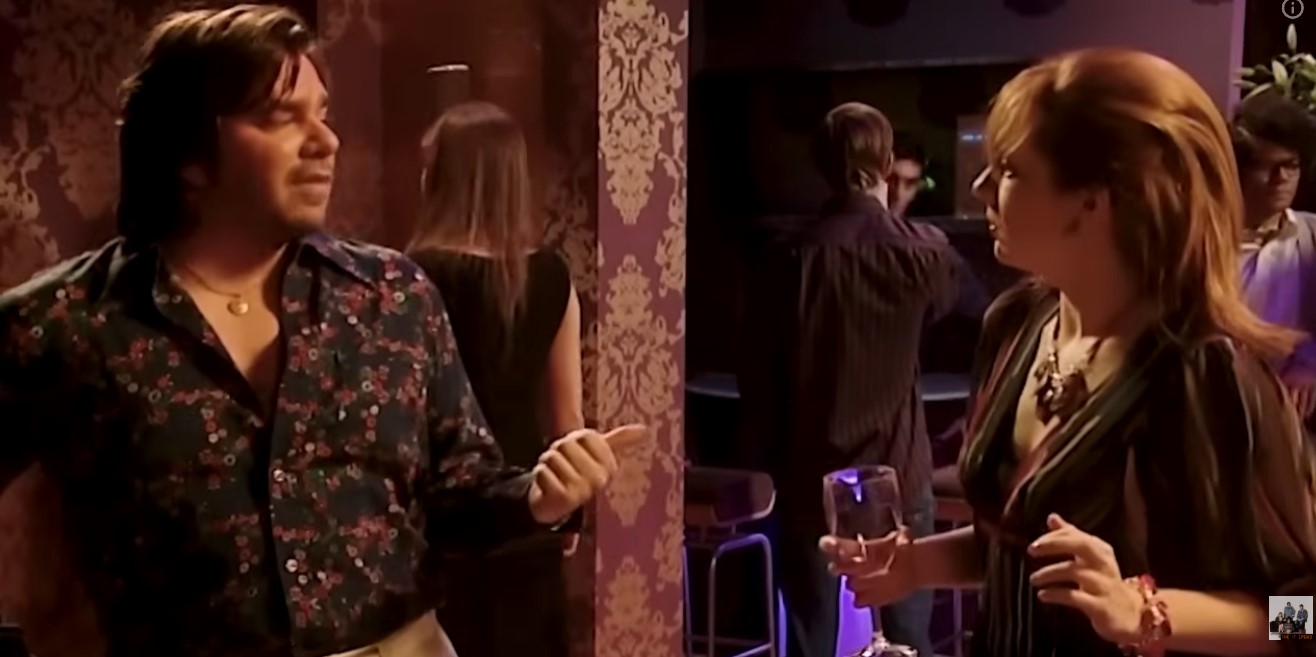
In the fluorescent-lit basement of Reynholm Industries, where the air always smelled faintly of burnt toast and overworked servers, Maurice Moss once again proved why he remains one of the most quietly devastating forces in British comedy history. The IT Crowd never needed celebrity Hollywood glamour or vintage culture red-carpet moments to land its punches. It simply let Moss stand still, deliver a line with the emotional range of a spreadsheet, and then freeze. That freeze was never empty. It was loaded.
Fans who have followed the series from the early days know the pattern. Moss, with his thick glasses, carefully parted hair, and wardrobe that seemed permanently stuck in a 1980s computer-science prospectus, would open his mouth and something clinical would emerge. No raised voice. No theatrical pause for effect. Just pure, unfiltered data delivered in a tone that suggested the universe itself had been reduced to binary. Then the freeze. Arms slightly away from his sides. Eyes locked forward. Mouth still in the exact shape of the final syllable. The room would hold its breath, and so would the audience.
What made these moments land so hard was not the line itself, though the writing was always razor-sharp. It was the absolute refusal of the character to soften the edges. Moss never winked at the camera. He never undercut his own seriousness with a nervous laugh. He simply stated the fact, however absurd the surrounding situation, and then waited as if the world was supposed to reorganise itself around his statement. That waiting—that frozen stillness—is where the real comedy lived. And in the particular clip that has been circulating again, that freeze carries more weight than usual.
The setup looks ordinary enough at first glance. The IT department is dealing with yet another crisis that only they can see. Roy is already halfway to a meltdown. Jen is trying to translate technical reality into language the rest of the building might understand. And Moss, true to form, is the calm centre of the storm. He has just processed whatever latest piece of digital chaos has been dropped on their desk. The solution, or the diagnosis, forms in his mind with the same efficiency he once applied to building a perfect firewall or explaining why a user’s computer is not, in fact, broken but simply misunderstood.
Then the line arrives. It is short. It is precise. It is delivered with the same affect he might use to announce that the coffee machine has been unplugged again. And the moment the final word leaves his mouth, everything stops. Moss does not move. He does not blink more than necessary. He becomes a living screenshot of the sentence he has just spoken. The camera holds on him just long enough for the audience to realise that the freeze is not a glitch in the performance. It is the performance.
This is the point where most sitcoms would cut to a reaction shot or let the other characters fill the silence with noise. The IT Crowd, at its best, refuses that easy exit. It lets the silence stretch. It lets Moss remain locked in place while the implications of what he has said begin to rearrange the scene around him. The deadpan is not a shield. It is a weapon. And the freeze is the moment the weapon is left in plain sight, daring everyone else to pretend they did not just hear what they heard.
What follows that freeze is where the real story sits. The reaction is never the one the line seems to invite. It is smaller, stranger, and somehow more revealing than a big laugh or a shouted argument would have been. The way the other characters process the information, the tiny shifts in posture, the half-second of genuine confusion before the comedy reasserts itself—these are the details that turn a simple deadpan into something that feels almost archaeological. You are watching a character who has never once pretended to be anything other than what he is, and the world is still not quite ready for him.
There is a reason these Moss moments travel so well across years and platforms. They do not rely on topical references that age badly. They do not require knowledge of celebrity Hollywood film history or the latest women’s lifestyle trends in entertainment photography. They work because they are built on a pure contradiction: a man who speaks with absolute certainty while existing in a permanent state of social bewilderment. The freeze is the physical manifestation of that contradiction. It is Moss insisting that reality has just been correctly described, and reality itself hesitating before it agrees.
In the broader landscape of British sitcom, this particular brand of stillness is rare. Most comedy thrives on movement—on double-takes, on physical bits, on the frantic energy of characters trying to dig themselves out of holes. Moss digs the hole with perfect calm, then stands at the edge and waits for everyone else to notice they are already at the bottom. The freeze is not hesitation. It is confidence so complete it has no need to perform.
That is why the aftermath matters so much. The clip does not end on the line. It ends on what the line does to the room. The way Roy’s face cycles through several emotions in the space of a breath. The way Jen recalibrates her entire approach to the conversation in real time. The quiet victory that Moss does not even seem to register because, for him, the correct statement has already been made and the rest is merely administrative. These are the textures that keep people coming back to the series long after the final episode aired.
There is also something almost photographic about the freeze itself. In an era obsessed with vintage culture aesthetics and carefully framed entertainment stills, Moss’s motionless face becomes an accidental piece of portraiture. The lighting in the basement is unflattering by design. The set is cluttered with the kind of outdated technology that now looks like film history props. Yet the composition of that frozen moment—glasses reflecting the overhead lights, mouth set, shoulders square—carries the same quiet power as a carefully lit still from a classic British comedy archive. It is not styled. It is simply true to the character, and that truth is what makes it memorable.
The IT Crowd always understood that the funniest people are often the ones who refuse to play along with the expected rhythms of a joke. Moss does not build to a punchline. He is the punchline, delivered early and then left standing there while everyone else catches up. The freeze is the space in which that catching-up happens. It is generous, in its way. It gives the audience time to feel the full weight of the absurdity without rushing them toward the next gag.
And yet the freeze also contains a quiet sadness that the best comedy never fully erases. Moss is not performing detachment. He is detached. The world of small talk, of office politics, of the thousand tiny social negotiations that fill an average day, remains largely opaque to him. When he freezes after a perfect line, part of what the audience is seeing is a man who has just spoken the only language he fully trusts, and is now waiting to see whether anyone else in the room speaks it too. Most of the time, they do not. The comedy comes from that mismatch. The lingering aftertaste comes from the same place.
What happens after the freeze in this particular moment is the part that rewards a second and third viewing. The surface reaction is funny, of course. The IT Crowd almost never fails at surface reactions. But underneath it there is a small, precise shift in the power balance of the scene. Moss has not raised his voice. He has not demanded attention. He has simply stated a fact and then become a statue of that fact. The other characters are forced to move around him, to adjust their own energy to the new stillness he has introduced. In a department that spends most of its time reacting to other people’s emergencies, this is a rare inversion. For a few seconds, the emergency has to react to Moss.
That inversion is what the clip ultimately delivers, even if it never spells the idea out in dialogue. The freeze is not just a comic beat. It is a brief, wordless assertion of control in a life that otherwise offers Moss very little of it. He cannot control the users who call the helpdesk. He cannot control the management decisions that cascade down from the upper floors. He cannot even fully control the social dynamics inside his own tiny team. But he can control the exact moment a sentence ends, and he can control how long he remains inside that moment before the world is allowed to start moving again.
In the end, the power of the sequence lies in how little it needs to do. No big reveal. No sudden change of heart. No celebrity Hollywood-style emotional breakdown shot in flattering light. Just a man who has said something true in the only way he knows how, and then stood still long enough for everyone else to feel the truth land. The freeze becomes a kind of punctuation mark that the rest of the scene has to respect. And once you have seen it, you start noticing how often the series uses silence and stillness as its sharpest tools.
The IT Crowd remains one of the purest examples of how British comedy can turn the ordinary into the unforgettable without ever raising its voice. Maurice Moss, frozen mid-sentence, glasses catching the light, is the series distilled into a single image. The line was perfect. The stillness that followed was even better. And the quiet chain reaction that spread outward from that stillness is the reason people are still watching, still quoting, and still pausing the frame just to look at the expression on his face a little longer.
There are other moments in the series that are louder, broader, more obviously designed for the highlight reels of entertainment history. There are episodes that lean harder into physical comedy or into the escalating chaos that Jen and Roy so often create. But the Moss freeze occupies a different category. It is comedy that trusts the audience to meet it halfway. It does not explain itself. It does not apologise for its own precision. It simply exists, complete and unmoving, until the rest of the world is forced to catch up.
That is the lasting gift of the character, and of the writing that sustained him. In a media landscape increasingly crowded with noise, with rapid cuts, with the constant demand for bigger and louder reactions, Moss still stands there after the perfect line and refuses to move. The freeze is an act of faith in the power of understatement. It is also, somehow, the funniest thing in the room. And once the freeze breaks and the scene continues, the aftertaste of that stillness stays with you longer than any punchline ever could.
The basement will always be a little too warm. The computers will always be on the verge of some new catastrophe. Roy will always be one bad call away from open rebellion. Jen will always be trying to build a bridge between two incompatible languages. And Moss will always be ready with the next perfectly calibrated sentence, followed by the same absolute stillness that makes the sentence impossible to ignore. That is the rhythm the series taught its audience to love. That is the rhythm this clip captures so cleanly.
What happens next, after the freeze finally ends, is never quite what you expect. It is smaller than the setup seems to promise, and somehow larger because of that restraint. The IT Crowd never needed to shout. It only needed Maurice Moss to say the quiet part out loud, then stand there long enough for the quiet part to become the only thing anyone could hear.
Để lại một bình luận