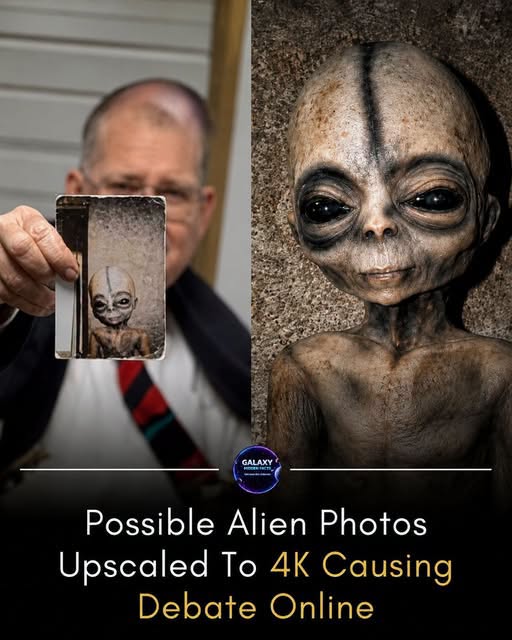
A recently enhanced image of an alleged extraterrestrial figure has reignited debate across social media, with supporters claiming that modern artificial intelligence has revealed details previously hidden in an old, low-resolution photograph. The comparison, which shows an individual holding what appears to be a small printed image alongside a dramatically upscaled digital version, has attracted millions of views and sparked renewed discussion about whether advances in AI image processing can help uncover evidence of unexplained phenomena—or simply create convincing illusions.
The image began circulating on several online communities dedicated to unidentified aerial phenomena (UAPs), where users claimed that the original photograph had remained largely overlooked for years due to its poor quality. According to posts accompanying the comparison, recent AI-powered enhancement software was used to increase the image resolution from a blurry scan into a highly detailed 4K rendering, revealing what some viewers believe are facial features and anatomical characteristics unlike those of any known human.
The enhanced version depicts a small humanoid figure with an enlarged head, oversized dark eyes, a narrow chin, thin neck, and a slight smile. The striking appearance immediately reminded many observers of the so-called “Grey” extraterrestrials frequently described in UFO literature and alleged witness encounters dating back several decades.
Within hours of the images appearing online, discussions spread rapidly across social media platforms. Some users argued that the enhanced photograph represented one of the clearest depictions of a possible non-human entity ever produced from historical imagery. Others urged caution, emphasizing that artificial intelligence is capable of generating realistic details that never existed in the original source material.
Image-processing specialists explain that AI upscaling works by predicting missing visual information rather than recovering hidden pixels. Unlike traditional sharpening techniques, modern neural networks analyze millions of reference images during training and estimate what textures, edges, facial features, and shadows are most likely to exist based on statistical patterns. As a result, an enhanced image can appear remarkably realistic while containing details that were never actually captured by the original camera.
This distinction has become central to the ongoing debate surrounding the viral comparison. Supporters believe the enhancement simply clarifies existing information buried within the low-resolution photograph. Skeptics counter that the software may have unintentionally invented anatomical details, giving viewers the false impression that previously invisible evidence has been uncovered.
Several digital-forensics experts commenting on similar cases note that AI-generated enhancements should never be treated as forensic evidence without access to the original image. Authentic investigations typically begin with the highest-quality source available, allowing analysts to examine camera metadata, compression artifacts, lighting conditions, and sensor characteristics before drawing conclusions. Once an image has been processed through enhancement software, distinguishing original information from computer-generated predictions becomes significantly more difficult.
Despite these limitations, the enhanced image has revived interest in historical UFO archives. Researchers have begun revisiting numerous photographs taken throughout the second half of the twentieth century, applying modern restoration techniques in hopes of improving clarity. While many restored images reveal previously unnoticed environmental details, experts stress that every enhancement must be interpreted carefully to avoid confusing reconstructed imagery with genuine photographic evidence.
The viral comparison has also highlighted how rapidly artificial intelligence is transforming discussions surrounding unexplained phenomena. In previous decades, blurry photographs were often dismissed because they lacked sufficient detail for meaningful analysis. Today, AI tools can dramatically improve visual quality, but they also introduce a new challenge: determining which details originated from the camera and which were generated by sophisticated algorithms.
Psychologists studying perception suggest that human observers naturally search for recognizable patterns, particularly faces. This tendency, known as pareidolia, can become even stronger when viewing AI-enhanced images because the software often emphasizes facial structures and symmetrical features. Consequently, viewers may become more confident in interpretations that are not necessarily supported by the underlying data.
Meanwhile, UFO researchers remain divided. Some investigators believe artificial intelligence could become an important tool for restoring damaged archival photographs, allowing experts to better analyze historical material that was previously unusable. Others argue that AI should be used only as a visualization aid rather than as evidence itself, warning that reconstructed imagery can unintentionally reinforce existing beliefs rather than objectively reveal new information.
The individual shown holding the original photograph has also become the subject of speculation online, with some users claiming the image was presented during a private investigation into alleged extraterrestrial encounters. However, no independently verified documentation accompanying the viral posts has confirmed the photograph’s origin, the identity of the presenter, or the circumstances under which the original image was allegedly captured.
Without access to the unprocessed source file, experts say it is impossible to determine whether the enhanced image accurately reflects the original subject. Independent verification would require examination of the original negative or digital file, documentation of the enhancement process, and transparent disclosure of the AI software and settings used during restoration.
As artificial intelligence continues to reshape digital photography, cases like this illustrate both the remarkable capabilities and significant limitations of modern image enhancement. While AI can produce visually impressive reconstructions, it cannot independently prove the existence of extraterrestrial life or authenticate extraordinary claims. The viral comparison therefore remains an intriguing example of how emerging technology can breathe new life into old mysteries while simultaneously raising new questions about authenticity, interpretation, and the reliability of visual evidence.
For now, the enhanced “alien” photograph remains an unverified image that has fueled widespread online discussion rather than providing conclusive proof of extraterrestrial visitors. Whether future analysis uncovers additional evidence or identifies a more conventional explanation, the debate serves as a reminder that extraordinary claims require equally extraordinary evidence, especially in an era when artificial intelligence can transform even the blurriest photograph into something that appears astonishingly real.
Để lại một bình luận