The Postwoman’s Path

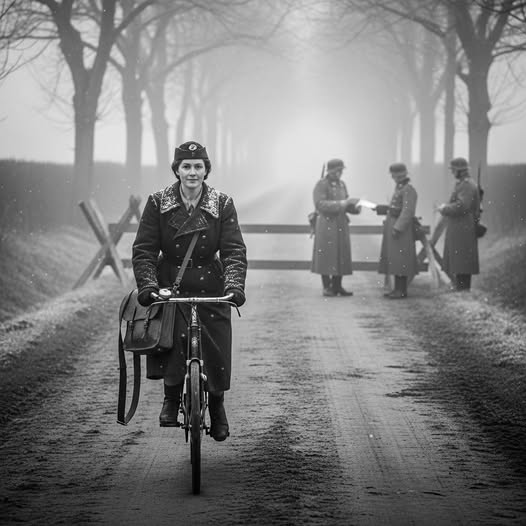
The winter fog stretched like a cotton curtain over the sleeping countryside. The only sound was the steady squeak of a bicycle on the frozen road, that dry, fragile sound that resonates like a heartbeat in the silence of busy days. Marie Duhamel pedaled unhurriedly, her gaze fixed straight ahead, her face reddened by the cold, but her mind burning with constant vigilance. At first glance, she was just a simple postwoman, a familiar figure crossing the village each morning, carrying letters, news, bills, hopes. But in 1943, under the German Occupation, even a banal gesture could become an act of resistance.
In her worn leather bag, the censored letters rested neatly atop a heavier secret: forged baptismal certificates, coded messages, hand-drawn cards slipped inside religious images. Every day, Marie carried in her basket not just paper, but fragments of freedom. She knew that the slightest check, the merest suspicion, could spell her end. Yet she carried on, because she also knew that beyond the barriers, in barns and rectories, entire lives depended on her discretion.
The path she was taking led through bare orchards and dark hedgerows, disappearing into an increasingly dense fog. The trees stood like silent sentinels. In the distance, three gray silhouettes were visible: a German checkpoint. Marie felt her stomach clench, but her hands remained firm on the handlebars. She knew the men who were waiting for her; they, in turn, knew her measured smile, her polite greetings, her soft voice that could feign naiveté.
— Guten Morgen, Fräulein Duhamel, one of them called out, giving a weary smile.
She replied in an even tone, in hesitant German:
— Guten Morgen, Herr Offizier. The mail doesn’t stop, even in the cold.
https://www.youtube.com/watch?v=UyG4QvPwcck
The soldier laughed, waved distractedly, but another approached, curious. He patted the bag slung over his shoulder. Marie felt her heart pound against her ribs. Beneath the official letters, well hidden, were the false papers for a Jewish child hidden on Madame Lemoine’s farm. She couldn’t afford the slightest tremor.
“You’re wearing a lot today,” he said.
“Christmas is coming,” she replied with a smile. “Soldiers receive mail too, don’t they?”
The man shrugged, closed the bag, and let her pass. She thanked him politely and continued on her way. Her legs trembled almost imperceptibly. Behind her, the German voices faded into the fog. Ahead, the road stretched out again, gray and endless.
Each house she stopped at was a stage set, where every word mattered, every gesture could betray. At the priest’s house, she ostentatiously dropped off the parish mail, but secretly slipped in a small note rolled up in a rosary. At the widow Martin’s, she pretended to chat about the price of bread, while her hand left a card hidden under the tablecloth. These discreet exchanges formed an invisible network, a tenuous thread connecting defiant souls through fear and censorship.

She wasn’t alone, of course. Other women and men were waging the same silent battle: teachers, doctors, bakers. But what made Marie unique was her way of operating openly, in broad daylight. Courage wasn’t always an explosion of bravery; sometimes it lay hidden in the regularity of a repeated gesture, in the apparent ordinariness of a daily round.
She often thought of her father, a postman before her, who died in 1940 under the bombs of Dunkirk. He had taught her a simple lesson: “To deliver the mail is to deliver trust.” Since the war, this phrase had taken on a more serious meaning. She now carried the trust of an entire country silenced by the war.
One evening, as the sky filled with a light dusting of snow, Marie stopped by the roadside to hand an envelope to a young man with an emaciated face. His eyes betrayed his fear. He thanked her in a trembling voice: it was a forged baptismal certificate, which would allow him to flee the next day. She watched him disappear into the night, aware that she might have just given him a few more years of his life.
The weeks passed, punctuated by inspections, raids, and whispered news. One day, a villager was arrested. It was said he had talked. Marie felt the trap closing, but she carried on. An arrest would have been more suspicious than routine. Her eyes grew accustomed to reading in people’s gazes: fear, weariness, stubborn hope. Every smile she received was a silent promise not to give in.

Then came January 1944. That morning, the fog was so thick you couldn’t see ten meters ahead. She pedaled slowly, her frozen fingers gripping the handlebars. Around a bend in the road, two military trucks blocked the way. She stopped abruptly. The soldiers stared at her. An unfamiliar officer stepped forward.
— Your papers, madam. And your bag.
Marie handed over her papers, which were perfectly in order. The bag, however, contained a crucial message for the Vercors resistance group. She knew that if it were discovered, everything would be lost. The officer searched methodically, took out a few letters, and sighed. Then he came across a religious image. He turned it over, examined the drawing of a saint, and then put it back. Marie held her breath.
“You can pass,” he said finally.
She got back on her bike. The fog seemed to engulf her. She pedaled against her fear; each meter gained was a silent victory. That day, she knew she could never stop again.
When the war ended, spring timidly returned. The lilacs bloomed again, the church bells rang once more. Marie continued to travel the same roads. But this time, she carried safe letters, words of love, news of soldiers who had returned alive. Hardly anyone knew what she had done. The forged documents, the coded messages, the cards slipped into prayers—all of it had vanished, dissolved in the newfound peace.
Yet some remembered. The old priest, seeing her pass by, discreetly crossed himself. The village children, for their part, greeted her without understanding that this quiet woman had once been their invisible shield.
Even today, on the road to Saint-Clair, one sometimes glimpses in the morning mist a figure on a bicycle, seemingly emerging from another time. Some say it’s a memory, others a legend. But those who know simply whisper: It’s Marie, the postwoman of courage.
Because sometimes you have to pedal through the heart of danger to deliver hope. Because resistance, in its purest form, is not shouted — it is lived, every day, in the silence of simple gestures.
Note: Some content was generated using AI tools (ChatGPT) and edited by the author for creative reasons and suitability for historical illustration purposes.
Để lại một bình luận