The death marches of Auschwitz: the winter when humanity slowly died out

There are winters whose cold never fades. The winter of 1944-1945, in the frozen plains of Poland, was one of them. The wind blew across the snow as if to erase all traces, to bury in silence the cry of a dying world. It was here, around the name that has become a symbol of inhumanity— Auschwitz —that one of the darkest chapters in history began: the death marches .
At that time, Europe trembled under the dull rumble of Soviet tanks. The Red Army advanced inexorably westward, and in the corridors of Nazi power, panic was setting in. The Reich was crumbling, but the ideology remained implacable. At Auschwitz, the command received a clear order: erase the evidence , move the prisoners , make the unspeakable disappear before the Allies discovered the extent of the human disaster.
Thus, in the biting cold of January 1945, more than 60,000 deportees were forced to leave the camp in endless columns, heading towards other camps located in the heart of Germany: Buchenwald, Dachau, Mauthausen . They were called the “evacuation marches”; History, however, will rightly call them: the death marches of Auschwitz .
The departure: a silence more cruel than the screams
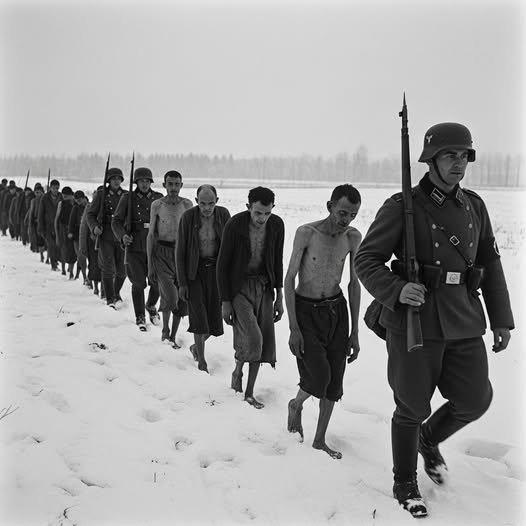
Imagine. It is three in the morning. Fog shrouds the barbed wire. Loudspeakers blare orders in German. Men and women, reduced to shadows, stagger in the snow. Some have lost their shoes, others remain upright only by sheer willpower. In the gloom, the glow of torches reflects off the helmets of SS soldiers. Their rifles, bayonets fixed, gleam like flashes of death.
The prisoners don’t know where they’re going. Many believe execution is imminent. Others, driven by an almost animal instinct for survival, move forward without question. Each step is a negotiation with death . The frozen ground crunches beneath their bare feet, hunger burns their hollow stomachs. In the air, a terrifying silence—for even the groans have fallen silent.
It was during this march that the very essence of the word despair was revealed . The Nazis had nothing left to gain, yet they continued to kill. Those who stumbled were shot in the back of the neck, sometimes without the soldier even deigning to slow down. Bodies collapsed in the snow, quickly covered by the icy wind.

Cold, hunger, death: a hellish triptych
Those who survived recounted that the cold was no ordinary enemy: it seeped into their bones, numbed their thoughts, and ultimately erased their fear. The thermometer plummeted well below zero. The prisoners, clad in simple striped pajamas, trudged through the snowstorms, their feet frozen, their lips blue. Occasionally, one of them would murmur a prayer—not for life, but for a swift death.
The SS, for their part, marched in fur-lined boots, thickened by their coats. They sometimes laughed, smoked a cigarette. For them, this march was merely a routine mission, a final act of obedience to a doomed regime. The contrast between these robust figures and the staggering skeletons behind them is one of the most unbearable images of the Second World War .
The death marches at Auschwitz were not a transfer; they were a method of extermination in disguise. Hunger , exhaustion , and hypothermia did the work that the gas chambers could no longer do. Every kilometer became a test of survival. Those who fell were left there, without burial, without a name, without a goodbye.
The numbers behind the tragedy
It is estimated that several thousand deportees died during these marches, but no figure can truly capture the reality. The archives are incomplete, witnesses are scarce, and the snow of that winter covered more truths than it revealed.
Survivors recounted walking for weeks , sometimes up to 300 kilometers. Some were then crammed into open wagons, exposed to the icy wind. Others reached Buchenwald or Dachau, but most no longer had the strength to stand. When they arrived, their faces were nothing but wax masks. Many died a few days later, unable to bear the long-awaited liberation.
Walking as a symbol of the absurd

What makes the death marches at Auschwitz so tragic is not only their cruelty, but their utter futility . By then, the war was lost for Nazi Germany. Yet, the ideology continued to dictate death. The prisoners were no longer enemies, but burdens to be eliminated. The evacuation order was given not to save lives, but to erase the traces of genocide.
Perhaps this is where the greatest moral scandal of modern history lies: this obstinacy to kill, even in defeat, even when all is lost.
Witnesses and memory
Some of those who survived these marches left behind harrowing accounts. They describe the villages they passed through, the peasants who sometimes threw a piece of bread, risking being shot. Others recount the silent solidarity among prisoners: an outstretched hand, a glance, a shared breath. In the hell that was it, sparks of humanity still remained.
After liberation, these survivors were the first to testify before the world, to tell what they had seen, what they had endured. Their words were recorded in the archives, their voices captured, so that the Holocaust would never be forgotten.
But even today, when we talk about numbers, facts, statistics, we must remember that behind every step on the snow of Auschwitz was hidden a name, a face, a story .
The snow of Auschwitz: a mirror for the 21st century
Why return to these death marches today? Because forgetting is the first victory of evil. Because in a world where wars are reborn, where hatred resurfaces in other forms, the echo of these footsteps still resonates. Auschwitz is not just a place—it is a warning.
Every year, thousands of visitors come to the site of the camp. They walk the same paths, in silence, under the same gray sky. Some say they feel a strange, different kind of cold, as if memory itself had a temperature. No amount of sun can dispel this cold.
A lesson in memory and humanity
The death marches of Auschwitz remain one of the most poignant symbols of human barbarity. But they are also a lesson in resilience, in the human capacity to keep going despite everything, to continue breathing even when all seems lost.
The story of these marches is not only that of the victims, but also that of courage — that of the survivors, that of those who bore witness, and that of those who still refuse to look away today.
To remember is to walk against death. It is to refuse to let the snow cover the truth. It is to understand that the Holocaust is not a closed chapter, but a permanent warning.
And when the last survivor of these marches passes away, the duty to pass on the story will still remain. To recount again and again how, in that winter of 1945, humanity marched through the snow — and how, with every step, it almost disappeared.
Because as long as we remember the death marches of Auschwitz , as long as we repeat their stories, silence will not prevail .
Note: Some content was generated using AI tools (ChatGPT) and edited by the author for creative reasons and suitability for historical illustration purposes.
Để lại một bình luận