
The Breadcrumbs — Ravensbrück, 1944
In the freezing winter of 1944, Ravensbrück, the infamous Nazi concentration camp for women, stood as a place where hope was doomed to wither and humanity was systematically annihilated. Yet, even amid such unimaginable cruelty, fragments of love and resilience found a way to survive. Among the thousands of stories buried within the camp’s barbed-wire fences, one story stands out as a silent yet extraordinary testament to the power of sacrifice: the story of a mother who saved her child with nothing but breadcrumbs.
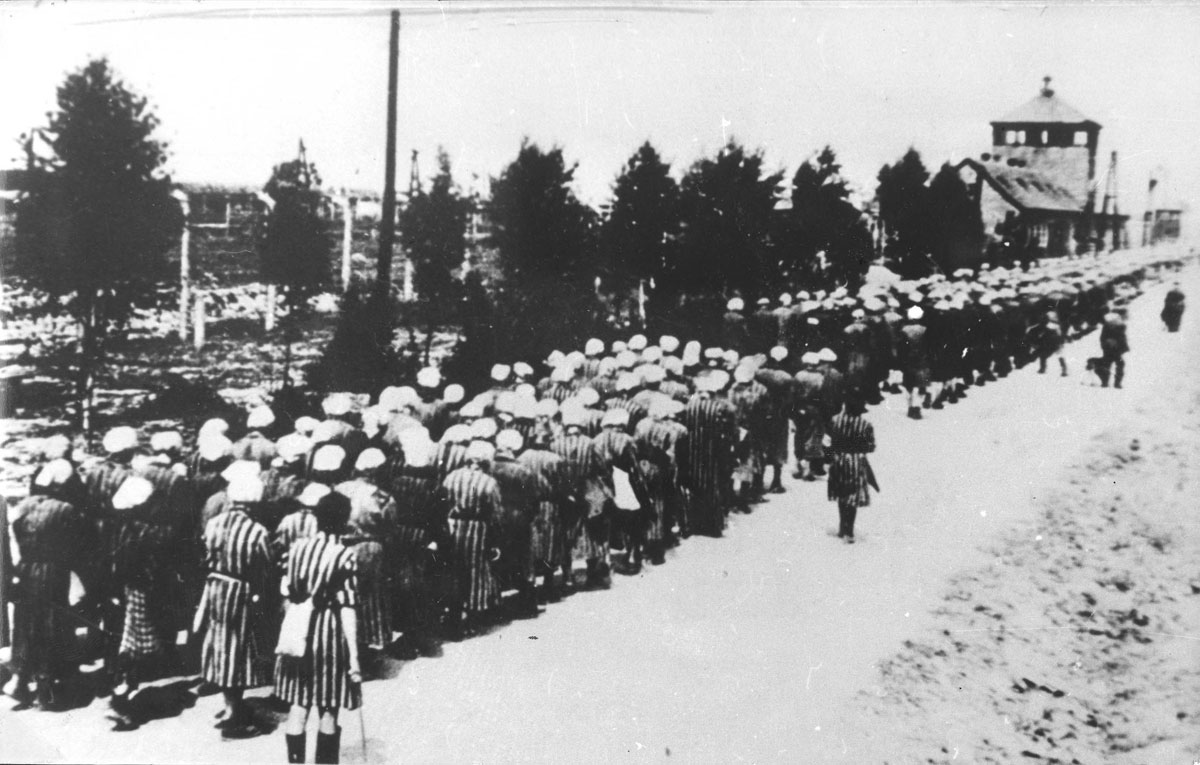
Ravensbrück wasn’t just a prison; it was a machine designed to break both body and spirit. The prisoners, mostly women from all over Europe, were subjected to forced labor, brutality, and starvation. Food was scarce, and every ration of bread or watery soup became a matter of survival.
In such a world, hunger was more than just physical pain: it was an enemy that consumed thoughts, stripped people of dignity, and drove them to desperate acts. A crust of bread could mean life, a single potato peel could mean the strength to endure another day. The Nazis understood this power and used hunger as a weapon of control.
Yet, in this cruel environment, love still endured. A mother, anonymous in official records but immortal in her daughter’s memory, chose to give even when she had nothing to give.
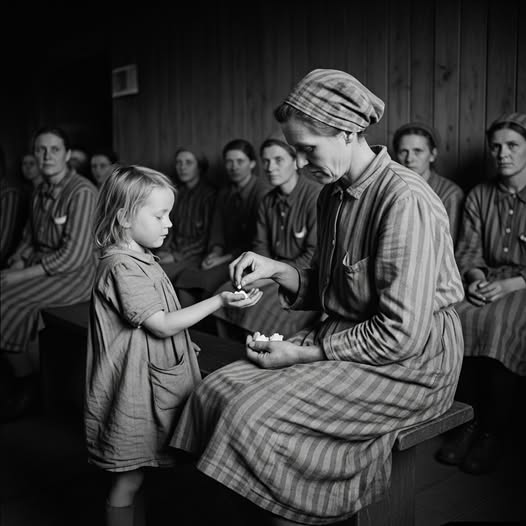
Every day, when the rations were distributed, the woman broke off a small portion of bread and carefully hid it. It wasn’t much, just a few scattered crumbs that could easily go unnoticed, but for her it was a deliberate act of devotion. She endured the excruciating hunger, clutching her belt tightly against her stomach, saving those crumbs for her child.
At night, after the brutal roll calls and long hours of forced labor, he sat in silence with his daughter. In the dark corners of the barracks, he gently placed crumbs into her little hand. It became a ritual, almost sacred in its repetition.
One evening, the little girl, tired but curious, asked why her mother never ate crumbs. Her mother, her eyes heavy with fatigue but filled with unwavering determination, whispered:
“Because your tomorrow is more important than my today.”
Those words remained like a shield around the little girl, protecting her from despair.
The crumbs weren’t just sustenance. They carried the weight of a promise, a symbol of resistance against the dehumanizing cruelty of the camp. In a place where survival often required selfishness, the mother’s gesture represented a silent rebellion. She refused to let the Nazis rob her of the most essential part of being human: the capacity to love selflessly.
Her daughter would later recall that those crumbs filled her with something greater than physical nourishment. They gave her hope, reminding her that she was valued, loved, and protected, even in a world where everything else had been stripped away from her.
To outsiders, the breadcrumbs might seem insignificant. But in Ravensbrück, where every morsel counted, giving them away was an unimaginable sacrifice. The mother chose to eat for herself, so that her son could feel a modicum of relief. It was an act of courage disguised as simplicity.
This sacrifice has reverberated throughout history. For the surviving daughter, those crumbs became the foundation of her strength. For the countless others who have heard this story, they have become proof that even in humanity’s darkest hour, compassion can endure.
The little girl survived the war. She would later reflect that her survival wasn’t due solely to luck, but to her mother’s tireless will. The crumbs had been more than calories; they had been a lifeline, both physical and emotional.
Decades later, telling the story to her children and grandchildren, she fully understood the weight of what she had been given. Her mother had starved herself so that her daughter could live. And in doing so, she had passed on a legacy far greater than survival: the enduring power of love.
Ravensbrück housed more than 130,000 women during its years of operation. Many died of starvation, disease, forced labor, or execution. Yet for every statistic, there were countless personal stories like this one: stories of quiet resilience, acts of kindness, and sacrifice that defied the logic of cruelty.
The Holocaust is often told through numbers, but the crumbs remind us that behind every number was a life, a connection, and a choice. Remembering these intimate details is crucial, because they humanize the story and prevent it from becoming abstract.
The mother’s crumbs carry lessons that resonate far beyond Ravensbrück. They remind us that:
-
Love can survive the most difficult conditions. Even when we are deprived of everything, we retain the capacity to give.
-
Sacrifice is the purest form of resistance. In a world that demanded selfishness, choosing generosity was an act of defiance.
-
Hope often comes in small forms. Sometimes, survival isn’t built on great miracles, but on crumbs shared in the darkness.
In an age when the world often seems divided and fragile, the story of these crumbs is a powerful reminder of what sustains us as human beings.
Historians and scholars often emphasize the importance of remembering the Holocaust not only as a horrific event, but as a testament to resilience. The crumbs perfectly symbolize this resilience. They weren’t just fragments of bread; they were fragments of dignity, strength, and dedication.
For her daughter, every crumb was proof that her life was worth saving. For us, looking back, every crumb reminds us that even in the most desperate circumstances, love can be an indestructible force.
Today, Ravensbrück is a place of remembrance. Visitors pass through its gates, admire the remains of the barracks, and reflect on the suffering that occurred there. Among the many memorials, the story of the crumbs lives on silently, perhaps not carved in stone, but preserved in the memories of those who share it.
It reminds us that history isn’t just about major events and radical movements. Sometimes, it’s also about small, almost invisible gestures that, in their simplicity, change everything.
The mother of Ravensbrück never imagined that her story would transcend that of her daughter. Yet, through her story, her sacrifice continues to inspire generations.
In 1944, within the brutal confines of Ravensbrück, a mother made a choice. She chose to starve a little more each day so that her daughter might have a chance for the future. With every crumb of bread placed in her daughter’s palm, she declared that love was stronger than hate, that sacrifice could defy cruelty, and that humanity could endure even in humanity’s darkest hour.
His words – “Because your tomorrow is more important than my today” – echo throughout history as a profound lesson for us all.
The breadcrumbs of Ravensbrück were never just food. They were hope. They were resistance. They were the silent but powerful legacy of a mother’s love.
Note: Some content was generated using artificial intelligence tools (ChatGPT) and edited by the author for creative reasons and to suit historical illustration purposes.
Để lại một bình luận