Some photographs do not simply show the past—they seem to confront us with it.
A prisoner facing the machinery of the Nazi state, a young woman resisting Hitler with nothing more than words, a soldier returning home, a child kissing a uniform, and cities reduced to ruins all reveal different faces of the twentieth century. Yet behind each image is a question that photographs cannot answer by themselves: what happened immediately before the shutter clicked, and what remained after the world moved on?
The most unsettling image in this collection is described as showing a Soviet prisoner of war confronting Heinrich Himmler, one of the most powerful figures in Nazi Germany. The identification of the exact scene deserves caution, because photographs from the final months of the war are sometimes mislabeled or given dramatic captions decades later. What is beyond dispute is the historical setting: by 1945, the Nazi regime was collapsing, millions of prisoners had suffered under German occupation, and Himmler himself was captured by British forces near the end of the war. He died by suicide in British custody on May 23, 1945. An Imperial War Museums photograph records his body the following day.
But another photograph from the collection leads into a different kind of wartime confrontation—one in which the weapon was paper rather than steel. Sophie Scholl was only 21 when she and her brother Hans became central figures in the White Rose resistance at Munich’s Ludwig Maximilian University. Their group distributed leaflets calling for resistance to National Socialism. On February 18, 1943, Hans and Sophie were arrested after distributing leaflets in the university building. Four days later, they and Christoph Probst were sentenced to death and executed the same day.
That sequence is difficult to comprehend through a single photograph. The images may show a young woman during interrogation, but the historical record reveals what photographs cannot: the extraordinary speed with which the Nazi judicial system moved from arrest to execution. There was almost no space between accusation, sentence, and death. Yet the leaflets survived, were reproduced outside Germany, and were eventually dropped over German cities by Allied aircraft. The image therefore preserves only one moment of a story that continued long after the person inside the frame was gone.
The collection then moves beyond Europe, reminding us that the violence and uncertainty of the twentieth century did not end with 1945. A photograph from the Vietnam War reportedly shows a soldier examining a Vietnamese woman in 1967. Whatever the exact circumstances of the image, such photographs are valuable precisely because they do not contain the whole story. They show an encounter, but not necessarily what happened before or afterward. The photographer captures seconds; history demands decades of context.
Other wartime photographs are even stranger. One image is described as prisoners of war wearing inflatable suits resembling the Michelin Man. The unusual appearance immediately attracts attention, but the circumstances behind such images can easily disappear beneath the novelty of the clothing. Across both world wars, military forces experimented with protective equipment, flotation devices, camouflage, and emergency gear. A photograph can make an unusual object look almost absurd while concealing the serious problem it was designed to solve.
Then the collection reaches backward, before the world wars, into older forms of punishment and public humiliation. A device displayed in an ancient Chinese setting is presented as an example of historical punishment. Here again, caution matters. Objects associated with old justice systems are frequently given simplified captions, and their original uses can be difficult to establish from photographs alone. Yet the broader lesson remains unmistakable: societies have repeatedly created public rituals designed not only to punish people, but to make punishment visible.
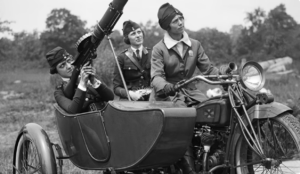
By 1918, another photograph shows women taking part in a machine-gun patrol in New York. The image belongs to a period when the First World War had transformed ideas about women’s roles, labor, and public responsibility. Across many countries, women entered occupations previously dominated by men while millions of men were serving at the front. What looks like an unusual photograph today was part of a much larger social transformation whose consequences would continue long after the armistice.

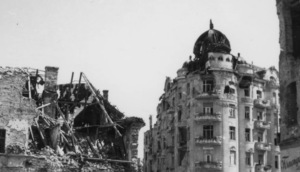
The devastation of Budapest in 1945 offers the opposite image of that transformation. Buildings stand broken, streets are scarred, and an urban landscape once associated with ordinary life has been reshaped by war. Budapest endured some of the fiercest fighting of the final phase of the European war. Looking at such destruction decades later raises an uncomfortable question: how many individual lives disappear from historical memory when only the ruins remain?
The answer may partly be found in smaller photographs. A little girl kissing an American soldier on Valentine’s Day in 1945 carries almost no military information, yet it captures something that maps and casualty statistics cannot. By that stage of the war, the uniform represented separation, uncertainty, and the possibility of homecoming. The child’s gesture is simple, but the historical circumstances surrounding it were anything but simple.
Another photograph shows a soldier returning home to Vienna around the end of the war. The exact identity of the individual may be lost, but the larger story is familiar. Millions of soldiers eventually crossed the boundary between military life and civilian life, only to discover that home itself had changed. Some returned to intact families. Others found destroyed cities, missing relatives, altered borders, or societies struggling to understand what had happened.

That contrast between war and ordinary life appears repeatedly throughout this collection. In one image, workers sit down for a lunch break in Chattanooga around 1900. In another, a poor family works together making cigars in a New York tenement during the 1890s. There is no battlefield here, yet these photographs reveal another historical struggle: survival in an industrializing society where families often depended on every available pair of hands.
The early twentieth century was filled with contradictions. Telephone and telegraph wires crowded the streets of Pratt, Kansas, in 1911, demonstrating how quickly communications technology was spreading. On trains in Ohio, passengers listened to railroad radio in the 1920s. Meanwhile, families still lived in modest homes, workers labored long hours, and transportation remained a physical test of distance.
Then came the machine that would change everything.

In December 1903, Wilbur and Orville Wright made four powered flights at Kitty Hawk, North Carolina. The first lasted only about 12 seconds and covered 120 feet. The final flight that day reached 852 feet in 59 seconds. The Smithsonian describes the 1903 Flyer as the first successful powered airplane with a pilot aboard.
The photograph of that flight is remarkable partly because it does not look like the beginning of a new age. The aircraft appears fragile. The landscape is open and ordinary. Nothing in the image announces the coming century of aviation, strategic bombing, passenger aircraft, satellites, or space exploration. Yet within a few decades, aircraft would become central to the wars that reshaped the world.
That connection becomes particularly haunting when the collection returns to 1936 Berlin. A large television camera used during the Olympic Games represented another technological threshold. The German Museum of Postal and Telecommunication History records that the Berlin Olympics produced some of the earliest live outdoor television broadcasts, using an enormous camera system with a very long lens because early television imaging tubes were relatively insensitive to light.

Technology, therefore, appears throughout these photographs as both promise and warning. The same century that produced mass communication also produced mass propaganda. The same aviation revolution that opened the skies also created new forms of warfare. The same scientific confidence that brought remarkable discoveries eventually confronted humanity with nuclear radiation.
The photograph of a Swedish farmer destroying contaminated forage after the Chernobyl disaster belongs to that darker chapter. The accident occurred in April 1986, and radioactive contamination reached Sweden soon afterward. Sweden imposed temporary grazing restrictions in affected areas because radioactive cesium could enter the food chain through grass, cattle, and milk. The image is powerful because there is no battlefield in it. The danger cannot be seen with the naked eye. Yet something as ordinary as grass has become unusable.

Other photographs show people confronting nature in entirely different ways. A massive organ-pipe cactus photographed in the Baja California region evokes a world before industrial transformation had completely altered the landscape. A mountain guide carrying a wealthy woman up Mount Vesuvius in 1910 reveals the peculiar relationship between adventure, tourism, and social class. A fossilized dinosaur track discovered in Texas in 1952 suddenly connects modern observers with creatures that disappeared millions of years ago.
And then there are the photographs that seem almost impossible because the people inside them lived so far outside modern expectations.
Several images in the collection depict sideshow performers, including Grady Stiles Jr., known as “Lobster Boy,” Lionel, the “Lion-faced Man,” and Josephine Joseph, promoted as a “half-woman, half-man” attraction. These images must be viewed carefully. The people pictured were real, but the language and presentation surrounding sideshows often reflected sensationalism rather than medical understanding or personal dignity. Their photographs tell us not only about unusual medical conditions but also about a society willing to turn physical difference into public entertainment.
That distinction matters. The historical curiosity should not become the exploitation again.

The same tension appears in the image of a woman sideshow performer holding a pistol and wearing an extravagant costume. The spectacle was part of a commercial culture in which novelty could be transformed into income. Behind the theatrical pose was a much more complicated question: how much control did performers have over the identities constructed for them?
The collection even includes trained animals and circus attractions. Jackie, the MGM lion, became one of the most recognizable animal performers associated with early Hollywood. Other photographs show an elephant carcass being transported through Zanzibar, a reminder of the enormous importance of the ivory trade and the destructive consequences of nineteenth- and early twentieth-century elephant hunting.
History often looks glamorous only from a distance.
Hollywood provides countless examples. Jane Russell and Marilyn Monroe appear together in a relaxed setting. Drew Barrymore was photographed by Bruce Weber in 1992. Bill Russell and Muhammad Ali appear together, bringing two extraordinary sporting careers into the same frame. These photographs seem lighter than the wartime images, yet they belong to the same historical century—a century in which celebrity itself became a global phenomenon.

The photographs of Albert Einstein are especially striking because they compress an entire life into a face. One image is said to show Einstein as a five-year-old in Munich. The child could not possibly have known what his name would eventually mean. That is part of photography’s strange power: the viewer knows the future, while the person in the photograph does not.
The same feeling emerges from photographs of cities before they became familiar. Council Bluffs, Iowa, around 1880 appears peaceful and social. Broadway in New York in 1952 is busy with pedestrians and storefront activity. Atlantic City beachgoers relax beneath the sun while listening to radios. A hotel boardwalk in Santa Monica connects guests with the beach in an age when seaside tourism was becoming increasingly accessible.
These scenes seem ordinary precisely because they were ordinary.
That may be why they matter.
The history of war is often remembered through generals, weapons, battles, and political leaders. But ordinary life is what wars interrupt. Before the fighting, people listened to music, rode motorcycles, bought groceries, went to beaches, worked in shops, raised children, watched trains, and waited for letters.
Afterward, people tried to rebuild those same routines.

The Moscow Metro provides another glimpse of a changing world. A trial train ran on the first section in October 1934, and the first line opened to passengers on May 15, 1935. The Moscow Metro’s official history records the opening section as running from Sokolniki to Park Kultury, with a branch to Smolenskaya. Within only a few years, Europe would be consumed by another war, yet the photograph of the early Metro reminds us that history does not move in a straight line from peace toward catastrophe. Construction, innovation, culture, fear, and ambition can all exist simultaneously.
The photograph of Anne Frank at her desk carries an even heavier silence. The source describes her writing in Amsterdam in 1941, before she went into hiding. By then, Nazi persecution of Jews had already transformed daily life in the Netherlands, although the full catastrophe that followed was not yet visible to everyone. The image is therefore difficult to look at without knowing what came next.
A young girl sits at a desk.
History knows the ending.
She did not.
That gap between what the photographed person knew and what the viewer knows is one of the most powerful features of historical photography.
The same principle applies to the photograph of a pile of captured German helmets displayed in New York in 1918. To contemporary viewers, such a display could symbolize victory. To historians, it also belongs to the complicated culture of wartime propaganda, public morale, sacrifice, and remembrance. Objects taken from battlefields could become trophies, evidence, symbols, and eventually museum pieces.
A century later, the objects remain while the emotions surrounding them have changed.

The collection also reaches back to Napoleon’s invasion of Russia through a remarkable photograph associated with a supposed veteran of the 1812 Battle of Borodino. The frequently circulated image identifies Pavel Yakovlevich Tolstoguzov as 117 years old in 1912. However, the identification and uniqueness of the photograph are not securely established by strong archival evidence, so it is safer to regard the claim as a traditional attribution rather than unquestioned fact. Contemporary records do, however, document photographs of veterans of the 1812 campaign during the centenary celebrations in 1912.
That uncertainty is itself part of the story.
Historical photographs are not automatically historical truth. Captions can change. Names can be misspelled. Dates can drift. A photograph can survive while its original context disappears. The responsibility of the historian is therefore not merely to admire the image, but to ask what can actually be proven.
That lesson becomes especially important with famous photographs.
The telescope displayed at the 1900 Paris World’s Fair represents the optimism of an age fascinated by science and engineering. The Wright Flyer represented the dream of flight. The first pressurized passenger aircraft represented the shrinking of distance. The futuristic Maserati Boomerang of 1971 represented a vision of the automobile’s possible future. Each object asked the same question in a different language: what will technology allow humans to do next?
But history repeatedly answered with something unexpected.

Technology does not determine how people will use it.
The telephone can connect families or transmit orders. Radio can entertain or spread propaganda. Aircraft can carry passengers or bombs. Television can bring distant events into homes or manipulate perception. Nuclear science can produce medical advances while also creating dangers that cross national borders.
Even the simplest photographs can carry this contradiction.
A chestnut vendor in Baltimore represents work and survival. A department-store employee taking lunch represents routine. An Italian grocery store in New York in 1943 represents immigrant enterprise continuing in the shadow of global war. A family outside a modest mud or sod house represents settlement and hardship. A mother photographed with her children around 1900 represents something even more basic: continuity.

Meanwhile, the world around these people was changing at extraordinary speed.
Cars appeared on streets. Motorcycles became symbols of modern mobility. Telephone networks multiplied. Radio entered public life. Aircraft crossed oceans. Trains became faster. Cities grew upward. Mass entertainment expanded. The world became increasingly connected—and increasingly capable of destroying itself on an unprecedented scale.
The photograph of a soldier and child in 1945 perhaps captures that contradiction better than any machine.
The soldier carries the history of war on his uniform.
The child carries the possibility of life after it.
Between them lies everything the camera cannot record: the years of fear, the absent people, the destroyed homes, the waiting, the uncertainty, and the fragile hope that ordinary life might return.
That is why these photographs should not be treated simply as collections of shocking curiosities. Their real value lies in the questions they leave behind.

Who was standing outside the frame?
What happened one hour later?
What did the people photographed believe was about to happen?
Which details did later generations forget?
And how many stories disappeared because nobody thought to write them down?
My personal view is that the most powerful historical photographs are not necessarily the most spectacular ones. They are the images that force us to stop and reconsider what we think we already know. A ruined city, a young resistance fighter, a returning soldier, a child, a worker, an inventor, or an ordinary family can reveal more about an era when we look beyond the caption and ask what the photograph cannot show.
The past is never completely visible in one frame. Perhaps that is why these images continue to hold our attention: every photograph gives us an answer, but quietly leaves another question waiting behind it.
Which photograph in this collection makes you want to know the untold story behind it most of all?
Some content was generated using AI tools (including ChatGPT) and edited by the author for creativity, storytelling, and historical illustration purposes. Historical facts and key details should be verified against reliable historical sources. Any AI-generated or reconstructed visuals are intended for illustrative purposes and should not be interpreted as original historical photographs or archival evidence.
Để lại một bình luận