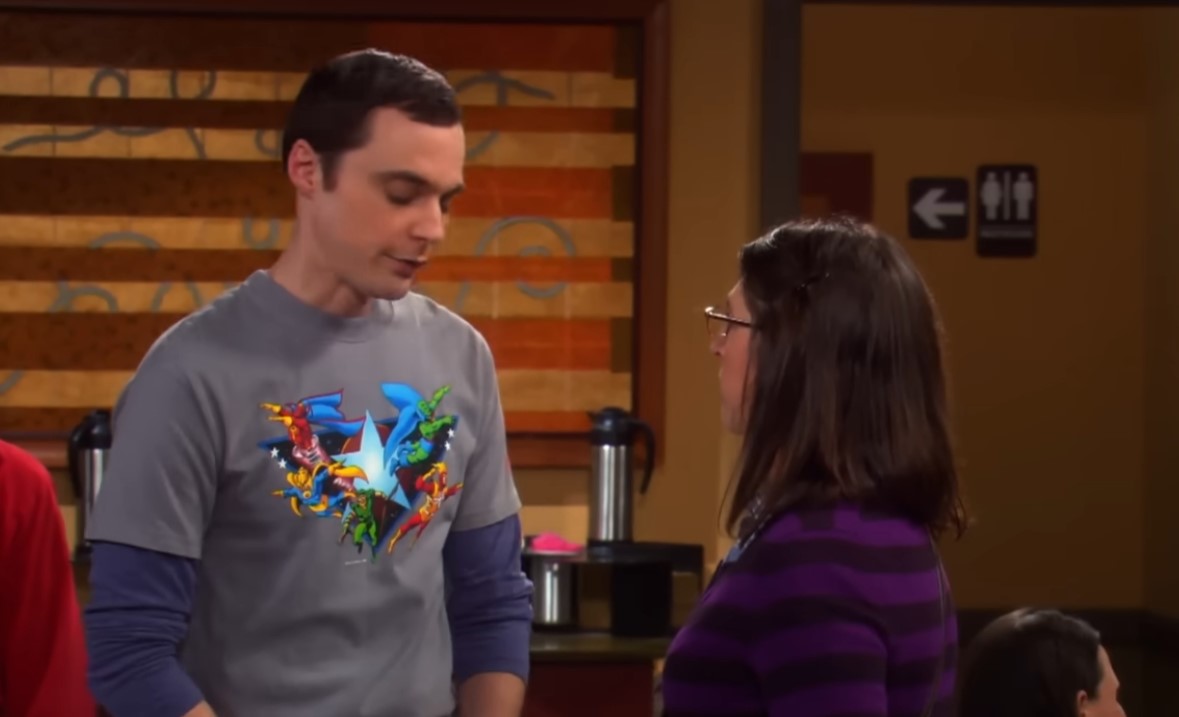
The apartment shared by Leonard Hofstadter and Sheldon Cooper became one of the most recognizable settings in The Big Bang Theory. For years, that living room served as the backdrop for arguments, scientific debates, awkward conversations, unexpected friendships, and countless moments that fans still remember. Add Penny to the mix, and even an ordinary visit could suddenly become much more entertaining.
That is exactly why a seemingly simple apartment moment involving Sheldon, Leonard, and Penny can feel so familiar to longtime viewers while still carrying its own little surprise. These three characters rarely approached everyday situations in quite the same way. Leonard often tried to keep things reasonable. Sheldon preferred his own highly specific rules and logic. Penny, meanwhile, frequently found herself reacting to both of them with a mixture of amusement, disbelief, patience, and perfectly timed frustration.
The chemistry between the three was never dependent on a huge event. Sometimes, the comedy came from something much smaller: a conversation, a reaction, an uncomfortable pause, or the simple fact that Sheldon and Penny could interpret the same situation in completely different ways.
And that is what makes this apartment moment worth another look.
On the surface, it feels like another familiar interaction inside the Pasadena apartment. Leonard is there, Sheldon is being unmistakably Sheldon, and Penny is caught in the middle of the dynamic that made so many episodes work. Nothing about the setup needs to be extravagant. The characters themselves are enough to create tension.
But there is always another layer when these three share the screen.
For Leonard, the apartment is supposed to be home. For Sheldon, it is a carefully controlled environment governed by rules, routines, and expectations. For Penny, it is a place where she can walk through the door and immediately find herself surrounded by two completely different personalities.
That contrast is the secret ingredient.
The Apartment Was Never Just an Apartment
Fans of The Big Bang Theory know that Leonard and Sheldon’s apartment was practically a character of its own. It was where friendships developed, relationships changed, disagreements exploded, and some of the series’ most memorable comedy unfolded.
Leonard and Sheldon could not have been more different in the way they viewed the world.
Leonard was generally more flexible. He wanted people to get along, even when that meant putting up with Sheldon’s unusual habits. Sheldon, on the other hand, viewed consistency as something close to a necessity. His routines were not merely preferences; they were part of the system through which he understood his environment.
Then there was Penny.
Penny did not enter their world with the same scientific background or fascination with elaborate rules. Her perspective was often much more practical and instinctive. She could understand what Leonard and Sheldon were talking about, but she did not always accept their logic simply because they had a complicated explanation for it.
That difference created a perfect comedy triangle.
When Leonard and Sheldon were together, their arguments could become intellectual. When Penny entered the conversation, the entire dynamic could shift.
Suddenly, something that seemed perfectly logical to Sheldon could look completely ridiculous to Penny.
And sometimes, Penny did not even need a long speech to make her point.
Her expression could do the work.
That is particularly important in moments like this one because The Big Bang Theory often found humor in the smallest reactions. A raised eyebrow, a confused look, a pause before answering, or a visibly exhausted expression could communicate exactly what the character was thinking without needing a dramatic explanation.
For Penny, those reactions became part of her identity.
She was often the person in the room who could look at Sheldon’s behavior and silently communicate what everyone else was thinking.
Leonard Was Often the One Stuck Between Them
Leonard’s position in this trio was always fascinating.
He cared deeply about Sheldon, despite the many difficulties of living with him. At the same time, Leonard also understood Penny in a way Sheldon sometimes could not. That meant Leonard frequently found himself in the middle of conversations where two very different perspectives collided.
That familiar apartment environment made those situations even funnier.
Leonard knew Sheldon’s rules.
Penny knew Sheldon’s rules too, at least to some degree, but she was far less interested in pretending that every rule made sense.
This difference became one of the recurring sources of comedy throughout the series.
Leonard could attempt to explain Sheldon’s reasoning. Penny could listen. And then she could deliver the kind of reaction that immediately reminded viewers that there was a huge gap between understanding someone’s behavior and actually agreeing with it.
That is why the apartment scenes involving all three characters have such staying power.
They do not need a complicated plot.
The personalities are already doing the heavy lifting.
And once Sheldon becomes involved, viewers know that even the most ordinary interaction can take an unexpected turn.
Penny’s Reactions Became Part of the Comedy
One of the reasons Penny became such a beloved character was her ability to react to the world around her.
She did not need to be the smartest person in the room to understand when something was becoming absurd.
In fact, that was often the joke.
Sheldon could construct an incredibly detailed argument based on his own logic. Leonard could attempt to mediate. Penny could simply stare at them as if wondering how the conversation had become this complicated in the first place.
That contrast worked beautifully.
It also helped make Penny an important bridge between the audience and the scientific world of the show. Viewers did not always need to understand every technical reference to enjoy the comedy. Penny’s reactions frequently translated the emotional reality of the situation.
If Sheldon was being unnecessarily complicated, Penny’s expression could tell us.
If Leonard was becoming frustrated, Penny could recognize it.
If something was obviously ridiculous, Penny did not always need to explain why.
She just reacted.
That is why a title such as “And Her Reaction Says It All” works so well for this kind of moment. The reaction itself becomes part of the storytelling.
Why These Small Moments Still Work
Modern television is full of enormous plot twists, dramatic reveals, and elaborate production design. Yet classic sitcom moments often survive for a completely different reason.
They feel familiar.
Fans can recognize the characters immediately. They know how Sheldon is likely to approach a problem. They know Leonard may attempt to maintain peace. They know Penny may not have the patience for an unnecessarily complicated explanation.
That familiarity creates anticipation.
Before anything even happens, viewers already have an idea of what each person might do.
But the fun comes from seeing how the specific interaction develops.
That is one of the great strengths of The Big Bang Theory. Its comedy was not always dependent on shocking viewers. Instead, it often took established personalities and placed them together in situations where their differences naturally created humor.
The apartment was perfect for this.
There was nowhere to hide.
Leonard and Sheldon lived together. Penny lived across the hall. Their lives constantly overlapped. Conversations could begin casually and suddenly turn into debates. A simple visit could become an argument. A normal evening could become another reminder that Sheldon operated according to a completely different rulebook.
And yet, beneath the comedy, there was something warmer.
These characters became family.
They annoyed one another. They disagreed. They misunderstood each other. They occasionally drove one another crazy.
But they also kept showing up.
That is part of what made the apartment scenes feel meaningful beyond the jokes.
The Real Entertainment Was the Chemistry
If someone had described the premise of The Big Bang Theory without showing the characters, it might have sounded relatively simple: a group of friends living, working, dating, arguing, and trying to navigate everyday life.
But the success of the show came from the chemistry between those characters.
Sheldon was Sheldon.
Leonard was Leonard.
Penny was Penny.
And when their personalities collided, the audience knew something entertaining was likely to happen.
That chemistry also explains why viewers continue revisiting older scenes. A clip may be short, but the relationships behind it carry years of context.
A simple glance from Penny can feel funnier when viewers already understand her long history with Leonard and Sheldon.
A familiar Sheldon behavior can feel even more ridiculous because audiences have seen him repeat variations of the same logic throughout the series.
Leonard’s reaction can become funny simply because viewers know how often he has been caught between the two.
This is where nostalgia becomes powerful.
For fans interested in television history, classic sitcom culture, celebrity entertainment, Hollywood television, photography, vintage pop culture, and the evolution of modern comedy, The Big Bang Theory offers plenty to revisit.
The series became more than a sitcom. Its characters became part of popular culture.
Sheldon’s personality became instantly recognizable.
Leonard and Penny became one of the show’s central relationships.
And the apartment became one of television’s most familiar fictional homes.
The Moment Becomes More Than the Setup
That is what makes the interaction between Sheldon, Leonard, and Penny so enjoyable.
The setup may look ordinary.
The apartment may look familiar.
The characters may be doing something viewers have seen variations of before.
But sitcom comedy often lives in the reaction rather than the setup.
One character says something.
Another responds.
Someone pauses.
Someone looks confused.
And suddenly the audience understands the joke without needing it explained.
Penny was especially effective at this.
Her reactions could puncture the seriousness of Sheldon’s logic without turning the scene into something artificial. She could make the audience feel as though they were sitting in the room watching the situation unfold.
Leonard often provided another layer because his familiarity with Sheldon meant he understood exactly how difficult the conversation could become.
And Sheldon, naturally, remained completely capable of turning a simple situation into something much more complicated than it needed to be.
That combination was almost impossible to resist.
Why Fans Still Remember This Dynamic
There is a reason clips featuring these characters continue to attract attention long after the original episodes aired.
Nostalgia is only part of it.
The bigger reason is recognition.
Fans recognize themselves in the dynamic.
Most people have experienced some version of it: one person overthinking something, another person trying to keep everyone calm, and someone else silently wondering why the situation has become so complicated.
That is classic sitcom storytelling.
It takes something ordinary and exaggerates the personalities involved just enough to make it memorable.
The best moments do not necessarily require a major storyline.
Sometimes, three characters standing in an apartment are enough.
And when those three characters are Sheldon, Leonard, and Penny, viewers already know that the smallest interaction can become memorable.
The Reaction Says More Than the Words
Ultimately, that is the appeal of this classic apartment moment.
The entertainment does not come only from what happens.
It comes from how the characters respond to one another.
Sheldon brings his unmistakable logic.
Leonard brings his familiar attempt to manage the situation.
Penny brings the reaction that can instantly change the emotional temperature of the room.
Together, they create the kind of chemistry that helped define The Big Bang Theory.
It is also a reminder of why sitcoms can remain culturally relevant years after their original broadcasts. The best characters become recognizable enough that viewers can anticipate their behavior, yet their interactions still contain enough unpredictability to keep the scene entertaining.
For fans of celebrity Hollywood entertainment, television history, vintage culture, photography-inspired nostalgia, women’s lifestyle content, and pop-culture storytelling, moments like these offer something particularly valuable: a small window back into a television era that audiences still love.
And perhaps that is why Penny’s reaction feels so important.
Sometimes, the biggest joke is not what Sheldon says.
It is the look someone gives him afterward.
And once Leonard, Sheldon, and Penny are together in that apartment, there is always another reaction waiting to happen.
Because in The Big Bang Theory, one familiar conversation can easily lead to another unforgettable character moment—and somewhere else in that apartment, Sheldon is probably already preparing his next argument.
Để lại một bình luận