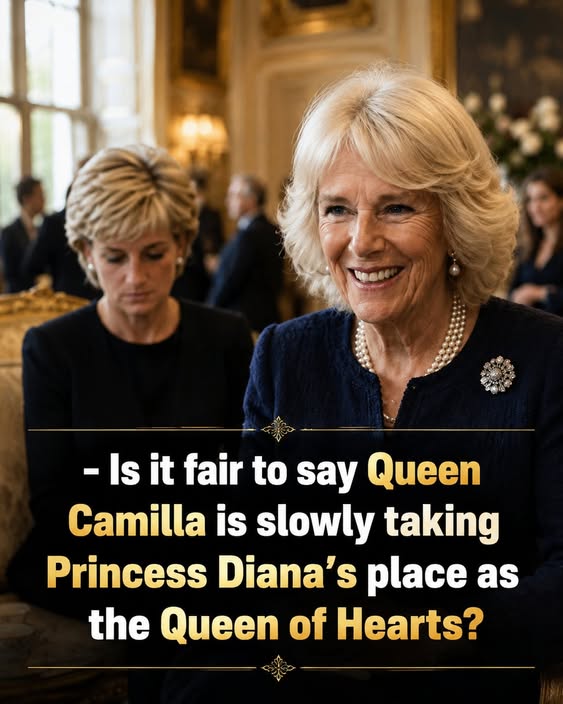
Few topics in modern royal history inspire as much emotion as the comparison between Queen Camilla and Diana, Princess of Wales. Decades after Diana’s passing, discussions about their roles, legacies, and places within the British Royal Family continue to spark passionate debate around the world.
Yet perhaps the comparison itself begins with a mistaken assumption—that one woman must somehow replace the other.
Princess Diana became one of the most beloved figures of the twentieth century. Her compassion, warmth, and ability to connect with people from every walk of life created an extraordinary bond that transcended traditional royal expectations. Whether comforting hospital patients, embracing children in need, or drawing attention to humanitarian causes, Diana demonstrated a rare emotional connection that earned admiration far beyond Britain’s borders.
Although she never officially held the title “Queen of Hearts,” the phrase became forever associated with her because of the affection millions felt toward her. It was a legacy built on empathy, kindness, and a willingness to show vulnerability in a public role often defined by formality. Even decades later, her influence remains deeply woven into the public memory.
Queen Camilla’s path has been very different.
Unlike Diana, Camilla entered public life under intense scrutiny and carried the weight of years of controversy. For many people, acceptance did not come easily. Her relationship with King Charles III was often viewed through the lens of the past, making it difficult for some to separate her identity from one of the most famous royal stories in history.
Despite those challenges, Camilla remained committed to her public duties. Over time, she developed a reputation for supporting charitable organizations, advocating for literacy and domestic abuse awareness, and providing steady support to King Charles during significant moments of national and royal transition. Her approach has generally been quieter and less dramatic, focused more on consistency than public attention.
This is why judging Camilla solely in comparison to Diana may miss an important point.
The two women represent different generations, different personalities, and different experiences within the Royal Family. Diana captured hearts through emotional openness and an unprecedented connection with the public. Camilla has gradually earned respect through resilience, patience, and a dedication to duty despite years of criticism.
The British Monarchy is large enough to acknowledge both legacies without placing them in competition.
Diana’s place in history is secure. Her impact on humanitarian work, public perception of the monarchy, and countless lives around the world will continue to be remembered for generations. Nothing about Camilla’s position as Queen can diminish that legacy.
At the same time, Camilla deserves the opportunity to be evaluated on her own contributions rather than on an impossible comparison. Her role in supporting the Crown, promoting charitable causes, and helping guide the monarchy through a changing era forms a chapter of royal history that belongs uniquely to her.
Honoring Diana does not require rejecting Camilla.
Likewise, recognizing Camilla’s service does not require rewriting history or forgetting the profound impact Diana had on the world.
In the end, royal history is not a story with only one place at the top. It is a collection of individuals whose contributions are remembered in different ways. Diana will always be remembered for the extraordinary affection she inspired. Camilla will be remembered for the perseverance and service that helped define her own journey.
Neither woman needs to replace the other. Their legacies are different—and that is precisely why both deserve to be remembered.
Để lại một bình luận