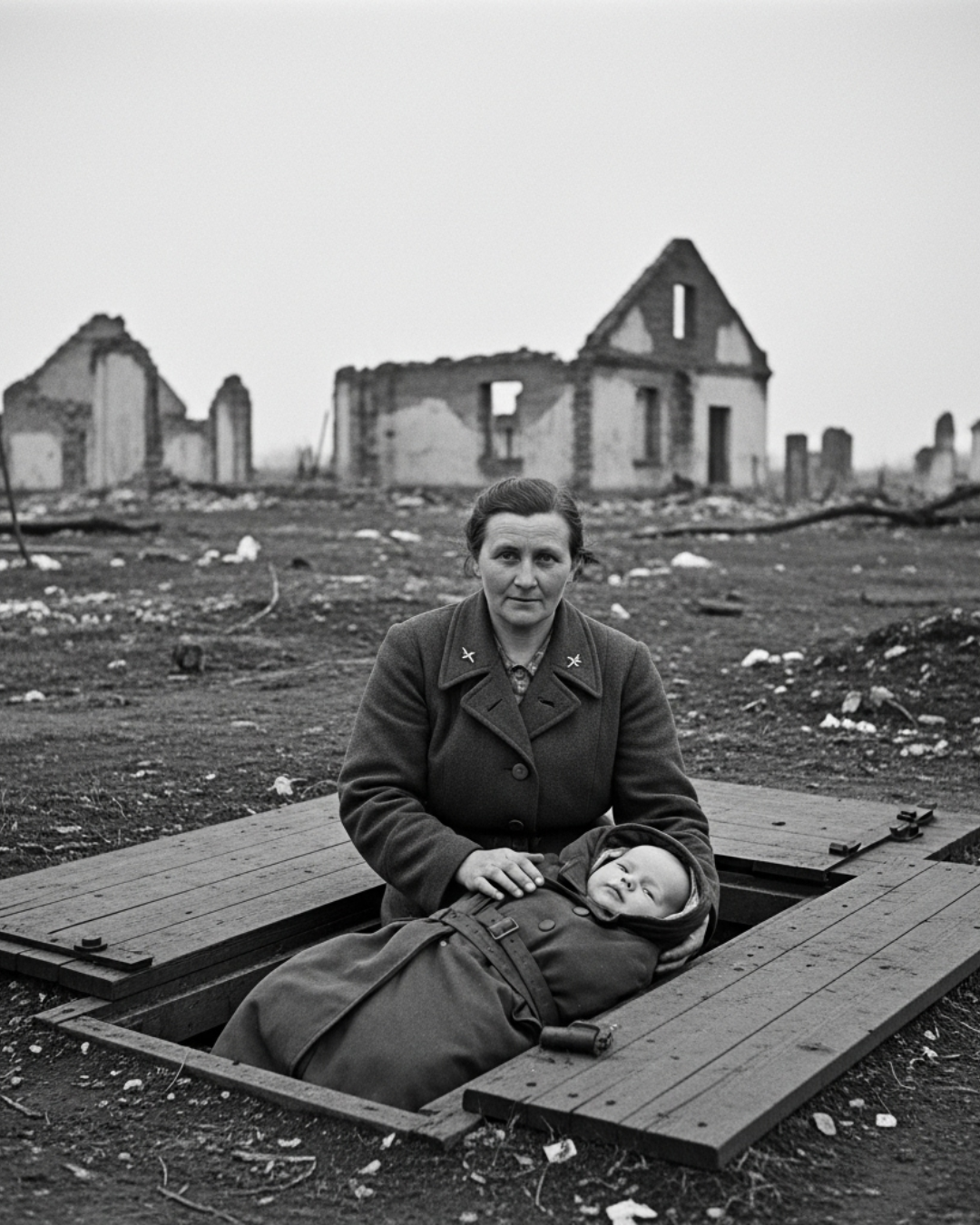
Poland 1947 – Silence after the war

The post-war world was like a shattered mirror. In each shard, a different fragment of pain, fear, and longing could be seen. The Poland of 1947 was nothing like the country Marta Zielińska had known before the war. Black skeletons of houses protruded from the ruins, and the air smelled of ash and the past. She returned here after years of wandering, when the front swept through her village like a hurricane, taking everything—her husband, Jan, her two sons, her farm, and her faith that the world could still be good.
The snow melted slowly, revealing the ground pockmarked by bomb craters. The silence of the land echoed with the footsteps of those who had passed away. Marta stood amid the ruins of her home and felt something within her end. But life, even after the greatest catastrophe, finds a way to survive. And it was then, in that silence, that she heard a cry.
The sound was faint, almost unreal, as if it were coming from underground. She followed it, past the ruins of a church, its cross still crooked against the ashes. There, beside it, was a hatch leading to an old cellar. When she lifted it, she was hit by cold air and that sound—a soft, persistent whimper. In the darkness lay a baby wrapped in a soldier’s cloak.
There were no papers, no note. Only the smell of gunpowder and war. Marta leaned forward, and something she hadn’t felt in years trembled in her hands—a reflex of concern. She took the child in her arms, not thinking that he might be someone else’s, that someone was looking for him. In a world that had forgotten what compassion was, this gesture was like a prayer.
In the cottage she’d rebuilt from fragments of brick and beam, the fire that had been kindled wouldn’t stay lit for long. The child slept in a potato basket, and Marta sat nearby, listening to every breath. She named him Adam. She didn’t know why—perhaps because she wanted him to be the beginning of something new, like the first man after the end of the world.
The years passed slowly, in a rhythm of reconstruction and silence. The Poland of 1947 was a country of people who had stopped believing in miracles but were beginning to understand the value of survival. Every day, Marta went out to the fields where grain had once grown, now overgrown with weeds and memories. Adam grew, and his eyes reflected a different world—purer, more peaceful.
One day, people from the city arrived, taking a census of the survivors. They asked for names, relatives, and children. When they asked about Adam, Marta replied curtly,
“My son.”
They didn’t ask. In those days, no one asked too many questions.
But the shadow of war didn’t leave easily. At night, she dreamed of gunfire, of fire, of the faces of those she hadn’t been able to say goodbye to. Sometimes, when Adam fell asleep, she’d go outside and gaze into the distance—where her parents’ house had once been. Now, there were only weeds and silence.
Polish history was like a wound then, still bleeding. People were returning from the camps, from Siberia, from the front. Some with a stigma, others with emptiness. Marta knew that everyone carried their own war within. That’s why she never asked who Adam’s father was.
In the spring of 1948, a small school opened in the village. Adam was one of the first students. He brought with him a notebook made of newspapers and a pencil that Marta had received from a friend in Krakow. The teacher, a young man from Warsaw, asked the children what they wanted to do when they grew up. Adam replied,
“I want to build houses so no one has to live in ruins.”
Marta listened with a heart full of pride. She knew that although the war had robbed her of everything, this child—adopted from the darkness—had become her greatest victory.
The years after the war passed, and Poland changed slowly. The country continued to rise from its knees, as if still searching for meaning in what had passed. Marta worked in a cooperative, sewing uniforms for the new army. The irony of fate did not escape her – she was sewing clothes for those tasked with preserving peace, even though she knew how fragile peace was.
Adam grew up. He was wise, quiet, and sensitive—like someone born with the memory of tragedy. Sometimes, while helping his mother in the garden, he would ask,
“Mom, was my father a soldier too? ”
Marta always answered the same:
“Maybe he was, or maybe he just wanted you to live.”
She didn’t want to feed him hatred. The war had taught her that hatred was only an extension of death. And she wanted Adam to live in a world worth loving.
In 1950, Marta went to the city for the first time to see the monument dedicated to the victims of the war. The plaque bore thousands of names, including her husband, Jan Zieliński. She stood for a long time, holding Adam’s hand. Then the boy asked quietly,
“Mom, do I also have his last name?
” “Yes, son,” she replied. “Because a last name isn’t just blood. It’s memory.”

Poland’s history in those years was full of women like Marta—unsung heroes who lifted the country from ruin. Their names rarely made it into textbooks, but they were the true foundation of its reconstruction. Each of them carried within them a story that no one had written down.
When Adam grew up, he went to study in Gdańsk. He wrote letters to his mother, mentioning his desire to design homes for families who had lost everything—just as they had once. Marta kept these letters in an ammunition box she had once found among the ruins. Ironic—once again, something that had served death now protected the words of life.
When Adam asked in one of his letters,
“Mom, was I your real son?”
Marta replied with only one sentence:
“You were the only real thing I had.”
In 1970, Marta passed away peacefully, in her sleep. Adam returned to his home village, now rebuilt, green, and filled with new houses. A small monument with the inscription:
“To those who gave life when all was lost.”
Adam placed a bouquet of wildflowers there. He knew that his mother was one of those who had saved not only life but humanity.
Poland 1947 wasn’t just a date. It was the beginning of a new era—a time when hope was born from the ruins. Amid the ashes of war, Marta Zielińska found a child, and with it, a meaning to life. Her story is not just one of survival, but of the power of love to rebuild the world.
Because in a country that went through hell, every mother was like the earth – wounded, burned, but still capable of giving birth to new life.
Note: Some content was generated using AI tools (ChatGPT) and edited by the author for creativity and suitability for historical illustration purposes.
Để lại một bình luận