
Ohrdruf: April 4, 1945, when American troops discovered the horror
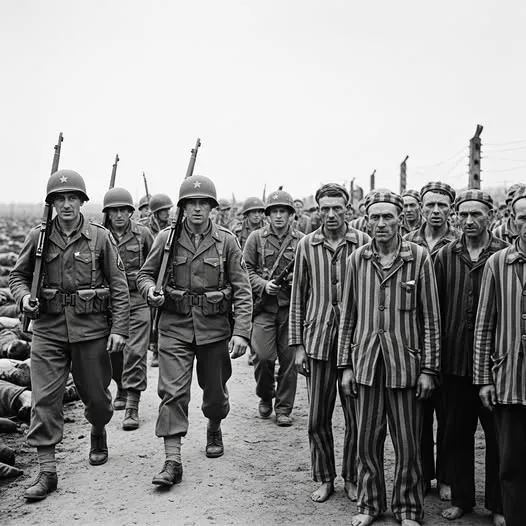
On April 4, 1945, as Europe entered the final weeks of World War II, an event forever shocked the conscience of Western liberators. American troops of the 4th Armored Division and the 89th Infantry Division, advancing through German Thuringia, stumbled upon Ohrdruf , a subcamp of Buchenwald. Until that day, rumors and secondhand accounts had informed the world of the Holocaust and the Nazi concentration camp system, but American forces had never encountered a concentration camp directly. Ohrdruf thus became the first Nazi camp discovered by Americans. What they saw that day left a lasting impression on them.
Approaching the camp’s rusty barbed wire, the soldiers were first struck by a fetid, unbearable stench. A smell that permeated the damp spring air: the smell of death. They passed through the gates and discovered a sight even veterans of Europe’s bloodiest campaigns could not have imagined. Hundreds of bodies littered the ground, some half-covered by earth in barely dug mass graves. Others lay where they had fallen, skeletal, their eyes still open, as if frozen in silent supplication. Traces of mass executions were everywhere: bullets in the neck, execution stakes, bloody clothing. For seasoned soldiers who had fought in the Battle of the Bulge or the liberation of France, this was a shock of a different kind. The enemy they were fighting suddenly assumed a monstrous and undeniable face.
Amid the barbed wire and ruined barracks, survivors emerged, staggering, wrapped in striped rags, their eyes sunken with hunger and terror. Some were speechless, so profound was the trauma. Others, in weak, hoarse voices, muttered words of greeting or despair. One man, little more than a living skeleton, stared at an American soldier and whispered, “Now you’ll believe what we’ve been through.” These simple yet harrowing words summed up the urgency of their testimony: they had survived not just to live, but to prove to the world that the horror was real.
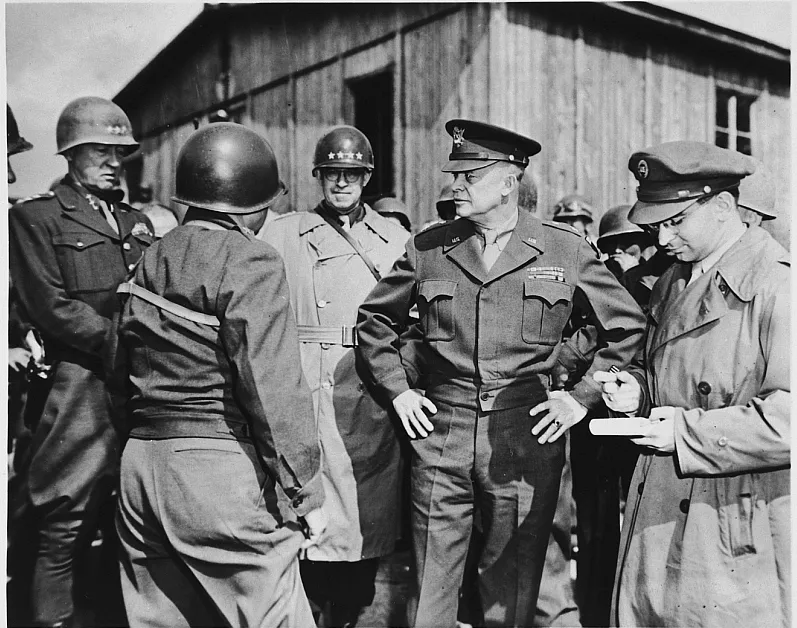
Ohrdruf’s discovery had an immediate impact. Word spread through the Allied ranks and quickly reached the High Command. A few days later, three of the biggest names in the war in Europe arrived at the scene: General Dwight D. Eisenhower , Supreme Commander of the Allied Expeditionary Force, accompanied by Generals George S. Patton and Omar Bradley . They wanted to see for themselves what their soldiers had described to them with such horror. Patton, accustomed to the horrors of the front, was so shocked that he vomited at the sight of the piles of bodies. Bradley, usually reserved, remained silent, his face ashen. As for Eisenhower, he immediately understood that what he had seen would be beyond words and might one day be denied.
That’s why Eisenhower made a historic decision. He insisted that German journalists, filmmakers, and even civilians visit the camp. He appealed to members of the U.S. Congress and newspaper correspondents to come and see it for themselves. “Go there, see for yourself,” he later declared, “because the day will come when people will deny that such things ever happened.” This prophetic prediction proved accurate: Holocaust deniers later tried to minimize or erase the Nazi crimes, but the images and testimonies collected at Ohrdruf remained irrefutable evidence.
For the survivors, the arrival of the Americans meant far more than liberation. It was a recognition of their suffering, a confirmation that their ordeal was not imaginary. For years, they had watched their comrades die, endured hunger, beatings, humiliation, and constant fear. And now, finally, people from afar saw what they had endured. Many wept; some fell to their knees, too weak to stand. One survivor later recalled, “When I saw the stars on their helmets, I knew we were saved.”
However, Ohrdruf was just one link in a vast network of Nazi concentration camps. It served as a forced labor and transit camp, but it was also the site of mass executions as Allied forces approached. In the last days of March 1945, the SS, seeking to erase the traces of their crimes, shot hundreds of prisoners and forced others on a death march to Buchenwald. American soldiers found traces of these crimes everywhere: burned papers, burned barracks, half-filled graves. Nothing could conceal the scale of this barbarity.
The Ohrdruf discovery had a profound impact on American and global public opinion. Photographs published in the American press depicted emaciated corpses, survivors with sunken faces, and distraught generals in uniform. These photographs, reprinted in newspapers such as the New York Times and Life Magazine , raised the public’s awareness of the Nazi concentration camp system . This visual shock helped cement the collective memory of the Holocaust, alongside such now-infamous names as Auschwitz, Treblinka, and Dachau.
Eisenhower also ordered German civilians from nearby villages to visit the camp. Some wept silently, others pretended they knew nothing. However, for Eisenhower, it was crucial that the German people see, without hindrance, what had been committed in their name. This act was intended not only to prevent future denials but also to confront the German public with a truth they could not ignore.
Today, for historians, Ohrdruf remains a powerful symbol: the moment when liberators came face to face with the Holocaust in its raw, direct form. It was at Ohrdruf that many American officers grasped the enormity of the Nazi genocide. Before, the camps had been only horrifying rumors; after Ohrdruf, they became an indisputable reality. Testimonies from American soldiers, collected in the days that followed, describe a mixture of disbelief, anger, and sadness. One lieutenant wrote in a letter to his family: “I saw hell today, and its name is Ohrdruf.”
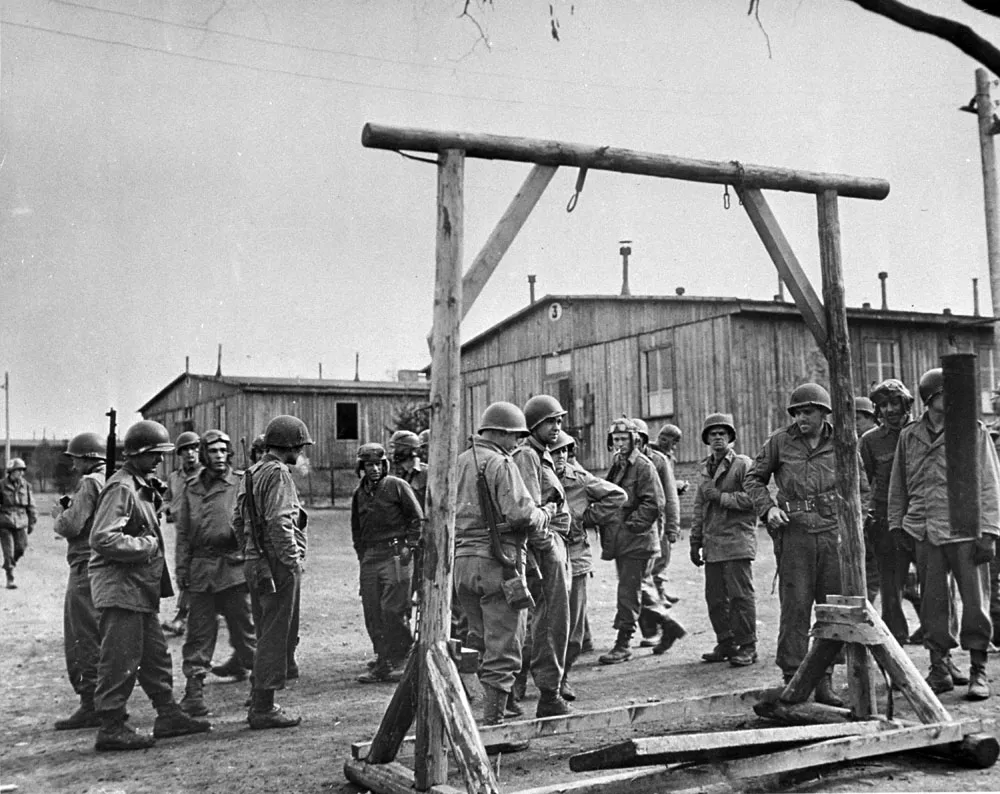
In the decades that followed, Ohrdruf’s name was mentioned less frequently than Auschwitz or Dachau, but its historical significance remains immense. It was there that Eisenhower, Patton, and Bradley, the three highest-ranking Allied commanders, realized the need to document and publicize Nazi crimes. It was there that the world understood that no battlefield, no ruined city, could match the cold, systematic horror of the concentration camps.
The Ohrdruf Memorial is now only a modest monument, but it marks a turning point. At the commemorative ceremonies, American veterans, survivors, and families of the victims stand shoulder to shoulder, reminding us that the memory of these events transcends generations and borders. Eisenhower’s words, “Go and see,” still echo. They remind everyone that the responsibility to remember rests not only on historians but on all of humanity.
The liberation of Ohrdruf also teaches us a universal truth: even in the final days of conflict, even when victory seems imminent, darkness can still reveal its depths. The American soldiers who entered the camp on April 4, 1945, were unprepared for what they were about to see, but their shock, outrage, and determination to bear witness ensured that the world will not forget. In a century marked by so much violence, Ohrdruf remains a warning: as long as these images and voices are remembered, truth will remain stronger than denial.
Để lại một bình luận