In the winter of 1946

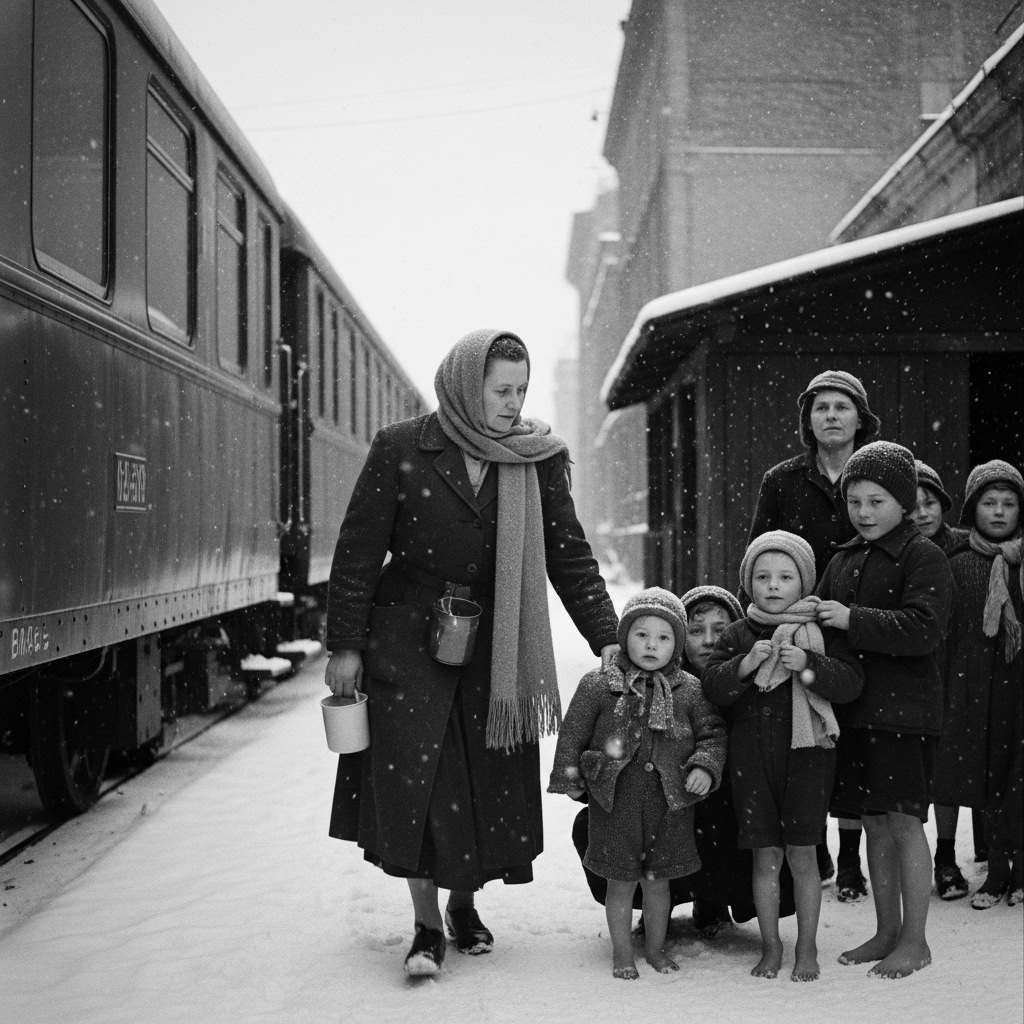
In the winter of 1946, a train slowly entered Krakow, its metal groaning in the cold, and steam billowing from the chassis mingled with the fine snow that danced in the air like a memory of something long gone. On the platform, between soldiers returning from the front and women in scarves searching for someone who would never return, stood Marta Zielińska. She was thirty-two years old, with eyes older than the war. She had survived Auschwitz, but there, behind the barbed wire, she had lost everything—her husband, two young daughters, and something even deeper: the sense that the world had any meaning.
In her hands she held a metal cup, tied to her belt like a relic. It was the only item that had accompanied her since her final days in the camp. Around her neck was a woolen scarf, the same one that had once belonged to her eldest daughter, Hania. The scarf smelled of a former life, though the scent of a child had long since vanished from it, only coldness and memory.
Snow covered the ruins of the city like a shroud, muffling the sounds of life. Krakow in 1946 was a place full of ghosts—people who had returned, but not truly. Each carried something within them that words couldn’t describe. Marta wandered the streets, searching with every step for any trace of her daughters. She asked in orphanages, in hospitals, among women who—like her—had experienced the unimaginable. But no one knew anything. Sometimes someone lowered their gaze, sometimes touched her shoulder, but the answer was always the same: “No, I didn’t see it.”
Weeks passed. In her pocket, she held a letter from the Red Cross, saying that a girl with a similar name had been seen in one of the displaced persons camps. Marta had walked there, through the snow, only to see another child—not her own. The girl looked at her as if to ask, “Why didn’t anyone come for me?” Marta realized then that the world was full of children no one was looking for anymore.
One morning, as dawn was just breaking over the city, Marta heard crying. The sound was faint, muffled by the snow. She followed it until she reached a small shelter by the freight station. There, in the shadow of the train cars, sat a group of children—barefoot, emaciated, huddled together as if trying to keep each other warm with their very existence. The oldest might have been ten, the youngest only three. They looked at her with a mixture of fear and hope, the fragile hope that only a child can still feel after all they’ve seen.
Marta didn’t hesitate. She took off her scarf and wrapped it around the youngest boy’s shoulders. The chill immediately ripped through her, but it didn’t matter. “You need to warm up,” she said quietly, her voice trembling not only from the cold. The boy looked at her with wide eyes, reflecting the snowflakes, and whispered, “Mom?”
Tears welled in her eyes, hot as shame and love at once. She didn’t correct him. She didn’t have the strength to say, “I’m not your mother.” Because in that moment, she understood something that had seemed impossible until then—that the war might have taken her own children, but it hadn’t robbed her of her ability to love. So she knelt, hugging the boy as she had once hugged Hania. The snow melted in her hair, and she felt the child’s heart beating beneath her fingers.

The next few days brought a decision that would change her life. With the help of several women from the Red Cross, she began caring for a group of orphans. First, there were five, then ten, and soon the entire room in the former tenement house in Podgórze was filled with laughter, tears, and silent prayers. Marta cooked from scratch, sewed old clothes, and traded bread for coal. Each child had their own story—short, tragic, and broken like a thread. One had seen her mother die in a burning house, another had escaped from a train heading east. All had known hunger, fear, and cold. But in her home, they also learned something else: that love doesn’t always have to have a first name or surname.
In the winter of 1947, Marta Zielińska’s home became a place spoken of in Krakow with respect and affection. People brought clothes, blankets, sometimes a little sugar, while some simply stood by the door, unsure if they could come in. In those days, everyone carried their own wound, and Marta knew how to listen—to adults and children alike. No one left her the same way they had arrived. She had something about her that resembled light—gentle yet unwavering.
Years passed. Poland was rebuilding from the ruins, and life went on, though memories of the war lingered like a shadow on the walls. Marta never stopped searching for her daughters, though deep down she knew she would never find them. Each child she took in was an echo of those lost—but also a new beginning. Some of her war children later went abroad, others stayed in Poland, raising families, studying, and writing books about survival, hope, and love after the Holocaust . Everyone remembered one woman from Krakow who could not ignore suffering.
In 1963, in one of the letters she received from Israel, a girl wrote, “I don’t know who my real mother was. But I know you taught me that love can survive even in ashes.” Marta read the letter by candlelight, holding her old metal mug in her hands. For a moment, she thought she heard Hania’s laughter—somewhere beyond the wall, in the voices of children playing in the yard.
She died quietly in February 1969. It was freezing, just like when she arrived in Krakow after the war. The children she had once saved came from all over the country. On her grave, among the bouquets and photos, someone placed the same metal mug, polished to a shine. The words familiar to many were engraved on the gravestone:
“She made us believe we were never truly alone.”
And although decades have passed since that day, Marta Zielińska’s memory lives on in the stories of women who, after the war, rebuilt the world not with bricks, but with hearts. Her story is not just a part of the history of World War II —it is a testament to the fact that even after the greatest darkness, a person can find light.
The Red Cross archives preserve several of her letters, yellowed with time, in which she wrote:
“I cannot bring back to life those who have died. But I can teach these children that life, even in its fragility, is worth loving.”
This sentence became a motto for the generation that grew up after the war. For the children of war who, thanks to it, found faith in the future. For women who—like Marta—took upon themselves the burden of survival, reconstruction, and hope. And for us who read these stories today to understand that history is not just a collection of dates, but a living memory of those who saved humanity in the darkest of times.
Note: Some content was generated using AI tools (ChatGPT) and edited by the author for creativity and suitability for historical illustration purposes.
Để lại một bình luận