Gunskirchen, May 1945: When Darkness Revealed Humanity
In May 1945, as World War II drew to a close in Europe, American troops advancing through Austria seemed to have glimpsed the heart of the Nazi horror. The fighting was fierce, cities were reduced to rubble, and soldiers had lost many friends on the front. But what they were to discover at the Gunskirchen camp , part of the Mauthausen concentration camp complex , surpassed all their imaginations. Gunskirchen was not simply a camp: in the final days of the Reich, it became an abyss of suffering and a devastating witness to the Holocaust .
The camp was built to house exhausted prisoners from death marches, columns of deportees forced to march hundreds of kilometers in cold and hunger, under the blows and bullets of the SS. As American soldiers approached the scene of the crime, an unbearable stench filled the air: a mixture of disease, excrement, and unburied bodies. Even seasoned veterans of the Ardennes and Normandy battles were enveloped in a heavy silence. One of them later recounted that this smell, more than the sounds of enemy weapons or shells, would haunt him for the rest of his life.
Climbing through the barbed wire, they discovered thousands of prisoners lying on the ground, skeletal , with sunken eyes that seemed to float in their emaciated faces. Some were barely moving, others were already dead, their bodies mingling with those of those still breathing. Many of them were Hungarian Jews, displaced from Mauthausen during the hasty evacuation in April 1945. The SS, fleeing the Allied advance, had abandoned them without food or care. Gunskirchen became an open-air extermination camp.
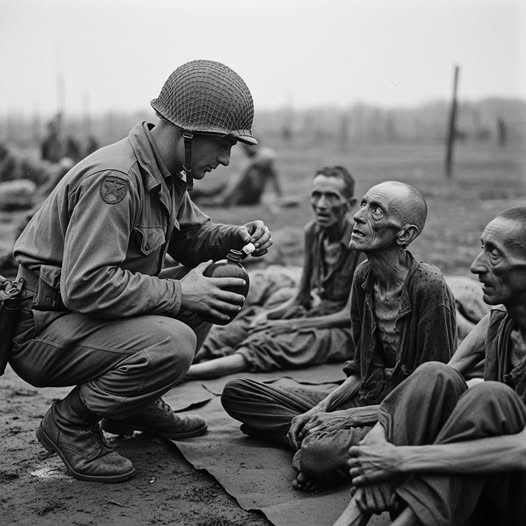
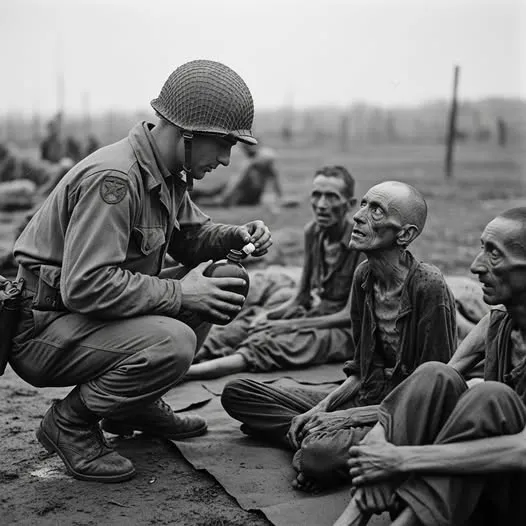
An American soldier, a young infantry sergeant, knelt beside a prisoner whose hands were shaking so badly he could no longer raise them to his mouth. He opened a canteen, poured water into a dented metal cup, and pressed it to the man’s chapped lips. The man looked up with dull eyes and whispered, “Danke.” A single, fragile word, yet one that held all the gratitude, all the pain, and all the dignity of a survivor plucked from oblivion. For the sergeant, that word became a poignant memory, living proof that even amidst horror, humanity can still shine.
Survivor testimonies later collected confirm the indescribable conditions in Gunskirchen. One former prisoner recalled that the barracks were so overcrowded and filthy that there was nowhere to sit. The weakest were trampled as they fell. Without food for days, some gnawed on grass or roots. Others, in a state of unimaginable despair, resorted to actions that no one dares to describe. The liberation of the Nazi camps was a salvation for them, but also a test: their survival hung in the balance, and many later died, their bodies too weakened to endure even a sip of water or a piece of bread.
Lacking sufficient equipment, American military doctors improvised makeshift hospitals. They quickly realized that eating too much or too quickly could kill emaciated bodies. So they patiently distributed small amounts of water and warm broth, monitoring every movement, every breath. Their notes describe an almost surreal scene: men weighing less than 30 kilograms, with bones protruding from their skin, trying to smile despite the pain. Death still lurked, but a glimmer of hope was beginning to circulate.
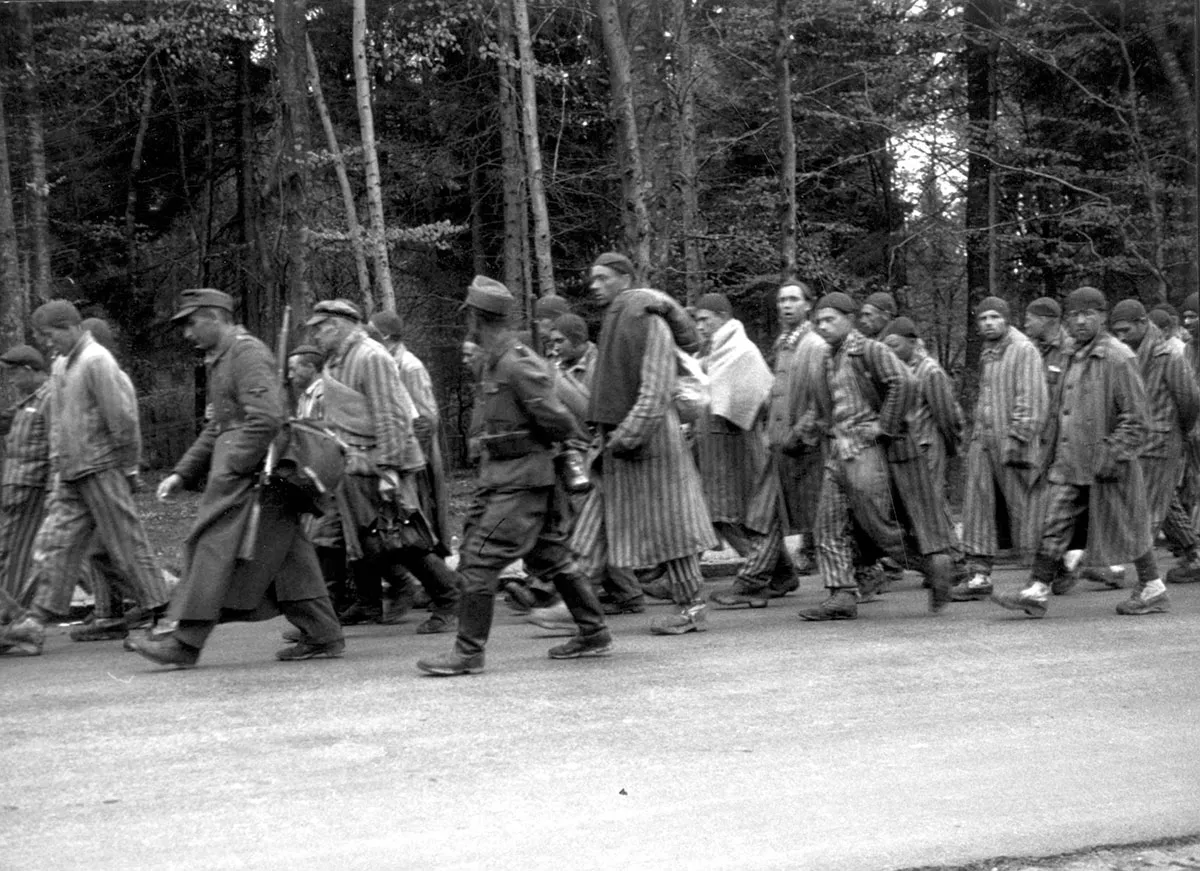
To the outside world, Gunskirchen became a symbol. Photographs and films taken by American soldiers quickly spread, starkly exposing the barbarity of the Nazi regime. These images, unbearable yet necessary, would later serve as irrefutable proof of the Holocaust . Allied commanders, like Eisenhower at Ohrdruf, understood that the world needed to see and know this. One officer wrote in his report: “Only by looking at Gunskirchen can one understand the enormity of the evil we fought.”
Residents of surrounding villages were called in to investigate the camp. Many claimed ignorance of what was happening there, but silence became impossible in the face of the rows of corpses and starving survivors. This direct confrontation aimed not only to break down denials but also to raise awareness of the collective responsibility of a system that had dehumanized and massacred millions of innocent people.
Today, the Gunskirchen camp no longer exists in its original form. The barracks have disappeared, and the area is largely overgrown with forest. However, monuments and memorial plaques commemorate this event. Annual ceremonies bring together former deportees, their families, historians, and local residents to pay tribute to those who suffered and perished. Survivors’ testimonies are carefully preserved in archives and museums, including the Mauthausen Memorial and audiovisual collections dedicated to World War II and the Holocaust .
The history of Gunskirchen is also a history of memory. In a time when some seek to distort or deny the facts, the stories of these soldiers and survivors retain their unwavering power. Teachers, journalists, and writers know that every detail counts: the word “Danke” whispered by a dying man, the despairing gaze of a young soldier, the unbearable stench that haunted the veterans throughout their lives. These elements give the story a physical character and remind us that behind the numbers—six million murdered Jews, millions of subsequent victims—hide individuals, faces, entire lives that were silenced.
Modern SEO for the history of the Holocaust and the liberation of Nazi camps demonstrates that public interest in these events continues unabated. Internet users are seeking authentic accounts, archival photos, and in-depth historical analyses. Keywords such as Gunskirchen concentration camp , Mauthausen , survivor testimonies , and World War II frequently appear in searches for contemporary history. By honestly telling the story of Gunskirchen, we not only satisfy this curiosity but also fulfill a moral mission: preserving memory.
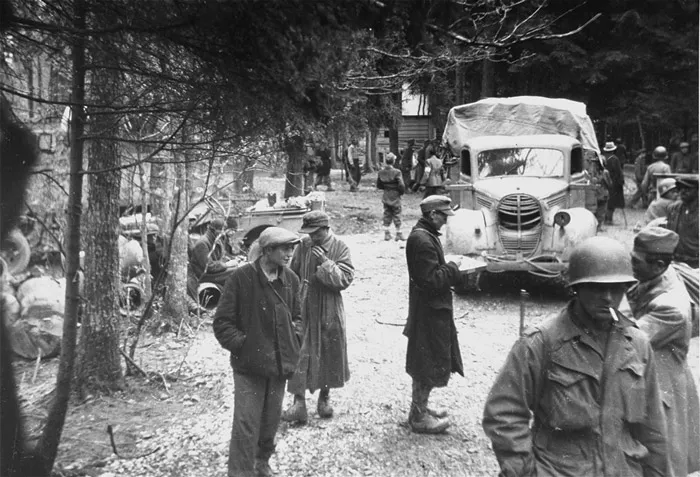
Through this history, we also measure the courage of the liberators. These soldiers were not historians or judges; they were young men torn from their homes and sent to distant fronts. Yet, in that moment of limbo, their humanity triumphed over war. Offering water, sharing a portion of food, placing a reassuring hand on a trembling shoulder: these simple gestures became acts of heroism. For them, fighting was no longer a fight with weapons, but with compassion. Gunskirchen showed them that military victory meant nothing unless accompanied by a moral victory.
Ultimately, Gunskirchen speaks to us of a future that must be built. Every time a student learns the name of this camp, every time a visitor stops before the memorial stele, a fragment of human dignity is preserved. The memory of the deportees, their whispered gratitude , their will to bear witness despite suffering, passes through the decades, reminding us of our responsibility: to never forget. Because to forget would mean betraying not only the dead but also the survivors who, with a whispered “Danke,” entrusted us with their memories.
Để lại một bình luận