
France, 1942 – Under the barn floor
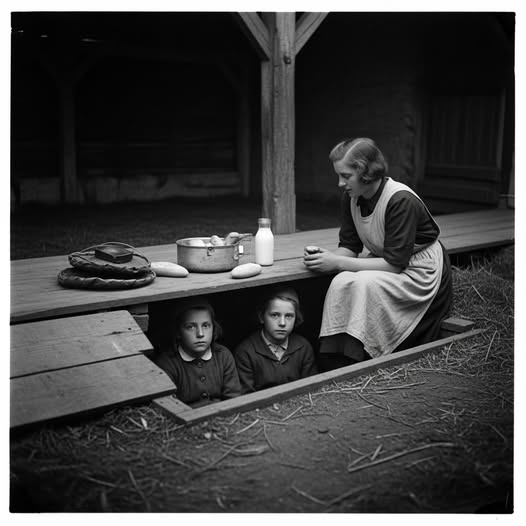
The November wind blew across the Rhône plains like a sigh from another world. In the small village of Saint-Andéol, an hour from Lyon, the war had taken the form of silence. The men had left, the houses seemed to hold their breath, and the rumors of the German occupation drifted from window to window, like shadows no one dared name.
On the Morel farm, on the edge of the village, life clung to its routine. Every morning, fourteen-year-old Marguerite milked the cows, collected the eggs, and then helped her father repair the fences. Yet, for the past few weeks, something had changed. Her father’s gaze had become more serious, more evasive. And under the old barn floorboards, where the rusty tools used to be stored, two children waited, motionless, like shadowy statues.
Their names were Jakob and Ruth. They had come from Paris, having fled the Vel’ d’Hiv Roundup. Their mother had told them, her voice trembling, “Go with this man. He will protect you.” This man was Father Morel—a farmer whom no one would have suspected of belonging to the French Resistance . Yet, fear was there, lurking behind every glance, every word exchanged at the market. Helping one Jewish child meant risking deportation. Helping two meant signing one’s own death warrant.
Marguerite remembered the day her father had first lifted the planks. The smell of damp hay, the creaking of the wood, Jakob’s short breaths—it all remained etched in her memory.
“You won’t say a word,” her father had whispered. “Not to your mother, not to the priest, not to anyone. It will be our secret.”
Since then, every night she would tiptoe down to the barn, a kerosene lamp in hand. Under the floorboards, two pairs of eyes awaited her. She gave them bread, milk, sometimes a little hot soup. And when she saw Ruth shivering, she would slip her own shawl over her, without a word.
She had never seen fear so close. The fear that doesn’t scream, the fear that hides beneath the silence.
One evening, as the wind rattled the shutters, Jakob asked her in a low voice:
“Why are you helping us?”
Marguerite hesitated, then simply replied:
“Because you could be my brother.”
She never forgot those words.
Months passed. Snow fell, shrouding the roads in silence. German soldiers often came to the village. They were searching for fugitives, resistance fighters, Jewish families. The Morels knew they couldn’t hide the children forever. But where could they send them? The Resistance network promised evacuation, but the roads were under surveillance, the trains searched, and the forests teeming with patrols.
One December night, there was a knock at the door. Three short knocks. Father Morel froze. It was the agreed-upon signal. He opened the door.
A man in a dark coat entered, soaked by the rain.
“The Germans are searching the farms tomorrow morning,” he said in a low voice. “We have to leave tonight.”
Marguerite felt her heart pound in her temples. Leave? Into the cold, into the night?
She ran toward the barn. Jakob was asleep, his head resting on his sister’s arm. She shook them gently.
“Get up. We have to go.”
They asked no questions. The children knew, instinctively, that asking a question was a waste of time.
In the driving rain, they advanced across the fields, guided by the faint glow of a lantern. The wind lashed their faces, and mud clung to their boots. Marguerite held Ruth’s hand, feeling her icy fingers. Jakob walked behind, clutching a small piece of bread—his treasure.
When they reached the edge of the woods, the man stopped.
“They will continue with me to the river,” he said to Morel. “From there, another will pick them up.”
The goodbyes were silent. No tears, no hugs. Only glances.
Marguerite wanted to say something, but no words came. So she did what she knew best: she softly sang them the song her mother used to hum to her every night.
“Sleep, little angel, the night is watching over you…”
Jakob turned around one last time, raised his hand, then disappeared into the forest.
The Germans arrived at dawn. Boots clattered on the frozen ground, voices barked orders. Marguerite, motionless, clutched her apron. An officer entered the barn, inspected the hay, and stamped his foot on the floor. The noise resounded like thunder in her chest.
“Nothing here,” he finally said.
When they left, the young girl collapsed. The floor was empty. And for the first time in weeks, she felt both the relief and the pain of emptiness.
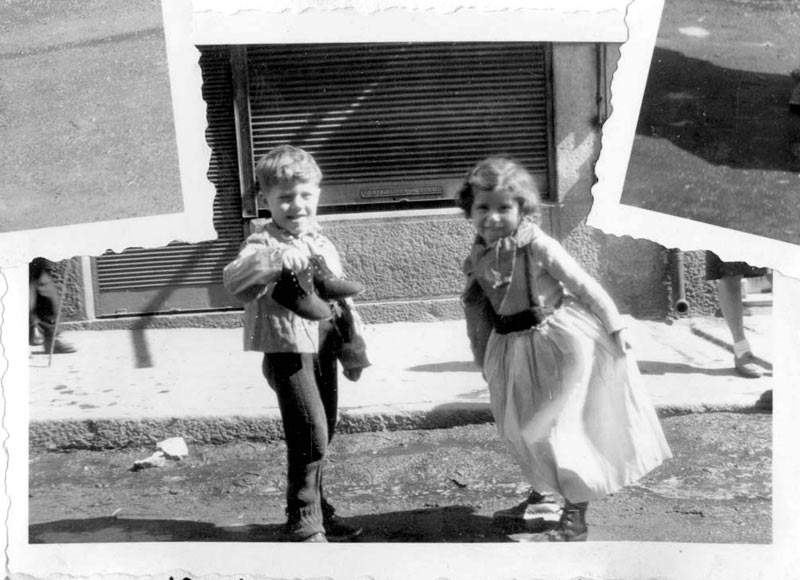
Years passed. The Second World War ended. The village regained its bells, its laughter, its light. But in Marguerite’s heart, a space remained suspended — that of the hollow floor, that of the faces that had disappeared into the night.
One autumn morning, while she was helping her father stack the hay bales, the postman stopped in front of the farmhouse. He handed her a letter.
The handwriting was clumsy, childlike.
“Marguerite Morel, Saint-Andéol, France.”
She opened it. Inside, a yellowed sheet of paper.
“Dear Marguerite,
We are alive. We were welcomed to Switzerland. We grew up, we studied. We think of you every day. You not only saved our lives—you taught us that kindness can be stronger than fear.
Jakob and Ruth.”
She read those words again and again, her fingers trembling. Then she went down to the barn and gently lifted the trapdoor. The wood had aged, but the smell of hay hadn’t changed.
She closed her eyes and whispered:
“It’s over, my little ones. You are free now.”
Even today, on some farms in France, visitors are shown the old trapdoors, the secret floors, the dark cellars where families hid lives. Every crack, every plank tells a story of courage, fear, and humanity.
The story of Marguerite Morel has become one of those tales passed down in hushed tones, by the fireside, like a whisper of memory. For in a world where hatred had sought to erase everything, a teenage girl had simply chosen to love.
And perhaps that is the greatest victory of the French resistance — the one that history books sometimes forget to name: the resistance of the heart.
Note: Some content was generated using AI tools (ChatGPT) and edited by the author for creative reasons and suitability for historical illustration purposes.
Để lại một bình luận