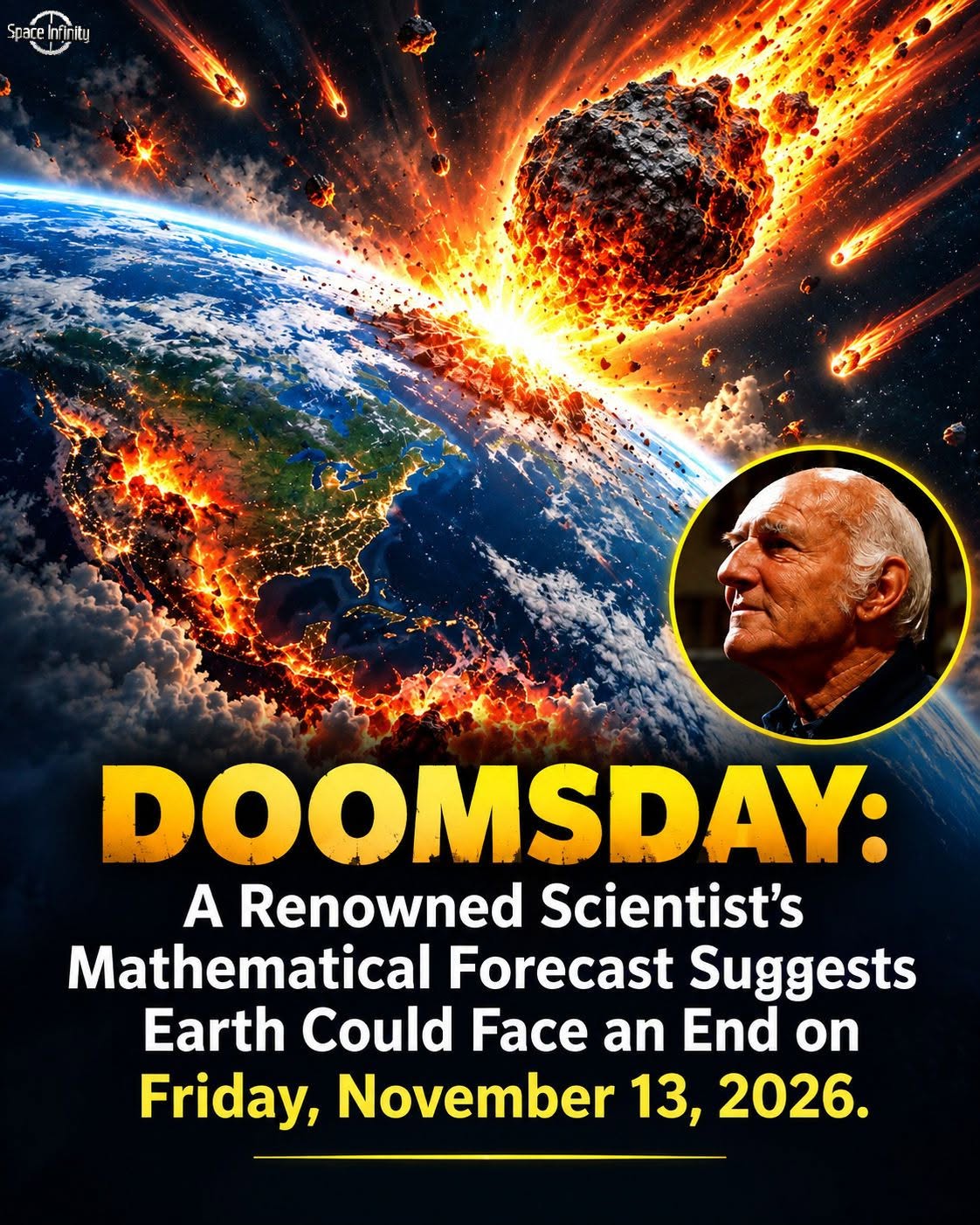
DOOMSDAY 2026? Could the World Really End on November 13?
November 13, 2026. A Friday. A date that sounds ordinary—until an obscure mathematical calculation from more than six decades ago suddenly puts it in the spotlight.
According to a famous 1960 population-growth model developed by Heinz von Foerster and his colleagues, humanity was mathematically heading toward a startling “singularity” on November 13, 2026.
The date has since inspired a wave of online speculation: Could this really be the day the world ends? Could a calculation made in the early days of modern computing somehow have seen something that scientists today have missed?
The short answer is reassuring: there is no credible scientific evidence that Earth will end on November 13, 2026.
But the story behind the date is far more fascinating than the headline suggests.
The original calculation was not a conventional prophecy. It was an extrapolation of population-growth trends available in the mid-20th century. And the closer we get to the famous date, the more interesting the comparison becomes—because the real world did something the simple mathematical curve did not anticipate.
Humanity changed.
Birth rates changed. Families became smaller. Countries experienced demographic transitions. Population growth slowed dramatically in many parts of the world.
And that is exactly why the strange “Doomsday 2026” calculation remains worth examining.
The Mathematical Prediction That Created the 2026 Date
In 1960, Heinz von Foerster and colleagues published a provocative paper in Science examining the mathematics of human population growth.
The model treated population growth as a rapidly accelerating process. If the historical trend were extended indefinitely using that mathematical framework, the curve would eventually approach an extreme point—a mathematical singularity.
That extrapolation produced a remarkable date:
November 13, 2026.
The date was later nicknamed a “doomsday” prediction because the mathematical curve effectively suggested that population would become infinitely large at that point.
But there is an important distinction that is frequently lost in social-media posts.
The model did not demonstrate that the Earth would literally explode, that humanity would disappear, or that some supernatural event would occur on November 13.
It was a mathematical extrapolation.
The calculation essentially asked: What happens if a particular pattern of population growth continues far beyond the period in which it was observed?
The answer was mathematically dramatic.
Reality, however, is much more complicated.
What Is a Mathematical Singularity?
The word “singularity” can sound terrifying because it is often associated with black holes, artificial intelligence, or the hypothetical end of civilization.
In mathematics, however, a singularity can simply describe a point where a mathematical function behaves in an extreme or undefined way.
In von Foerster’s population model, the idea was that population growth could become so rapid that the mathematical curve would approach an effectively infinite value at a finite point in time.
That doesn’t mean the researchers had discovered a mechanism capable of producing an infinite number of human beings.
Instead, the singularity exposed a problem with extending a growth curve indefinitely.
A mathematical model can describe historical behavior extremely well while still failing to predict the distant future.
That distinction is crucial.
Why the 1960 Calculation Looks So Different Today
The world of 1960 was dramatically different from the world of 2026.
Global population was much smaller. Fertility rates were substantially higher in many countries. Medical advances were rapidly reducing mortality, while many societies had not yet experienced the demographic transition that would later produce smaller families.
The mathematical model was therefore working with a historical environment in which rapid population growth appeared to be a powerful and persistent trend.
But population growth isn’t governed by one simple equation.
It depends on fertility, mortality, migration, economic development, education, healthcare, urbanization, family planning and changing social expectations.
As those factors changed, the curve changed.
And that is one of the most important lessons hidden inside the famous November 13 date.
The Population Curve Didn’t Follow the Old Script
Modern demographic data paint a very different picture from the runaway-growth scenario implied by the old extrapolation.
According to the United Nations’ World Population Prospects 2024, the global population was about 8.2 billion in 2024. The UN now projects that world population will continue growing for another 50 to 60 years before reaching a peak of approximately 10.3 billion in the mid-2080s. After that, the population is projected to gradually decline to around 10.2 billion by 2100.
That is almost the opposite of an approaching mathematical infinity.
The UN also reports that the global fertility rate has fallen substantially, from about 3.3 births per woman in 1990 to approximately 2.3 in 2024. More than half of countries and areas now have fertility below the roughly 2.1 births per woman replacement-level benchmark.
In other words, the demographic system has changed.
The assumptions behind the old extrapolation no longer describe the world particularly well.
So Why Does November 13, 2026 Keep Going Viral?
Part of the fascination is the date itself.
Friday, November 13, 2026 has all the ingredients of a perfect internet mystery.
There is an old scientific paper.
There is a precise date.
There is a mathematical “singularity.”
And there is the cultural superstition surrounding Friday the 13th.
Combine those elements and it becomes extremely easy to transform an obscure demographic model into a dramatic headline:
“Scientists Predicted the End of the World for November 13, 2026.”
But that wording is misleading.
The original mathematical work is far more interesting than the viral version.
It demonstrates how dangerous it can be to assume that a trend observed over one period will continue indefinitely.
The Biggest Problem With Doomsday Predictions
There is a recurring pattern throughout the history of future predictions.
A model identifies a trend.
The trend is extended into the future.
The resulting curve produces a dramatic outcome.
Then the mathematical result is interpreted as though the future were predetermined.
But human societies don’t behave like simple mechanical systems.
When conditions change, people respond.
Families make different choices. Governments introduce policies. Technology changes productivity. Medicine changes mortality. Economic development affects fertility. Migration changes population distributions.
And those changes feed back into the system being modeled.
That means demographic projections must constantly be updated.
The United Nations itself emphasizes that the global demographic landscape has changed considerably, with fertility declining in many regions and population growth slowing in others.
The lesson is not that mathematical models are useless.
It is that models are tools for understanding possibilities—not crystal balls that reveal a fixed future.
What Happens on November 13, 2026?
As the date approaches, the obvious question remains:
What should people expect to happen?
Based on current scientific evidence, there is no reason to expect an apocalypse on that day.
There is no established scientific mechanism connecting November 13, 2026, to the destruction of Earth.
There is also no credible demographic projection from the United Nations suggesting that humanity will suddenly reach an infinite population on that date.
Instead, the latest mainstream demographic projections describe a much slower process: continued global population growth, a peak later this century, and gradual decline afterward.
That doesn’t mean humanity has nothing to worry about.
Population change creates serious challenges involving housing, healthcare, retirement systems, food production, employment, infrastructure, energy consumption and resource management.
But those are long-term policy and economic questions—not evidence of a scheduled doomsday.
The Real Surprise: Humanity Changed the Equation
Perhaps the most fascinating part of this story is not whether the 2026 date comes true.
It is what happened between 1960 and today.
The model assumed a continuation of a particular growth pattern.
Human civilization changed the conditions behind that pattern.
Fertility declined.
Mortality changed.
Families became smaller.
Population growth slowed.
And demographic transitions occurred at different speeds across different countries.
The United Nations now expects the global population to peak at around 10.3 billion in the mid-2080s, with an estimated 80% probability that the population peak will occur somewhere within the current century.
That is an extraordinary contrast with the idea of an imminent mathematical infinity.
Could Another “Doomsday” Model Be Wrong Too?
This is where the story becomes relevant beyond population.
Modern society relies heavily on forecasts.
Economists forecast markets.
Scientists model climate systems.
Engineers model infrastructure.
Technology companies forecast artificial intelligence development.
Financial institutions model economic risk.
Governments create demographic projections.
These models are incredibly useful—but every model depends on assumptions.
Change the assumptions, and the future changes.
That doesn’t make forecasting meaningless.
It makes understanding uncertainty essential.
The history of the November 13, 2026 calculation is therefore less a story about the end of civilization and more a lesson in how predictions work.
A mathematical equation can produce a precise date.
But precision is not the same thing as certainty.
The Date Is Real. The Apocalypse Isn’t Supported.
There is a fascinating irony at the heart of the entire story.
The date November 13, 2026 really does come from a mathematical population-growth extrapolation associated with von Foerster’s 1960 work.
The date isn’t simply an internet invention.
But the interpretation that this means the world will actually end is another matter entirely.
The original model was based on a historical growth pattern and its extreme mathematical extrapolation. It was never a scientifically established timetable for Earth’s destruction.
Modern demographic evidence has moved dramatically away from that scenario.
The latest UN projections point toward a global population peak decades later—not an infinite population in 2026.
What the “Doomsday 2026” Story Really Teaches Us
Perhaps November 13 should not be viewed as a countdown to destruction.
Instead, it can be viewed as a fascinating reminder of one of the most important principles in science:
The future is not obligated to follow the past.
A trend can accelerate.
It can slow down.
It can reverse.
And sometimes the biggest variable in the equation is human behavior itself.
The 1960 model captured something important about the power of exponential and accelerating growth. But it could not fully anticipate the demographic transformations that would reshape the world.
That is why the date remains fascinating without being frightening.
Final Verdict: Is the World Ending on November 13, 2026?
No credible scientific evidence indicates that the world will end on November 13, 2026.
The date comes from a historical mathematical model of population growth—not from an astronomical prediction, a geological forecast, or a confirmed physical threat.
Modern population projections are substantially different. The United Nations expects global population to rise from about 8.2 billion in 2024 to roughly 10.3 billion around the mid-2080s before gradually declining.
So when Friday, November 13, 2026 arrives, the most likely “mystery” will not be the end of civilization.
It will be the survival of a six-decade-old mathematical curiosity that continues to capture the imagination of the internet.
And perhaps that is the real warning hidden inside the story.
Not that the world is going to end—but that humanity should never confuse a mathematical extrapolation with a guaranteed future.
The most important question isn’t “Will the world end on November 13?”
It’s:
“How much can humanity change before an old prediction catches up with reality?”
Để lại một bình luận