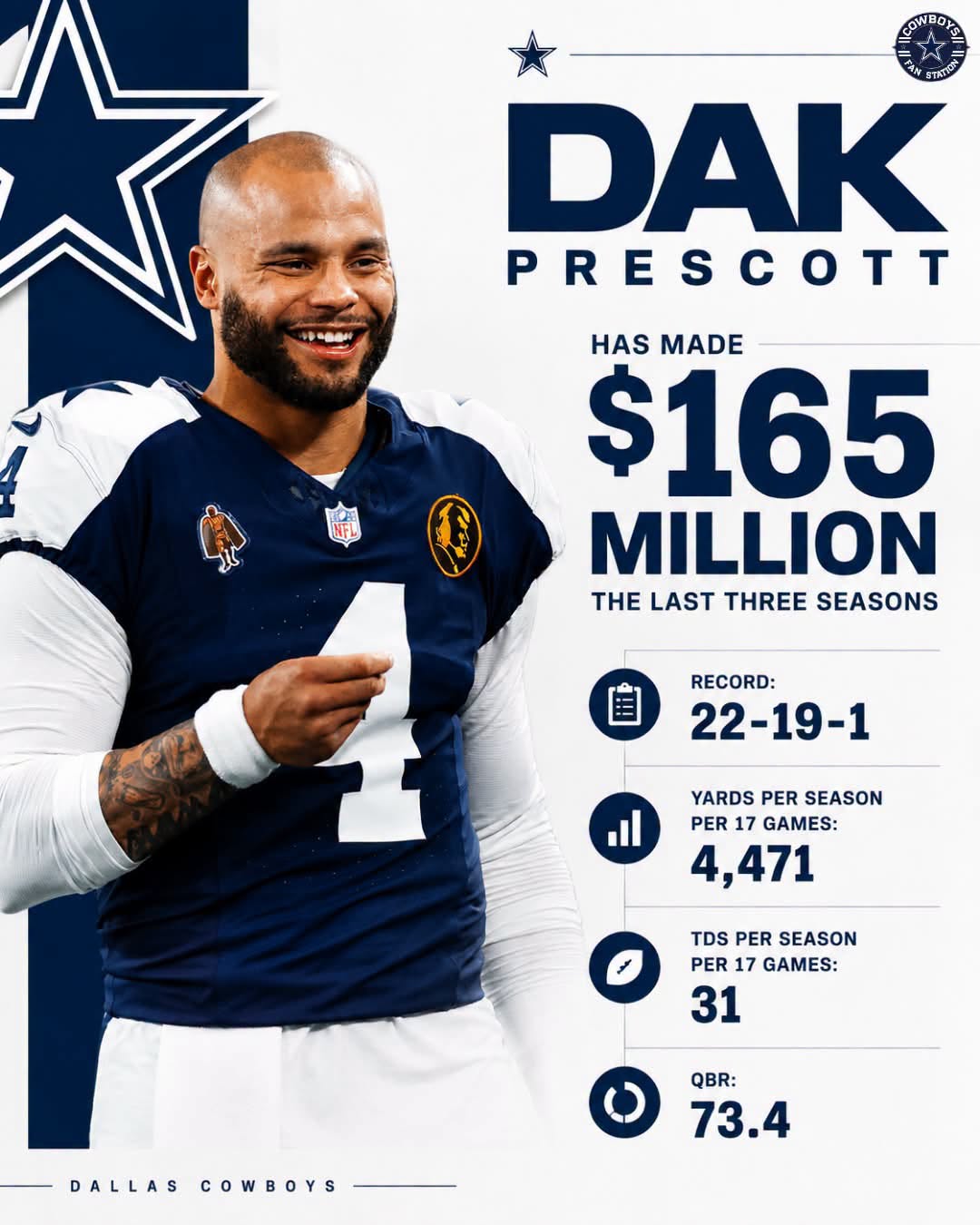
Dak Prescott has been one of the highest-paid quarterbacks in NFL history. But after hundreds of millions of dollars in contract commitments, one question continues to divide Dallas Cowboys fans: has Prescott actually delivered enough value to justify the price tag?
Money changes the conversation around an NFL quarterback.
A quarterback making $10 million per year is evaluated differently from one making $40 million. And a quarterback earning $60 million annually carries an entirely different level of expectation.
That is why the discussion surrounding Dak Prescott has never been simply about passing yards, touchdowns or completion percentage.
It is about value.
Prescott’s financial profile has become extraordinary. In September 2024, the Dallas Cowboys signed him to a four-year, $240 million extension with $231 million in guaranteed money, giving him an average annual value of $60 million and making him the highest-paid player in NFL history at the time.
But here’s where the debate gets interesting.
Has Dak Prescott produced at a level that matches his contract?
The answer isn’t nearly as simple as either side of the argument would like.
The $60 Million Quarterback Era
Prescott’s current contract tells you everything about how highly the Cowboys value him.
A $240 million deal over four seasons means an average annual value of $60 million. The contract also contains massive guaranteed money, placing Prescott among the most financially protected players in professional sports.
From a business perspective, the Cowboys made a massive commitment to their quarterback.
From a football perspective, that commitment creates pressure.
When an organization pays a quarterback $60 million per year, fans aren’t simply expecting him to be good.
They expect him to be the difference-maker.
They expect playoff victories.
They expect the quarterback to elevate the roster when the game becomes difficult.
And perhaps most importantly, they expect the investment to translate into postseason success.
That is the difficult standard Prescott has been asked to meet.
The Numbers Make the Debate Complicated
If the argument is based purely on regular-season production, Prescott has a strong case.
The Cowboys’ official statistics show that Prescott finished the 2023 season with 4,516 passing yards, 36 touchdowns and only nine interceptions, while posting a 105.9 passer rating.
That wasn’t merely a good season.
It was one of the best statistical seasons of his career.
Prescott completed 69.5% of his passes and helped Dallas finish the regular season with a 12-5 record. His performance was strong enough to put him into the MVP conversation.
That season is one of the biggest reasons the Cowboys felt comfortable making an enormous financial commitment.
Then came 2024.
Prescott appeared in only eight games after suffering a hamstring injury, finishing the season with 1,978 passing yards, 11 touchdowns and eight interceptions.
That created an uncomfortable reality.
The Cowboys had committed elite-level quarterback money to a player who had just experienced a significant injury and whose team had enormous expectations.
But the story didn’t end there.
Dak Prescott Came Back With Another Big Statistical Season
Prescott’s 2025 season changed the conversation again.
According to the Cowboys’ official statistics, he played all 17 games and finished with 4,552 passing yards, 30 touchdowns and 10 interceptions, while completing 67.3% of his passes and recording a 99.5 passer rating.
Those numbers matter.
A quarterback throwing for more than 4,500 yards in a season is producing at a very high level.
Thirty touchdown passes also demonstrate that Prescott remains capable of operating a high-volume NFL offense.
But once again, statistics only tell part of the story.
Because the real question isn’t:
“Is Dak Prescott a good quarterback?”
It is:
“Is Dak Prescott good enough to justify being paid like the most valuable quarterback in football?”
That is a much harder question.
The Real Cost of an NFL Quarterback
Quarterback contracts are not simply about salary.
They are about opportunity cost.
When a team commits tens of millions of dollars annually to one player, that money affects virtually every other roster decision.
The Cowboys have to consider how Prescott’s contract affects their ability to retain defensive stars, offensive linemen, wide receivers and other core players.
This is why NFL salary cap management has become almost as important as player evaluation.
A quarterback can produce excellent statistics and still create a difficult roster-building problem if his contract consumes too much of the salary cap.
Prescott’s current contract demonstrates exactly how complicated that equation can become.
Over The Cap lists his 2024 cash due at more than $52 million, followed by approximately $47.75 million in 2025 and $40 million in 2026. The site also lists significant future cap numbers later in the contract.
In other words, the Cowboys aren’t simply paying for what Prescott has already accomplished.
They are investing heavily in what they believe he can accomplish next.
The Argument For Dak
There is a legitimate argument that Prescott has earned his contract.
First, he has been remarkably productive throughout his career.
Through the 2025 season, Prescott had accumulated 35,989 passing yards, 243 touchdown passes and 92 interceptions, according to the Cowboys’ official statistics.
Those are franchise-quarterback numbers.
Second, Prescott has demonstrated that he can produce at an elite level when healthy.
His 2023 campaign remains the clearest example.
A quarterback who throws for 4,516 yards and 36 touchdowns while completing nearly 70% of his passes is difficult to replace.
Third, quarterback scarcity matters.
There are only a limited number of players capable of consistently producing at a high level in the NFL.
The alternative to paying Prescott isn’t necessarily finding another elite quarterback for half the price.
It could mean spending years searching for one.
And that is a risk NFL teams understand very well.
But Then Comes the Playoff Question
This is where the conversation becomes uncomfortable for Prescott supporters.
NFL quarterbacks are ultimately judged by winning.
Regular-season statistics matter.
Contract value matters.
Fantasy football production matters.
But championships matter more.
The Cowboys have not won a Super Bowl during Prescott’s career, and that reality inevitably affects how his contract is viewed.
It is possible for a quarterback to be statistically excellent and still leave fans wondering whether he can take the team through the most difficult games of the season.
That doesn’t mean Prescott is solely responsible for every playoff loss.
Football is the ultimate team sport.
The offensive line, defense, coaching staff, special teams and front office all influence postseason results.
But when a quarterback is paid $60 million per year, the expectation is that he will have an outsized impact when everything is on the line.
That’s the burden of being one of the NFL’s highest-paid players.
Was the Contract a Mistake?
Calling Prescott’s contract a mistake would be premature.
The Cowboys didn’t sign him because they believed he was an average quarterback.
They signed him because they believed he was indispensable.
In fact, Cowboys owner Jerry Jones later explained that Prescott was considered indispensable when discussing the organization’s major quarterback investment.
That word is important.
Indispensable.
It means the Cowboys believed losing Prescott would hurt more than paying him.
And that is ultimately the logic behind massive quarterback contracts.
The team isn’t trying to prove that $60 million is objectively cheap.
It is betting that keeping a proven starting quarterback is worth more than entering an uncertain quarterback market.
The Financial Reality Is Bigger Than One Number
The headline figure of $165 million is certainly eye-catching.
It immediately creates the kind of debate that drives NFL audiences:
How much is too much for a quarterback?
But sophisticated contract analysis requires looking beyond one number.
NFL contracts contain signing bonuses, guaranteed salaries, roster bonuses, restructures, incentives and salary-cap charges.
The amount a player earns in cash during a particular period can differ significantly from the salary-cap figure assigned to that season.
That is why contract databases such as Over The Cap track cash flow and cap accounting separately.
For fans, however, the larger point remains the same:
Dak Prescott is operating under one of the most expensive quarterback contracts in professional football.
And every season under that contract will be measured against that reality.
The 2025 Season Gives Cowboys Fans Something to Watch
Prescott’s 2025 production provides an important reason for optimism.
He returned to a full 17-game workload and produced more than 4,500 passing yards with 30 touchdown passes.
That suggests the 2024 injury did not permanently erase his ability to operate at a high level.
But the next step is obvious.
Can that production become postseason success?
That is where Prescott’s legacy will increasingly be determined.
A 4,500-yard season looks impressive on a stat sheet.
A deep playoff run changes the perception of an entire career.
And a Super Bowl appearance can completely transform the conversation surrounding a quarterback’s contract.
The Cowboys Are Betting on More Than Statistics
The Dallas Cowboys are one of the NFL’s most valuable sports franchises.
Every major decision is therefore both a football decision and a business decision.
Quarterback contracts influence ticket sales, merchandise, television exposure, sponsorship opportunities and long-term roster planning.
Prescott’s presence gives Dallas a recognizable franchise quarterback and a player capable of producing elite regular-season numbers.
But the financial pressure will continue to rise.
Every additional dollar invested in Prescott creates another question:
What could the Cowboys have built with that money elsewhere?
That is the hidden part of quarterback economics.
It isn’t simply about whether Prescott deserves $60 million.
It is about whether the Cowboys can construct a championship roster while paying him $60 million.
So, Has Dak Prescott Lived Up to the Contract?
There are two very different answers.
Statistically?
There is a strong argument that he has.
Prescott has produced multiple 4,500-yard seasons, has thrown for hundreds of touchdowns over his career and has demonstrated that he can perform at an elite level when healthy.
From a championship perspective?
The argument is much harder.
The Cowboys’ ultimate objective isn’t to lead the NFL in passing statistics.
It’s to win the Super Bowl.
And until Prescott leads Dallas deep into the postseason, critics will continue to question whether the financial investment has generated enough return.
That doesn’t make him a failure.
It simply means his contract has raised the standard.
The Next Chapter Could Decide Everything
The fascinating part of the Dak Prescott debate is that the verdict isn’t finished.
His career is still being written.
His 2025 statistical rebound gives Cowboys fans a reason to believe that another elite season is possible. At the same time, the financial commitment means every future playoff game will carry even greater significance.
The longer Prescott remains productive, the easier it becomes for Dallas to justify the contract.
The deeper the Cowboys go in the postseason, the stronger that argument becomes.
And if Dallas eventually wins a Super Bowl with Prescott leading the offense, today’s $60 million debate could suddenly look very different.
But if the Cowboys continue producing impressive regular-season numbers without postseason breakthroughs, the questions will only become louder.
Was the money worth it?
Could Dallas have built a better roster with a cheaper quarterback?
And will Dak Prescott ultimately be remembered as the quarterback who justified the biggest investment in Cowboys history—or the player who never quite delivered the championship everyone expected?
Those questions make Prescott’s contract one of the most fascinating financial stories in the NFL.
Because when a quarterback is paid at the very top of the market, every touchdown, every interception, every playoff game—and every dollar—becomes part of the evaluation.
Để lại một bình luận