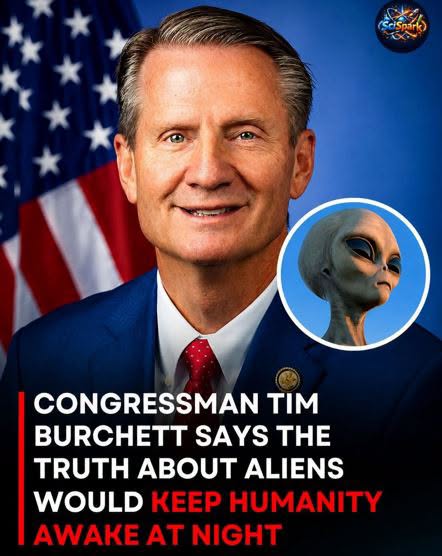
Congressman Tim Burchett Says Full Truth About UFOs Could Be Too Much for the Public, Renewing Disclosure Debate
Washington, D.C. — Renewed comments from U.S. Congressman Tim Burchett regarding unidentified aerial phenomena (UAP) and the possibility of non-human intelligence have once again fueled public debate over government transparency and the long-standing mystery surrounding UFO investigations.

Speaking during recent interviews and public appearances, Burchett suggested that if the American public were to learn everything the government allegedly knows about unidentified aerial phenomena, the information could be deeply unsettling. While he did not present classified evidence to support his remarks, the Tennessee congressman reiterated his belief that greater transparency is needed and that decades of secrecy have contributed to growing public distrust.
“The truth,” Burchett has said in various interviews, “may be difficult for many people to accept.” His comments have been widely interpreted by supporters as another indication that information regarding unexplained aerial encounters may exist beyond what has been publicly released.
Burchett has become one of the most outspoken members of Congress advocating for increased oversight of government UAP programs. Over the past several years, he has repeatedly called for classified records to be declassified whenever possible and has urged military and intelligence agencies to cooperate more fully with congressional investigations.
His latest remarks quickly spread across social media, where headlines claiming that “the truth about aliens would keep humanity awake at night” generated millions of views. While the phrase has captured public imagination, experts caution that such statements should not be interpreted as confirmation of extraterrestrial life. Rather, they reflect Burchett’s personal opinion regarding the potential significance of information that may remain classified.
Interest in unidentified aerial phenomena has grown dramatically since several high-profile congressional hearings examined reports from military pilots who encountered objects displaying unusual flight characteristics. These hearings prompted lawmakers from both major political parties to demand greater accountability and standardized reporting procedures for unexplained aerial incidents.
Government agencies have acknowledged that some military encounters remain unexplained after initial analysis. However, officials have also emphasized that an unresolved case does not necessarily indicate extraterrestrial technology. In many instances, investigators lack sufficient sensor data, witness information, or environmental evidence to determine a definitive explanation.
Scientists studying the possibility of extraterrestrial life also encourage caution when evaluating public statements from political figures. While many researchers agree that intelligent life may exist elsewhere in the universe given the enormous number of stars and potentially habitable planets, no verified scientific evidence has yet demonstrated that Earth has been visited by extraterrestrial civilizations.
Political analysts note that Burchett’s comments reflect a broader shift in Washington’s approach to unidentified aerial phenomena. Unlike previous decades, when UFO reports were often dismissed outright, lawmakers today increasingly view unexplained aerial incidents as matters of national security, regardless of their ultimate origin. Unknown objects operating near military installations or sensitive infrastructure warrant investigation because they could represent advanced foreign surveillance technology, classified domestic programs, or other unidentified aerospace systems.
Meanwhile, supporters of UFO disclosure argue that the public deserves greater access to government records concerning decades of reported sightings. They believe increased transparency would help distinguish credible incidents from misinformation, speculation, and conspiracy theories that have flourished online.
Skeptics, however, point out that extraordinary claims require extraordinary evidence. They argue that compelling testimony alone cannot establish the existence of extraterrestrial visitors without independently verifiable physical evidence, authenticated sensor data, or scientific analysis capable of withstanding peer review.
The image accompanying Burchett’s latest comments, featuring an illustration of a so-called “Gray” alien, has further amplified discussion across digital platforms. However, the illustration is symbolic and should not be interpreted as evidence supporting the congressman’s statements.
As congressional interest in unidentified aerial phenomena continues to expand, the debate surrounding government disclosure shows little sign of slowing. Whether future investigations uncover previously unknown aerospace technologies, additional classified programs, or entirely conventional explanations, lawmakers from both parties appear committed to seeking greater transparency.
For now, Congressman Tim Burchett’s remarks remain part of an ongoing political conversation rather than confirmation of extraterrestrial life. His statements underscore growing public interest in the UFO mystery while also highlighting an important distinction: curiosity and unanswered questions are not the same as verified evidence. Until new information is independently confirmed through official investigations and scientific scrutiny, the mystery surrounding unidentified aerial phenomena remains unresolved.
Để lại một bình luận