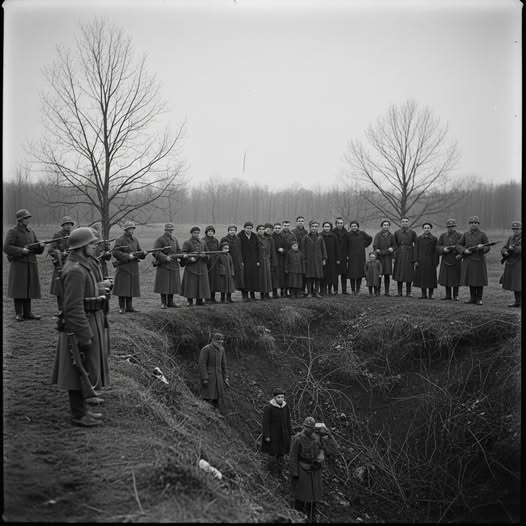
Babyn Yar — The Ravine of Shadows

Kyiv, September 1941.
Autumn had barely arrived when the city, besieged by German troops, already seemed to have lost its breath. The icy wind swept through the deserted streets, stirring up dust mixed with ash. On the outskirts, a ravine stretched out, deep and silent, like an open scar in the earth: Babyn Yar . Few yet knew that this place would become the scene of one of the greatest massacres of the Holocaust , an open-air tragedy that would forever haunt the memory of the world.
On September 29 and 30, 1941, in the space of just 48 hours, more than 33,000 Jews were murdered here, on the edge of this gloomy ravine. Men, women, children, the elderly: none escaped the murderous frenzy of the Einsatzgruppen , the Nazi mobile killing units, aided by Ukrainian collaborators and local police. Their bodies were thrown into mass graves, buried beneath the cold earth of Babyn Yar.
This tragedy, both horrific and methodical, marked a crucial step in the implementation of the Nazi genocide . Before the gas chambers of Auschwitz or Treblinka became the symbol of the Holocaust, there was here, in Kiev, the Shoah by bullets — the systematic murder at point-blank range, under the open sky, in the mud, in fear.
It all began a few days after the German troops occupied Kyiv. A series of explosions destroyed several Wehrmacht administrative buildings. The Nazis, in their logic of collective reprisals, immediately blamed the city’s Jews. The order was given: all Jews in Kyiv were to report on September 29th to the intersection of Melnikova and Dokterivska streets, carrying their identity papers, valuables, and warm clothing.
The posters promised a simple “transfer.” Some believed it; others understood. But many had no choice. They came, pushing carts, carrying their children, hoping to be deported to a ghetto or a labor camp. No one could imagine that, beyond the hill, the Babyn Yar ravine already awaited them like an open mouth leading to death.

The survivors recounted the scene. As the line moved forward, German soldiers ordered people to drop their suitcases, undress, and take off their shoes. Children’s cries mingled with the barking of dogs. Rifle butts swung through the air. Then, guided by SS officers, the prisoners were led to the edge of the ravine, lined up, and shot in the back of the neck. The bodies fell one on top of the other, forming layers of flesh and blood. A burst of gunfire, silence, another burst. The process repeated itself endlessly.
By the end of the second day, the Babyn Yar ravine was full .
The Einsatzgruppen , particularly Sonderkommando 4a led by Paul Blobel, recorded everything in their reports: “33,771 Jews executed.” These cold, bureaucratic words reveal nothing of the horror experienced. Not a word about the tears, the pleas, the songs of mothers clutching their children before the fatal blow. The absolute inhumanity was summed up in four figures.
For a long time, the Babyn Yar massacre was a secret. After the war, the Soviet authorities refused to admit that it was a crime against Jews. The ravine was filled in, the memory buried under concrete. No monument, no cross, no star. There was vague talk of a “massacre of Soviet citizens.” The story was silenced for decades.
This silence was a second death.
It was only in the 1960s, thanks to the courage of survivors, artists, and intellectuals, that the truth began to emerge. The poet Yevgeny Yevtushenko , in his poem Babyn Yar (1961), dared to write:
“There is no monument at Babyn Yar,
the ravine is a grave without a cross,
and fear grips me.”
His verses, set to music by Dmitri Shostakovich in his Symphony No. 13, broke the Soviet silence and gave voice back to the dead. Thanks to them, Babyn Yar finally became the symbol he deserved to be: that of violated Jewish memory , of denial, and of the duty to remember.
But Babyn Yar did not know peace. After the massacre of the Jews, the ravine was used again. Roma , Soviet prisoners of war , Ukrainian nationalists , and psychiatrists from the Kyiv hospital were executed there in turn. In total, more than 100,000 people died there between 1941 and 1943.
In 1943, as the Red Army approached, the Nazis set about destroying the evidence . Prisoners were forced to exhume the bodies and burn them on giant pyres made of rails and wood. The stench of burning flesh permeated the town. Babyn Yar thus became a crime committed twice: first against the living, then against memory.
Today, when you walk on this place, the grass has grown back. The wind blows gently through the bare trees. But if you close your eyes, you can still hear the murmur of thousands of voices. Birds avoid landing on the ground, they say. The earth remembers those it has swallowed.
In Babyn Yar, silence is louder than a cry .

A memorial was finally erected, albeit belatedly, in 1976, and later expanded after Ukraine’s independence with several monuments: a large menorah, a symbol of Judaism, and a black granite wall bearing the recovered names. Every year on September 29, survivors and their descendants gather there, laying stones and reciting the Kaddish , the prayer for the dead. Their voices tremble, but they are still there.
Because Babyn Yar is not just a place of death; it is a place of resistance. Resisting oblivion, trivialization, and indifference.
Historically, the Babyn Yar massacre illustrates the brutal transition from persecution to extermination. It was one of the first large-scale massacres of the Holocaust . In just a few days, the method was perfected: register, round up, strip, execute, and conceal. All this without gas chambers or camps. The Holocaust by bullets was born.
This method of extermination spread throughout Eastern Europe: Minsk, Riga, Kaunas, Odessa, Kamenets-Podolsk. Following the advance of the Wehrmacht, the Einsatzgruppen left behind fields of corpses, mass graves filled with innocent people. It is estimated that between 1.5 and 2 million Jews were killed in this way, in the open air.
The story of Babyn Yar confronts us with a disturbing truth: barbarity is not born in death factories, but in the hearts of men who obey. Period photographs show ordinary soldiers, not monsters. They smoke, they laugh, they pose in front of the ravine. Ideology has replaced conscience. This, perhaps, is the most frightening lesson: evil can be bureaucratic, organized, clean, “efficient.”
And yet, amidst this darkness, a few glimmers of humanity survived. Residents of Kyiv hid children, priests falsified baptismal certificates, and women opened their doors despite their fear. Their courage, often overlooked, reminds us that even in hell, light can persist.
In 2021, for the 80th anniversary of the massacre, Ukraine inaugurated the Babyn Yar Memorial Center , a museum and space for reflection. Sound installations broadcast the names of the recovered victims, one by one, in all the languages they spoke: Yiddish, Ukrainian, Russian, Polish, and German. Each name spoken is an act of justice.
For memory in Babyn Yar is not found in books; it is felt in the wind, in the earth, in the silence.
Today, as wars and hate speech resurface in Europe, the memory of Babyn Yar is more necessary than ever.
It is a mirror. It reflects back to us what we are capable of becoming when fear, propaganda, and indifference prevail. It reminds us that the Holocaust was not an inevitable event, but a human construct, built stone by stone, order by order.
And though the Babyn Yar ravine is now covered in grass and snow, it remains an abyss in our conscience. Every visit, every prayer, every line written for these 33,000 lost lives is a victory against oblivion.
Because memory is a weapon against time, and Babyn Yar, despite everything, still speaks.
Note: Some content was generated using AI tools (ChatGPT) and edited by the author for creative reasons and suitability for historical illustration purposes.
Để lại một bình luận