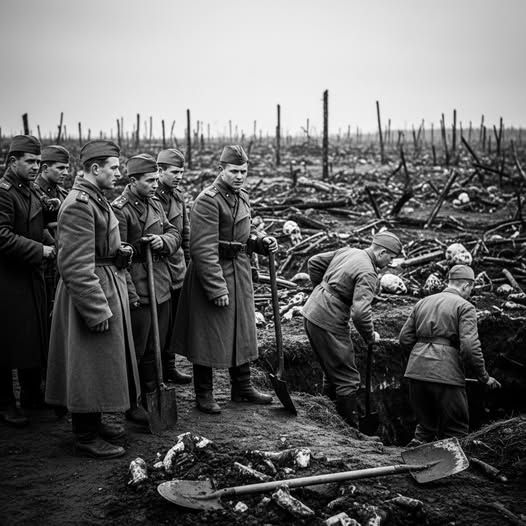
Babi Yar – The Ravine of Silence

On the outskirts of Kyiv, there is a ravine where the earth still seems to whisper. A place where the wind, even today, whistles like a muffled lament from the past. This place is called Babi Yar . For anyone who approaches it, the stark beauty of this landscape contrasts sharply with the horror it once held. It was here, in this anonymous fold of earth, that one of the darkest episodes of the Holocaust took shape.
At the end of September 1941, the Nazi army , advancing under the banner of Operation Barbarossa , had just occupied Kyiv , the Ukrainian capital. In the still-smoldering streets, posters with orders in German stood like death sentences. The inhabitants, already exhausted by the war, did not yet know that fear was about to take on a far more absolute form. On September 28, a chilling decree appeared: all Jews in Kyiv were to report the next day, with their papers, money, and valuables, to the intersection of Melnykova and Dokterivska streets. They were promised transfer to another location. In reality, it was a one-way trip to the abyss.
On September 29, 1941, at the crack of dawn, thousands of families converged on this assembly point. Mothers held their children by the hand, the elderly stumbled, some prayed in hushed tones. The air was cold, almost indifferent. They marched toward Babi Yar , surrounded by German soldiers and local collaborators. That day, 33,771 people were shot , in just two days. Two days of a hellish, methodical, implacable machine.
The victims of Babi Yar were forced to undress before being led to the edge of the ravine. Regular bursts of machine-gun fire rang out, punctuated by the sound of bodies falling into the pit. Surviving witnesses said the earth continued to tremble long afterward, as if refusing to heal its wound.
This massacre, one of the fastest and most massive of the Second World War , was a laboratory of death even before the construction of the extermination camps. Babi Yar, in its own way, foreshadowed Auschwitz, Treblinka, Sobibor — names that have become synonymous with absolute inhumanity.
But what few know is that Babi Yar didn’t stop there. The ravine became an open-air mass grave, a place of continuous execution. Roma , Soviet prisoners of war , Ukrainian political opponents , the mentally ill , and even Orthodox monks were shot there in the following years. More than 100,000 people perished in this place of silence.

And yet, after the war, the silence continued. The Soviet regime, obsessed with its own narrative of victory, long refused to acknowledge that the majority of the victims were Jewish. For decades, Babi Yar was not named for what it was: a symbol of genocide.
It was only in 1961 that a voice rose above the state silence. That of the poet Yevgeny Yevtushenko , whose poem Babi Yar began with the words: “There is no monument to Babi Yar…” These verses, of overwhelming power, awakened the forbidden memory. Shortly afterward, the composer Dmitri Shostakovich gave a universal dimension to this grief by incorporating the text into his Symphony No. 13 , aptly titled Babi Yar .
Through music and poetry, the dead found their voice again. The notes vibrated like echoes of footsteps in the ravine, the words resonated like a prayer for those they had tried to erase.
Even today, Babi Yar remains a vital place of remembrance. The Babi Yar memorial , erected in the 1970s and expanded since, pays tribute not only to the Jewish victims but also to all the other martyrs of Nazism who fell here. Walking in this park is to feel the invisible weight of history. Beneath each tree, perhaps, lies an unfinished story, a name without a grave, a prayer without an echo.
But Babi Yar doesn’t just speak of the past. It questions our present. How could hatred have fed on such coldness? How, in the turmoil of the world, can we preserve memory in the face of oblivion? Every visitor who stops here is confronted with these questions. The ravine, now a symbol, reminds us that the Holocaust is not just a chapter in history books: it is a scar on the human conscience.
The archives of the Babi Yar massacre , now open, reveal the faces, letters, and belongings of the victims. These tiny fragments recreate a humanity that bullets had sought to erase. Researchers from around the world are studying these documents, seeking to understand, but above all, to bear witness.

And in this quest for truth, the internet plays a new role: thanks to databases like those of the Kyiv Holocaust Memorial or Yad Vashem , descendants find traces, names, sometimes even photographs. Thus, the memory of Babi Yar extends beyond the ravine—it travels, it breathes, it lives.
For to remember is to refuse to let silence prevail again. It is to declare, in the face of modern indifference, that every life lost at Babi Yar still matters. The place has become, despite itself, a universal memorial : not only a Jewish memory, but a warning to all humanity.
As evening falls, and shadows lengthen on the hill, one could almost hear the voices of those who rest there. They ask neither for vengeance nor glory—only to be remembered. And in this memory, in this duty to pass on the memory, perhaps lies the greatest victory over barbarity.
Babi Yar , the ravine of silence, is no longer just a place. It is a consciousness. A promise that, as long as its name is written, sung, or read, no darkness can completely triumph.
Note: Some content was generated using AI tools (ChatGPT) and edited by the author for creative reasons and suitability for historical illustration purposes.
Để lại một bình luận