

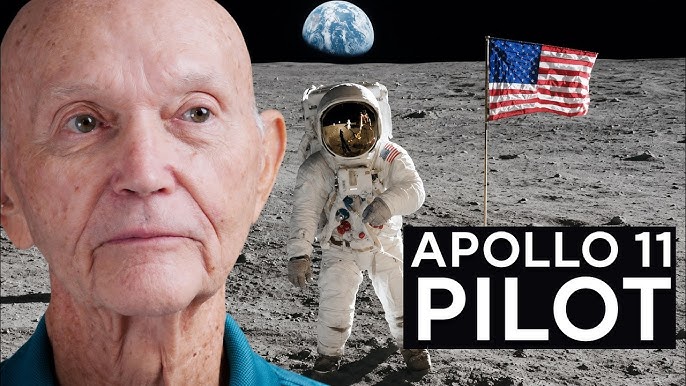
20 Secrets About The Apollo 11 Mission. The Apollo Eleven Mission stands as one of humanity’s greatest triumphs, forever etched in memory as the historic voyage that successfully transported humans to the moon. Neil Armstrong and Buzz Aldrin, courageous pioneers, cemented their names in history as the first individuals to grace the lunar surface. Amidst these celebrated figures, an often-overlooked astronaut, Michael Collins, played a crucial role in the mission. Now emerging from the shadows, Collins sheds light on the eerie enigmas encountered during the lunar expedition. Join us in this video where we dig into the mind-boggling lunar secrets revealed by Michael Collins about their lunar odysse
More than half a century after Apollo 11 changed history, the mission still contains details that can make even the most familiar Moon landing feel strangely mysterious.
On July 20, 1969, Neil Armstrong stepped onto the lunar surface and delivered one of the most famous moments in human history. Buzz Aldrin soon joined him, while Michael Collins remained alone in the command module Columbia, orbiting the Moon roughly 60 miles above the surface.
To millions watching on Earth, Apollo 11 looked like a carefully controlled triumph.
Behind the scenes, however, the mission was filled with uncertainty, technical challenges, split-second decisions and moments when failure was a very real possibility.
Michael Collins, often described as the “forgotten astronaut” of Apollo 11, had perhaps the most unusual perspective of all. While Armstrong and Aldrin explored the lunar surface, Collins was responsible for keeping Columbia alive in lunar orbit and making sure there would be a spacecraft capable of bringing the crew home.
Over the years, Collins spoke openly about the isolation, pressure and strange psychological experience of flying around the Moon alone.
Some stories surrounding Apollo 11 have since evolved into dramatic internet legends. Others are genuine pieces of mission history that are simply less well known.
Here are 20 fascinating Apollo 11 secrets, facts and mysteries that reveal just how extraordinary the first Moon landing really was.
1. Michael Collins Was Completely Alone Behind the Moon
One of the most remarkable aspects of Apollo 11 was something most television viewers never experienced.
While Armstrong and Aldrin were on the lunar surface, Collins remained in orbit aboard Columbia.
When the spacecraft passed behind the Moon, Collins temporarily lost communication with Earth.
For those minutes, he was effectively isolated from every other human being.
There was no radio conversation.
No direct contact with Mission Control.
No Armstrong.
No Aldrin.
Just Collins, Columbia, the Moon and the darkness of space.
Collins later described the experience in a way that showed how unusual it was to be the only human being completely separated from both Earth and the lunar surface.
It was one of the loneliest jobs in the history of exploration.
2. Collins Was Not Simply “Waiting” for the Others
A common misconception is that Collins merely waited for Armstrong and Aldrin to return.
In reality, his role was absolutely critical.
He had to operate Columbia, monitor systems, maintain the spacecraft’s orbit and prepare for the eventual rendezvous with the lunar module.
If something went wrong with the lunar module, Collins might have had to return to Earth alone.
If something went wrong with Columbia, there was no backup spacecraft waiting nearby.
His mission was quieter than Armstrong’s historic first step—but the consequences of failure were enormous.
3. Apollo 11 Was Never Guaranteed to Succeed
The images of Armstrong stepping onto the Moon can make the landing appear inevitable.
It wasn’t.
NASA engineers were attempting something unprecedented.
The lunar module had to navigate to the surface, slow down, avoid dangerous terrain and land with enough fuel remaining for the astronauts to survive.
During the descent, Armstrong and Aldrin encountered a serious problem.
The planned landing area contained hazards, forcing Armstrong to manually guide the lunar module toward a safer location.
The famous lunar landing therefore wasn’t simply an automated sequence unfolding perfectly.
Human judgment played a decisive role.
4. Armstrong Had to Take Manual Control
As the lunar module descended, Armstrong realized that the computer’s intended landing trajectory was taking them toward a dangerous area.
He took greater manual control and searched for a suitable landing location.
Meanwhile, the spacecraft was consuming precious fuel.
The situation became increasingly tense.
Armstrong eventually found a relatively safe location and brought the lunar module down.
That decision transformed one of the most dangerous moments of the mission into one of the greatest achievements in exploration history.
5. The Computer Was Surprisingly Limited
Modern smartphones contain vastly more computing power than the Apollo guidance computer.
Yet that relatively primitive machine helped guide humans to another world.
The Apollo Guidance Computer was engineered for reliability and specific mission tasks rather than the enormous processing capabilities associated with modern consumer technology.
Its limitations are one reason Apollo remains such an extraordinary engineering story.
NASA wasn’t simply waiting for technology to become powerful enough.
Engineers designed systems that could accomplish extraordinary things within extremely strict constraints.
6. The Famous “First Step” Was Only the Beginning
When Armstrong stepped onto the lunar surface, the world watched.
But Apollo 11 wasn’t merely a publicity event.
The astronauts had scientific objectives to complete.
They collected lunar material, deployed scientific instruments and documented the environment.
The mission helped scientists begin studying the Moon in far greater detail.
The photographs and samples returned to Earth became enormously valuable to planetary science.
The Moon was no longer simply a distant object in the night sky.
Human beings had physically interacted with it.
7. The Lunar Surface Was Stranger Than Many People Expected
The astronauts quickly discovered that the Moon wasn’t simply a gray version of Earth.
The surface was covered with extremely fine lunar dust and rocky debris.
The regolith could cling to equipment and spacesuits.
The astronauts also had to move differently because lunar gravity is only about one-sixth of Earth’s.
Their famous bouncing movements weren’t simply for television.
They were an adaptation to an entirely different gravitational environment.
8. Lunar Dust Became a Serious Problem
Lunar dust created unexpected practical difficulties.
It accumulated on spacesuits and equipment and could become abrasive.
The astronauts had to deal with it after spending time outside the lunar module.
For future lunar missions, dust remains an important engineering concern.
This seemingly ordinary substance became one of the most interesting challenges revealed by the Apollo program.
9. Armstrong and Aldrin Had Very Little Room for Error
The lunar module wasn’t a luxury vehicle.
The astronauts were operating inside an extremely compact spacecraft filled with equipment, controls, life-support systems and scientific gear.
Every kilogram mattered.
Every system had a purpose.
Every decision had consequences.
Apollo 11 demonstrates just how different space exploration was from modern travel.
There was no convenient emergency rescue service waiting on the Moon.
10. The Mission Created a Historic Psychological Moment
Apollo 11 wasn’t only an engineering achievement.
It was also a psychological experiment on an enormous scale.
For the first time, humans were seeing Earth from the vicinity of another world.
The astronauts experienced something that most people on Earth could only imagine.
The Earth appeared small against the vastness of space.
That perspective would influence how astronauts and scientists thought about humanity’s place in the universe.
11. Collins Saw Earth in a Completely Different Way
Collins later became known for describing the profound experience of seeing Earth from space.
From lunar orbit, Earth could appear as a distant, fragile world surrounded by darkness.
That image became one of the enduring emotional legacies of the Apollo era.
It also helped inspire a broader conversation about Earth’s vulnerability and the importance of protecting the planet.
12. The Moon Landing Was Watched by Hundreds of Millions
Apollo 11 became a global media phenomenon.
Millions of people stayed awake to watch the historic broadcast.
For many viewers, the grainy images from the lunar surface were their first visual experience of humans exploring another world.
The broadcast itself has become part of television history.
The technology was primitive by today’s standards, but its cultural impact was enormous.
13. Armstrong’s Famous Words Became Immortal
Armstrong’s first words after stepping onto the lunar surface became one of the most recognizable quotations in history.
The phrase has been repeated in documentaries, books, films, classrooms and museums for generations.
Yet the historical significance wasn’t simply the sentence itself.
It represented the culmination of years of engineering, political competition, scientific research and human ambition.
One sentence marked the beginning of a new chapter in exploration.
14. Apollo 11 Was the Product of Years of Risk
The mission didn’t appear out of nowhere.
It was the culmination of the broader Apollo program and years of testing.
NASA had experienced tragedy before Apollo 11.
The Apollo 1 fire in 1967 killed astronauts Gus Grissom, Ed White and Roger Chaffee during a ground test.
That disaster led to major changes in spacecraft design and safety procedures.
Apollo 11’s success therefore cannot be separated from the lessons learned through earlier failures.
15. The Astronauts Carried More Than Scientific Equipment
Apollo 11 also carried symbolic objects representing humanity and the countries involved in the mission.
The astronauts left behind commemorative items on the lunar surface.
These objects reflected the political and cultural significance of the landing.
The mission wasn’t just about science.
It represented an extraordinary moment in human history.
16. The Moon Landing Happened During an Era of Global Tension
Apollo 11 took place during the Cold War.
The United States and Soviet Union were competing for technological and geopolitical influence.
The Space Race transformed that rivalry into an extraordinary contest of engineering.
But when Armstrong and Aldrin stepped onto the Moon, the event was watched by people around the world.
For a brief moment, the achievement transcended political boundaries.
17. Some Apollo Stories Became More Mysterious With Time
As Apollo 11 became part of popular culture, stories about strange lunar observations, unexplained lights and mysterious objects began circulating.
Some accounts have been exaggerated or taken out of context.
Others are simply misunderstandings of what astronauts actually reported.
This is why separating documented Apollo history from later internet mythology is important.
The real mission is fascinating enough without inventing evidence.
18. Michael Collins Became the Mission’s Quiet Legend
Armstrong received enormous attention.
Aldrin became one of the most recognizable astronauts in history.
But Collins had a unique role.
He was the person orbiting alone while his colleagues walked on the Moon.
His experience offered a completely different perspective on Apollo 11.
Rather than standing on the lunar surface, Collins watched the world below and waited for his crewmates to return.
His story reminds us that historic achievements often depend on people who are not standing at the center of the photograph.
19. Apollo 11 Changed the Economics of Space Exploration
The mission demonstrated what enormous investments in science, engineering and infrastructure could accomplish.
The Apollo program required thousands of engineers, scientists, technicians, contractors and support personnel.
It pushed advances in computing, communications, materials science and aerospace engineering.
Many of the technologies and engineering practices developed during the Space Race influenced industries far beyond space exploration.
That makes Apollo 11 more than a historical curiosity.
It became an example of how investment in advanced technology can produce effects far beyond its original purpose.
20. The Biggest Apollo 11 Mystery Is Perhaps Humanity Itself
After decades of documentaries, books and historical analysis, the most fascinating question surrounding Apollo 11 may not involve aliens, mysterious lights or secret discoveries.
It may simply be this:
How did humans manage to accomplish something so difficult with technology that now looks primitive?
The answer lies in engineering discipline, teamwork, risk management, scientific knowledge and an extraordinary willingness to attempt something that had never been done before.
Apollo 11 wasn’t perfect.
It wasn’t risk-free.
And it certainly wasn’t magic.
It was the result of thousands of people solving thousands of difficult problems.
Did Michael Collins Really Reveal “Alien Secrets”?
This is where the internet version of the Apollo 11 story needs careful examination.
Michael Collins did discuss unusual and psychologically intense aspects of his lunar mission, particularly the experience of being alone in lunar orbit.
But claims that Collins definitively revealed extraterrestrial beings, alien spacecraft or a secret NASA discovery should not be presented as established fact without reliable primary evidence.
Many sensational Apollo stories have grown through repetition.
A mysterious claim can appear in one article, then another, and eventually be presented as though it were an official historical record.
That doesn’t make it true.
The documented Apollo record is already extraordinary.
Why Apollo 11 Still Captivates the World
More than five decades later, people continue searching for Apollo 11 secrets, Moon landing mysteries, Michael Collins stories, and NASA discoveries because the mission sits at the intersection of science, history and human curiosity.
It was a journey into an environment no human had previously explored.
The astronauts didn’t know exactly what every moment would feel like.
Engineers couldn’t eliminate every risk.
And the world could only watch as events unfolded hundreds of thousands of miles away.
That uncertainty is part of what makes Apollo 11 timeless.
The Real Legacy of Apollo 11
The greatest secret of Apollo 11 may be that there was no single secret.
There was a collection of decisions, risks, calculations, engineering breakthroughs and human experiences that came together at precisely the right moment.
Armstrong made history on the lunar surface.
Aldrin helped explore it.
And Collins ensured that the mission had a way home.
Together, the three astronauts transformed the Moon from a distant symbol into a destination humans had actually reached.
Today, as governments and private companies prepare for another era of lunar exploration, the Apollo 11 story is becoming relevant again.
The next generation of lunar missions will benefit from technologies that Apollo engineers could barely imagine.
But the fundamental challenge remains the same:
How far are humans willing to go to explore the unknown?
And perhaps that is why Apollo 11 refuses to disappear from the headlines.
The Moon landing wasn’t the end of the story.
It was the moment humanity discovered that another world was no longer completely out of reach.
The real mystery isn’t whether Apollo 11 encountered something supernatural. The real mystery is how three astronauts, backed by an extraordinary global team, managed to travel to another world and come home safely.
And after more than 50 years, that achievement may be even more astonishing than the legends that grew around it.
Để lại một bình luận