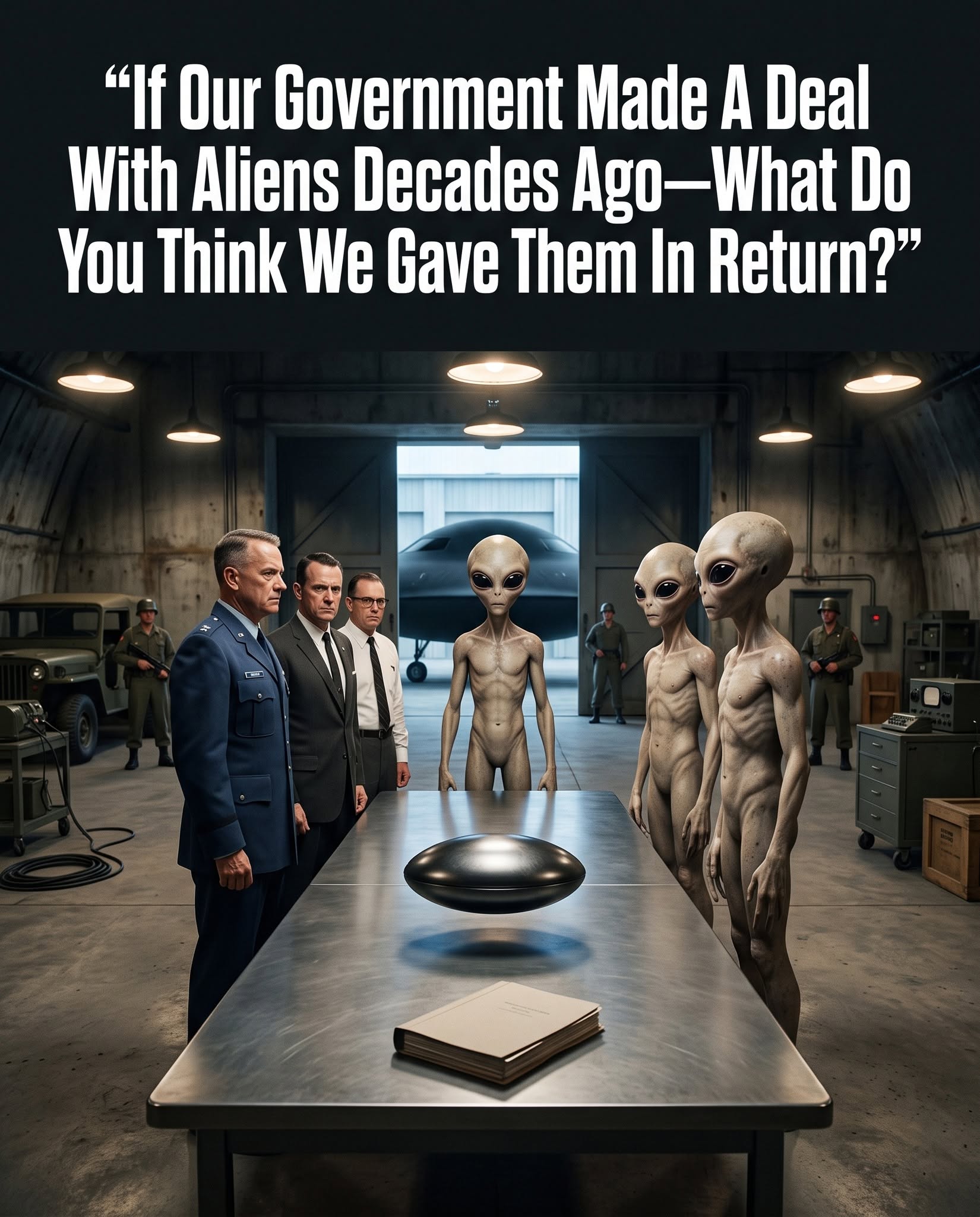
For decades, one of the most persistent questions surrounding the modern UFO phenomenon has been remarkably simple: What if some governments knew far more about unidentified objects than they were willing to tell the public?
That question has produced an extraordinary collection of stories involving secret meetings, classified UFO programs, alleged alien technology and even supposed treaties between human governments and extraterrestrial civilizations. Some versions of the story claim that officials secretly negotiated with nonhuman beings. Others go even further, alleging that advanced technology was exchanged for access, cooperation or permission to conduct activities on Earth.
The stories are dramatic.
But there is a critical distinction between a fascinating claim and an established historical fact.
There is no verified evidence that the U.S. government signed a treaty with extraterrestrial beings. No authenticated government document has established the existence of a formal diplomatic agreement between Washington and a nonhuman civilization.
Yet the persistence of these stories raises a fascinating question that goes beyond whether aliens have ever visited Earth.
If humanity ever encountered an intelligent civilization from another world, who would actually have the authority to negotiate on behalf of everyone else?
That question turns UFO mythology into something much larger than a mystery about lights in the sky.
It becomes a question about sovereignty, technology, national security, ethics and the future of humanity itself.
Where the Alien Treaty Stories Come From
The idea of secret government agreements with extraterrestrials did not emerge from a single verified event.
Instead, it developed through decades of UFO literature, alleged eyewitness accounts, conspiracy theories, popular books, television programs and internet discussions.
One of the most famous traditions connects alleged extraterrestrial agreements to the United States during the early Cold War.
According to various versions of the story, American officials supposedly encountered nonhuman beings and eventually established secret arrangements involving technology and access to classified facilities.
The details differ dramatically from one account to another.
Some versions describe agreements involving human technological development. Others claim that extraterrestrials were supposedly allowed to observe or interact with human beings in exchange for advanced technology.
Still others connect the story to famous UFO legends surrounding alleged government facilities and highly classified aerospace programs.
The problem is that these claims have never been substantiated with reliable evidence sufficient to establish that such agreements actually existed.
That has not stopped the story from becoming one of the most enduring pieces of UFO folklore.
The Technology Exchange Theory
Perhaps the most intriguing part of the mythology is the alleged exchange of technology.
The basic idea is easy to understand.
Imagine a civilization capable of traveling between star systems arriving on Earth with technology hundreds or thousands of years ahead of ours.
What would governments do?
Would they immediately reveal the discovery to the public?
Would they attempt to study the technology first?
Would military organizations try to determine whether it could transform national security?
Or would officials attempt to establish some form of controlled communication?
These are hypothetical questions, but they help explain why technology became such a central element of UFO conspiracy culture.
The twentieth century was already an era of extraordinary technological competition.
Nuclear weapons had transformed international security. Radar had revolutionized detection systems. The space race demonstrated how quickly governments could invest enormous resources into aerospace technology.
Against that background, the idea of obtaining technology from an extraterrestrial civilization became particularly powerful.
A secret technology exchange would theoretically provide a government with an advantage unlike anything in conventional military competition.
But there is a major problem.
There is no independently verified evidence demonstrating that such an exchange with extraterrestrials occurred.
Roswell and the Birth of a Modern Myth
Few events have contributed more to modern UFO mythology than the 1947 Roswell incident.
Something crashed near Roswell, New Mexico, and the event became the center of decades of speculation.
Over time, stories emerged claiming that the debris came from an extraterrestrial spacecraft and that alien bodies or technology were recovered by the U.S. government.
The U.S. government has maintained explanations involving classified military activities, while UFO researchers and conspiracy theorists have offered alternative interpretations.
The disagreement helped create one of the most recognizable mysteries in American popular culture.
But Roswell does not provide verified evidence of an extraterrestrial treaty.
That distinction is important.
A mysterious incident, disputed testimony or unexplained object does not automatically demonstrate that an alien civilization exists—or that a government entered into a diplomatic agreement with one.
Nevertheless, Roswell became part of the cultural foundation upon which later stories about government secrecy and extraterrestrial negotiations were built.
Why Would a Government Keep an Alien Contact Secret?
This is where the hypothetical becomes especially interesting.
If a government truly discovered evidence of intelligent extraterrestrial life, secrecy could theoretically have several motivations.
National security would be one obvious concern.
Imagine discovering technology capable of changing energy production, transportation, communications or military capabilities.
Any government possessing such technology might fear that revealing it could create an international crisis.
There would also be scientific considerations.
Researchers would need time to determine whether an object, material or signal was genuinely nonhuman in origin.
Premature announcements could create confusion, misinformation and public panic.
Then there would be the geopolitical problem.
If one nation established contact with another civilization before everyone else, would that nation suddenly become the most powerful political actor on Earth?
Could other countries demand access to the information?
Would the United Nations have a role?
Would governments compete rather than cooperate?
These questions demonstrate why the concept of alien diplomacy is so compelling even without accepting the underlying conspiracy theory.
The Question of Who Owns Alien Technology
Suppose, purely hypothetically, that a government recovered technology created by an extraterrestrial civilization.
Who would own it?
The government that discovered it?
The country where the object was found?
The scientists studying it?
Or humanity as a whole?
This is one of the most uncomfortable questions hidden inside the alien treaty narrative.
Governments generally claim authority over national territory and national security information.
But extraterrestrial technology would create a completely different category of problem.
It would not have been invented by one country.
It would represent knowledge from an entirely separate civilization.
If that knowledge could transform medicine, energy, transportation or computing, keeping it exclusively within one national government could raise profound ethical questions.
The debate would quickly move beyond UFOs.
It would become a debate over whether humanity has any legitimate framework for managing contact with an entirely different intelligent species.
What About Alleged Government Secrecy?
Government secrecy surrounding UFO reports is not entirely fictional.
Governments have historically classified information involving military aircraft, surveillance systems, radar capabilities and national-security programs.
That creates an obvious difficulty for researchers trying to investigate unusual aerial reports.
A document may be classified because it contains information about a military sensor system—not because it proves extraterrestrial activity.
This distinction is frequently lost in popular discussions.
The existence of classified UFO-related information does not automatically establish an alien cover-up.
At the same time, secrecy naturally creates suspicion.
When people know that governments possess information they cannot see, unanswered questions can become fertile ground for speculation.
The less information available, the more room there is for competing explanations.
And that is one reason UFO stories have remained so powerful.
From Flying Saucers to UAP
The language surrounding the phenomenon has also changed.
For decades, the term UFO—unidentified flying object—dominated popular discussion.
In more recent official and scientific discussions, the term UAP, or unidentified anomalous phenomena, has become increasingly common.
The change in terminology reflects a desire to focus on observations rather than immediately assuming an extraterrestrial explanation.
An unidentified object is simply something that has not yet been identified.
That does not mean it came from another planet.
It could be an aircraft, balloon, drone, atmospheric phenomenon, sensor artifact or something else that investigators have not yet determined.
This distinction is essential when evaluating claims about extraterrestrial contact.
The word “unidentified” describes the state of knowledge.
It does not describe the object’s origin.
Why the Alien Treaty Story Refuses to Disappear
If the evidence is lacking, why do these stories continue to attract so much attention?
Part of the answer is human psychology.
People are naturally fascinated by hidden information.
A secret document, a mysterious facility or an alleged meeting behind closed doors creates a powerful narrative structure.
There is a mystery.
There is an authority figure supposedly hiding information.
There is an extraordinary discovery.
And there is the promise that one missing piece of evidence could change everything.
The internet has amplified this effect.
A decades-old claim can now be rediscovered, reposted and presented to millions of people within hours.
An old photograph can circulate without its original context.
An alleged witness statement can be separated from the circumstances in which it was made.
A speculative story can eventually be repeated so many times that readers begin to remember the claim as though it were established history.
That is one of the greatest challenges in researching UFO mythology.
The Real Issue May Be Bigger Than Aliens
The most fascinating aspect of the alien treaty theory may not be whether the alleged agreement existed.
Instead, it is what the story reveals about humanity’s relationship with secrecy and power.
Modern governments routinely make decisions involving national security, advanced technology and classified intelligence.
Citizens generally accept some level of secrecy because governments cannot publicly reveal every military capability or intelligence operation.
But extraterrestrial contact would be different.
If another intelligent civilization were discovered, the consequences could potentially affect every human being.
That raises a difficult question:
Could any government legitimately make a civilization-changing decision behind closed doors?
Even if officials believed secrecy was necessary, who would represent humanity?
A president?
A military command?
A scientific organization?
The United Nations?
Or would a new international institution have to be created?
There is currently no universally accepted framework designed specifically for negotiating with an extraterrestrial civilization.
And that fact is far more concrete than any alleged alien treaty.
What Would First Contact Actually Look Like?
Scientists have long considered how humanity might respond if extraterrestrial life were detected.
The first discovery might not resemble a Hollywood spacecraft landing.
It could be a signal.
It could be evidence of microbial life.
It could be an unusual atmospheric signature detected on a distant planet.
It could even be an unmistakable technological signal arriving from another star.
Each scenario would create different scientific and political challenges.
A confirmed signal from an intelligent civilization could be one of the most consequential discoveries in human history.
Scientists would need to verify the observation independently.
Governments would have to determine whether national-security concerns existed.
International organizations could become involved.
And the public would demand answers.
The process would likely be slow because extraordinary claims require extraordinary verification.
That is exactly why sensational claims should be treated carefully.
The difference between “scientists detected something unusual” and “the government signed a treaty with aliens” is enormous.
The Technology Question Is Still Worth Asking
Even without accepting the treaty narrative, the technology question remains fascinating.
Human civilization has already experienced technological transformations that would have seemed impossible only centuries ago.
Electricity changed industrial society.
Nuclear physics changed warfare and energy.
Computing transformed communication and finance.
Artificial intelligence is now changing research, business and everyday life.
Now imagine discovering a technology developed by a civilization that had a head start of thousands—or perhaps millions—of years.
The economic implications alone would be extraordinary.
Energy markets could change.
Transportation could be transformed.
Manufacturing could be disrupted.
Healthcare could potentially enter an entirely new era.
Financial systems and national economies could face unprecedented changes.
That is why hypothetical extraterrestrial technology naturally intersects with subjects such as technology investment, energy markets, aerospace innovation, cybersecurity and global economics.
But again, these are hypothetical consequences—not evidence that such technology has actually been obtained.
Separating Mystery From Evidence
The most responsible way to examine UFO stories is not to dismiss every unusual report.
It is also not to accept every extraordinary allegation.
Instead, each claim should be examined according to the quality of evidence behind it.
Is there an original document?
Can its authenticity be independently verified?
Are there multiple reliable sources?
Can witnesses be corroborated?
Is there physical evidence available for scientific examination?
Are alternative explanations possible?
These questions may not produce the most sensational headlines.
But they are essential for separating historical investigation from mythology.
The distinction matters because UFO history contains a mixture of genuine government programs, classified aerospace technology, unexplained observations, eyewitness testimony, hoaxes, speculation and popular mythology.
Treating all of those categories as identical makes the mystery harder—not easier—to understand.
If Humanity Ever Makes Contact
The idea of an alien treaty remains unverified.
But the question behind it is surprisingly serious.
If humanity someday establishes undeniable contact with an extraterrestrial civilization, the world will face decisions that no government has ever confronted.
Who speaks for Earth?
Who controls the information?
Who decides whether technology should be shared?
Can one country negotiate independently?
What protections would be needed for humanity?
And perhaps the most important question:
Would extraterrestrial contact belong to one nation—or to every human being?
Those questions turn UFO folklore into a thought experiment about governance and civilization.
For now, however, the evidence does not establish that the United States or any other government signed a treaty with extraterrestrial beings.
The alleged agreements remain part of UFO mythology rather than verified history.
But the mystery survives because the hypothetical itself is so powerful.
Perhaps that is why stories about secret alien treaties continue to return generation after generation.
People are not only fascinated by the possibility that we might not be alone.
They are fascinated by what could happen to our world if we discovered that we weren’t.
And if humanity ever receives undeniable evidence that another intelligent civilization exists, the biggest story may not be the discovery itself.
It may be the question of who gets to answer when the universe finally knocks on Earth’s door.
Để lại một bình luận