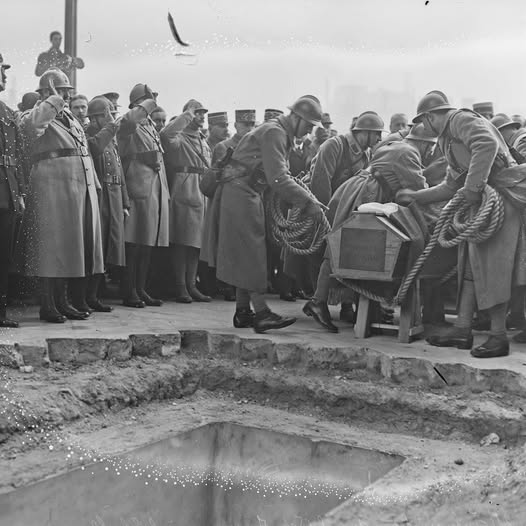
Burial of the Unknown Soldier: the day France wept beneath the Arc de Triomphe

On a gray January morning, the city of Paris seemed to hold its breath. On this 28th of January, 1921, all of France had a rendezvous with its memory, with its dead, with a nameless man, yet the bearer of millions of shattered lives. Under a low, heavy sky, a silent crowd thronged around the Arc de Triomphe. Faces were somber, flags flew at half-mast, hearts heavy. On this day, the Unknown Soldier was buried , a symbol of all those who, between 1914 and 1918, had given their lives for their country without ever seeing the light of home again.
In the middle of the square, the troops lined up, forming a wall of blue uniforms. Boots clattered, medals clinked softly in the icy wind. The veterans, recognizable by their faces marked by mud and gunpowder, stood straight, as if for a final roll call. The Minister of War, Louis Barthou , was present at the ceremony. He, the grieving father whose son had fallen at the front, embodied the sorrow of an entire nation. It is said that he could not hold back his tears as the coffin approached the grave.
The coffin, draped in the tricolor flag, moved slowly forward, carried by soldiers with measured gestures. Around them, a reverent silence settled, broken only by the rustling of uniforms and the distant cry of a seagull. This coffin, chosen from among eight others in the Verdun citadel, contained the remains of a man whose identity would never be revealed. A simple soldier, fallen on the battlefield, anonymous, yet immortal.
The ropes creaked softly as the coffin was lowered into the earth. At that precise moment, Louis Barthou raised his eyes, his voice breaking with emotion, and cried out:
” Long live France!”
https://www.youtube.com/watch?v=FCFj665ny6Y
This vibrant cry rippled through the crowd like a wave. It was not merely a tribute: it was a vow, a cry of love for those who were no more, an echo of courage and sacrifice. Thousands wept silently. Among the soldiers, some closed their eyes, reliving the faces of their fallen comrades, the nights in the trenches, the whistling of shells, the mud that clung to their souls as much as to their boots.
Around the gaping tomb, the highest-ranking military and civilian dignitaries had gathered. Their impeccable uniforms contrasted sharply with the poignant simplicity of the coffin. The minister, the generals, the officers… all knew that this moment transcended their own destinies. The Tomb of the Unknown Soldier was not a mere ceremony: it was the founding act of a national memory.
The bugle sounded, piercing the silence with a pure and sorrowful note. Then, slowly, a soldier placed a laurel wreath on the coffin. A woman, dressed in black, stepped forward. She was trembling. Perhaps she had lost a husband, a son, a brother. She laid a flower and murmured a few words that no one could hear. In that murmur, all of France was present.
The next day’s newspapers would speak of a grand ceremony , a “moment of communion between the living and the dead.” But words were far too weak. What France experienced that day was something indescribable: the feeling of regaining its dignity after four years of hell.
Beneath the vault of the Arc de Triomphe , the vault was sealed. Above it, a few simple words were engraved:
Here lies a French soldier who died for his country – 1914-1918.

Through this inscription, every village, every family, every mother could recognize themselves. He was no longer just an anonymous soldier: he was everyone’s son, everyone’s brother, the eternal witness to courage and human suffering.
A few years later, in 1923, the flame of remembrance was lit above his grave , and has been rekindled every evening without interruption ever since. But on that day in January 1921, it was the first time that Paris felt the heartbeat of France again.
The photographs taken that day show grave faces, frozen by the cold and emotion. Officers salute, soldiers clench their jaws, civilians weep. Yet, behind this grief, there is also pride – the pride of a people who, after so many deaths, refused to be forgotten.
The First World War had left France devastated: more than 1.5 million dead, millions wounded, villages destroyed, families torn apart. But through this Unknown Soldier, the nation found meaning in its grief. He became the universal symbol of sacrifice and resilience , a bridge between the past and the future.
Tourists passing under the Arc de Triomphe today don’t always realize the weight of history that lies beneath their feet. But every evening, when the flame flickers under the stone, it’s as if the breath of that anonymous soldier returns to whisper to France: Remember.
It is said that at the end of the ceremony, as the crowd slowly dispersed, a ray of sunlight pierced the clouds. The light caressed the flag draped over the coffin, like a farewell, like a promise. And in that light, some saw a sign: that of a country reborn from its grief, sustained by the memory of its dead.

The Unknown Soldier has no name, and yet he bears millions of names. Behind him lie the faded faces of the battlefields – those of Verdun, the Somme, Reims, Ypres. Every shovelful of earth poured onto his grave contained the tears of an entire nation.
Louis Barthou would later confide that that day was both the most terrible and the most necessary of his life. He had lost a son, but he had witnessed the birth of a collective memory. His cry, “Vive la France!” , still resonates a century later in the November 11th ceremonies.
The story of the burial of the Unknown Soldier is that of a people who chose to transform pain into a symbol, loss into hope. It is one of the founding moments of French memory, on par with the commemorations of November 11th , the names engraved on war memorials, or the eternal flame that burns in Paris.
And perhaps this is the true meaning of that day in January 1921: to understand that the anonymity of the Unknown Soldier is not oblivion, but a victory over oblivion. In his silence, he still speaks to us. In his tomb, he watches over France.
Note: Some content was generated using AI tools (ChatGPT) and edited by the author for creative reasons and suitability for historical illustration purposes.
Để lại một bình luận