Babi Yar 1941: Two Days That Shocked the Conscience of the World

I am a writer from Poland, though my heart also lies in the lands of the East. Today I want to tell a story that, despite the passage of time, continues to torment humanity’s conscience. I write about a place and an event that have become a symbol not only of tragedy but also of a unique warning: Babi Yar – a ravine above Kiev – and the massacre that took place there on September 29-30, 1941 .
Earlier: Kyiv, in September 1941, had already been under German occupation since September 19th. For the local Jewish community – rich in tradition, customs, and daily life – this moment was to be the beginning of the end. On those days, the Nazi authorities, with the help of their police units and local collaborators, issued an order that – for many – sounded like a call for the transport of forced labor, but it soon turned into an act of unimaginable brutality.
It began on September 28, 1941, when notices appeared on the streets of Kiev, warning Jewish residents to report to a designated location the following day, bringing with them their documents, some clothing, and some cash. This seemed to be another step toward the “segregation” or “evacuation” that the Nazis were increasingly employing in their criminal plans.
On September 29 and 30—in just about 36 hours—some 33,771 Jewish men, women, and children were led in groups to the Babi Yar gorge, lined up on the edge, forced to undress or surrender their belongings, and then—without trial or justification—murdered by gunfire.
The ravine became an open-air tomb, and the bodies were given no symbolic burial—the victims were left where they were killed. This method of extermination—completely outside any “regulated” legal framework—is one of the most dramatic testimonies to the crimes committed during World War II.
But that wasn’t the end. Over the following months and years, the Babi Yar gorge became the site of further executions—not only Jews, but also Soviet prisoners of war, Roma, Ukrainian nationalists, and civilians who remained outside the framework of the Jewish tragedy. Historians estimate that the number of people murdered at Babi Yar between 1941 and 1943 may have reached around 100,000 .
It is worth emphasizing: this massacre was not an anonymous disappearance of people — it was a planned, mechanical extermination operation that dramatically demonstrates how far human civilization can go when it rejects humanity in favor of an ideology of hatred.
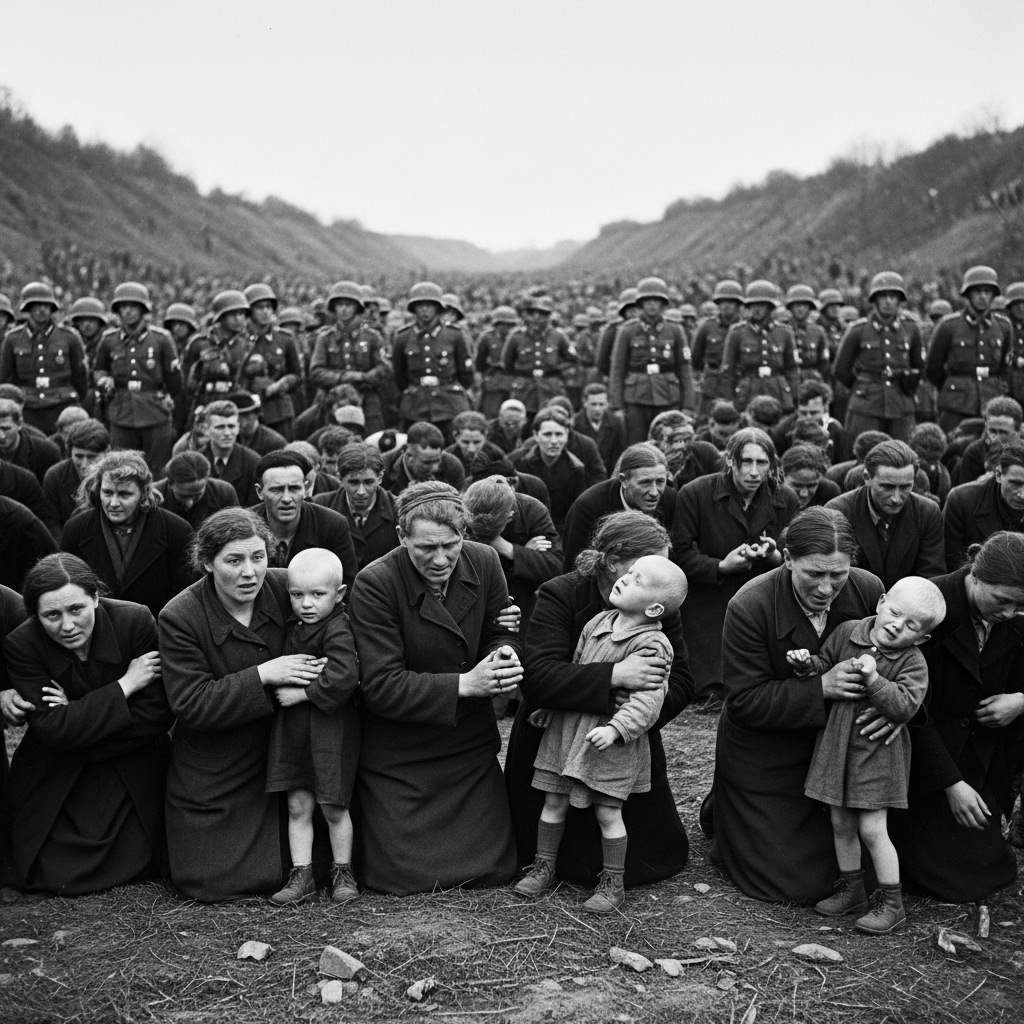
A look at those places: Kyiv, September 29th. People lined up. Still glances in the air, immense fear in their eyes. Someone was holding a child, someone else’s family by the hand. Just a moment earlier, they had believed they were being taken to work, to transport—and in a matter of moments, they were condemned. Gunpowder pellets, the roar of gunfire. The next step—the bodies were placed in mass graves or even in the middle of a ravine, without time to say goodbye, without names, without tears.
For me—as a writer from Poland who has spent thirty years analyzing and writing about the Holocaust in Central and Eastern Europe—this place represents the end of unimaginable drama, but also a turning point in the way Jews were murdered—a prelude to the enormous crimes that followed, in the extermination camps. At Babi Yar, people were shot outdoors, in groups, directly—without gas chambers, without staged settings—and perhaps this is what makes this crime so poignant.
But there’s another dimension to this story: long after the war—during Soviet times—the memory of Babi Yar was obscured, politicized, and limited. Soviet authorities refused to acknowledge that the main victims were Jews—preferring instead the narrative of “Soviet citizens” killed by the Germans. Only in later years did the Jewish dimension of this tragedy begin to be openly discussed.

So let’s imagine—in my writer’s imagination—a family from Kiev: mother, father, three children. The father goes to work, the mother tends the kitchen, the children play in the yard. On September 28th, the order comes: all Jews are to report tomorrow at a specified location, gathering their personal belongings. The mother counts her meager savings, the daughter cries quietly at night. In the morning, they walk—walk as if to work—and then, step by step, towards death, in a silence broken only by the roar of rifles. The gorge swallows people, their fates lost in the sand and rocks. No one knows who perished where and when.
With these words, I pay tribute—not only to the Jewish victims, but to all whose names have been lost in the earth, in the sand, in silence. For Babi Yar is also silence: the silence of the world that watched, the silence of neighbors, the silence after all these years.
Today, this place, Babi Yar itself, has become a site of remembrance and moral reminder. Remembrance here is not merely a matter of fact; it is a call—to never forget, to understand. Currently, educational projects and digital virtual tours are in operation that bring that day closer to new generations.
As a writer, I would like to end this story with a reflection: when we look at the photographs—the crowds of people lined up on the edge of the ravine, their final movements—we must understand that although September 29-30, 1941, was only two days, the echoes of this crime have echoed for decades. It’s not just about the number of people killed. It’s about the fact that people were treated like moving objects, like objects for liquidation. It’s not just about the extermination—it’s about the way it was carried out: with industrial mechanics, with the deprivation of human dignity, with the final extinction of life.
And that’s why—remembering the victims of Babi Yar—we must also remember us—the people of today: to react when we see hatred, to notice when someone is perceived as “another group,” “undesirable,” “less valuable.” Because there, in the gorge above Kyiv, the ideology of hatred was met with a passive response from the people, and then a tragedy arose that is difficult to comprehend.
So let this story, tragic as it may be, also be a testament to the power of memory. That each of us can be a guardian of past wrongs, to prevent them from happening again. For when the world is silent, the stones of memory become the only testimony, and they—though silent—speak powerfully.
In my Polish prose, striving to give voice to the victims and the history of this place, I conclude with these words: May Babi Yar—the gorge that absorbed the tears and screams of thousands—be a sign that humanity can never be treated as a number, as an obstacle, as a “problem.” Because if we allow ourselves to be treated this way, we ourselves lose our humanity.
Let the memory of those days, those human stories, resonate in our hearts and in our actions – today, tomorrow and forever.
Note: Some content was generated using AI tools (ChatGPT) and edited by the author for creativity and suitability for historical illustration purposes.
Để lại một bình luận