In 1945, a survivor walked through the ruins of Nagasaki, surrounded by what remained of a city transformed in an instant. Elsewhere, V-1 bombs still threatened London, submariners searched for moments of normality beneath the Atlantic, and soldiers carried wounded civilians toward safety. Then the war ended. Yet the photographs that followed told a different story: the weapons had fallen silent, but their consequences were only beginning. What did the people inside these frames see that history books sometimes fail to show?
The photograph of the survivor moving through the destroyed streets of Nagasaki belongs to one of the most consequential moments of the twentieth century. On August 9, 1945, the United States dropped an atomic bomb on Nagasaki. Three days earlier, Hiroshima had suffered the first atomic bombing. The National Archives preserves extensive photographic records of the destruction and aftermath of both cities.
From a distance, photographs of devastated cities can appear almost silent. Buildings are reduced to fragments. Streets stretch through empty spaces. There is no battlefield in the traditional sense, no clearly defined front line, no advancing army visible in the frame.
But that silence is deceptive.
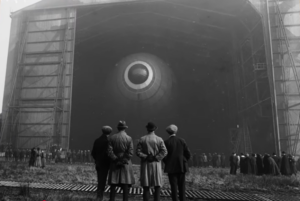
Nagasaki was a city inhabited by ordinary people. They had homes, workplaces, schools, families, routines and plans for the following day. Then the meaning of an ordinary day changed permanently.
The survivor walking through the ruins therefore represents something larger than one person. The photograph records the moment when the war’s destructive power became inseparable from the question of what human beings would have to live with afterward.
And the story did not end there.
Only months later, photographers and observers gathered at Bikini Atoll for a very different kind of scene. In 1946, the United States conducted Operation Crossroads, a series of nuclear weapons tests intended in part to study the effects of atomic explosions, particularly on naval vessels. The operation reflected a new reality: the war had demonstrated the power of nuclear weapons, and now military planners wanted to understand what that power meant.
The contrast is difficult to ignore.
In Japan, people had walked through the ruins of cities destroyed by atomic bombs.
At Bikini, cameras were positioned to record explosions.
The photographs were scientific, military and documentary. They were meant to measure effects that were still poorly understood. Yet they also marked the beginning of a new age in which the destructive technology of the final days of World War II would become central to the Cold War.
The war had ended.
The nuclear age had not.
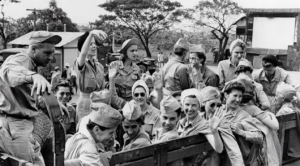
That distinction is one of the most important threads running through these old photographs.
Even before Nagasaki, another new weapon had turned the skies above Britain into a place of uncertainty. The German V-1 flying bomb began striking Britain in June 1944, and thousands were launched against British targets. Imperial War Museums records more than 10,000 V-1s launched against Britain, causing widespread damage and nearly 6,000 deaths.
A photograph showing a V-1 in flight can therefore seem almost unreal.
There is a strange quality to the weapon itself: no pilot sitting inside it, no human face visible through a cockpit, only an unmanned machine moving toward its target.
For people below, however, the experience was intensely human.
The sound of the engine became a warning.
The uncertainty became part of everyday life.
And when the engine stopped, people waited.
The V-1 campaign also revealed something darker about modern warfare. Technology allowed destruction to travel farther from the person who ordered or launched it. The distance between decision and consequence could grow enormous.
Yet the consequences always returned to human beings.
That is why photographs of London during the V-1 attacks remain so powerful. Imperial War Museums preserves extensive visual records of bomb damage and civilian life during this period.
But war was not only experienced from the ground.
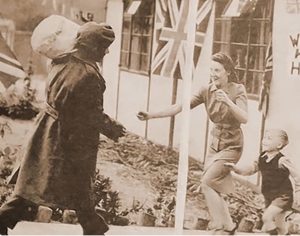
Far out in the Atlantic, German submarine crews sometimes photographed themselves enjoying brief moments of leisure. A photograph of sailors swimming beside a U-boat may look almost peaceful.
That is precisely what makes it so striking.
The submarine was a weapon.
The men beside it were human beings.
For a short period, they could leave the confined interior of the vessel, enter the ocean and experience something resembling ordinary freedom.
Yet the larger context could never disappear.
These men were part of a campaign of naval warfare in which submarines hunted Allied shipping and were themselves hunted by aircraft, surface ships and increasingly sophisticated anti-submarine forces.
The photograph freezes leisure.
History remembers the danger surrounding it.
That contradiction appears again and again.
A soldier helping a survivor from a cave.
An American serviceman sheltering an injured Japanese boy from the rain.
A soldier returning home to embrace his family in 1945.

The original source describes these moments as scenes of compassion, but individual captions require careful verification before assigning precise identities or circumstances. What can be understood more broadly is the human reality they represent: even inside an enormous conflict, people could still make choices that protected another human being.
That matters because photographs of war often focus on destruction.
But compassion is part of the historical record too.
Sometimes the most revealing image is not the explosion.
It is the hand extended afterward.
By 1945, millions of people were waiting for that afterward.
Soldiers had been separated from families for years. Children had grown older while fathers, brothers and sons were away. Parents had waited for letters. Spouses had learned to live with uncertainty.
So when soldiers finally returned, photographs of reunions carried a meaning that could never be captured by military statistics.
A returning gunner embracing his family was not simply one veteran coming home.
He represented thousands of similar reunions.
And yet every reunion was different.
Some families were complete.
Others were not.

Some soldiers returned physically wounded.
Others carried experiences that could not easily be explained.
The war had ended, but returning home was not necessarily the same thing as returning to the life that had existed before.
That may be one of the quietest truths hidden inside photographs from 1945.
Victory could be photographed.
Peace was much harder to capture.
There is another remarkable transformation visible in the source material: women who entered the war through roles once considered outside traditional expectations.
The British Air Transport Auxiliary recruited men and women to ferry aircraft and perform transport duties during World War II. Their work did not usually place them in the same combat role as fighter pilots, but it was essential to moving aircraft where they were needed. The wider wartime mobilization of women similarly expanded the range of roles they performed in military and civilian life.
A photograph of a woman pilot can therefore appear simple.
A person sits beside an aircraft.
But behind that image lies a society being transformed by necessity.
War required workers.
Factories needed people.
Aircraft needed to be delivered.
Hospitals needed staff.
Communications needed operators.
Transport systems needed drivers.
The familiar boundaries of civilian life were being pushed aside by an extraordinary national emergency.
And once those boundaries had moved, they could never be completely restored to their previous position.
The war also changed the meaning of technology.
The V-1 represented remote destruction.
Aircraft represented mobility and reach.
Submarines transformed naval warfare.
The atomic bomb transformed strategic thinking.
Yet technology did not make war less human.
In many ways, it made the human consequences larger.

That becomes painfully clear when the photographs move from Europe to Asia.
The National Archives contains images documenting not only the destruction of Hiroshima and Nagasaki but also the injuries and aftermath experienced by survivors. Some records show physical evidence of the blast preserved in the bodies and clothing of those who lived through it.
These are not simply photographs of weapons.
They are photographs of consequences.
And that difference matters.
A bomb can be described by its weight, design and explosive yield.
But a photograph of a survivor reminds us that the historical meaning of a weapon cannot be reduced to its technical specifications.
There were people underneath it.
There were families afterward.
There were cities that had to rebuild.
There were memories that continued long after the headlines changed.
This is why the end of World War II cannot be understood simply as a date on a calendar.
The surrender ceremonies were real.
The fighting stopped.
But the consequences moved forward through time.

Some appeared immediately in devastated cities.
Others emerged through the nuclear arms race.
Some were carried home by veterans.
Others remained in photographs, museums, archives and family memories.
And some became visible only decades later.
The source material includes scenes far removed from the battlefield: homeless families during the Great Depression, children at play, workers building bridges, people enjoying beaches, technological experiments, performers and entertainers.
At first, these images seem unrelated to World War II.
But perhaps they reveal something important.
History is not made only from famous battles.
The people who later experienced global war had already lived through economic crises, technological change, social transformation and political upheaval.
The child photographed in poverty during the Depression belonged to the same generation that would later confront world war.
The workers building infrastructure represented a society becoming increasingly industrial.
The pilots experimenting with aviation belonged to a world that would soon turn aircraft into instruments of global warfare.
Technology was changing faster than societies could fully understand.

And eventually, the same modern world that created mass transportation, radio, cinema and aviation also created weapons capable of destroying entire urban areas.
That contradiction is perhaps the defining tension of the photographs.
Human beings were becoming better at building.
And simultaneously better at destroying.
The photograph of abandoned military vehicles in liberated Europe offers another glimpse of what happened after the fighting.
Equipment that had once been valuable became unwanted.
Jeeps, machinery and military supplies were left behind.
The battlefield economy suddenly had to become a peace economy.
What had been built for war now had to be dismantled, reused or forgotten.
The landscape itself had to change.
Roads needed repair.
Buildings needed reconstruction.
Factories needed new purposes.
Families needed homes.
The physical process of rebuilding would take years.

The emotional process could take much longer.
That is why the photographs of returning soldiers matter so much.
They are images of transition.
The uniform remains, but the war is supposedly over.
The soldier stands between two worlds.
Behind him is the conflict.
Ahead lies an uncertain peace.
The same uncertainty appears in the image of a German soldier helping a boy near the Berlin Wall in 1961, although this belongs to the Cold War rather than World War II. The photograph’s presence in the collection reminds us that 1945 did not bring an uncomplicated peace to Europe.
Instead, the continent was divided.
Germany was divided.
Families could be divided.
And the political conflict that followed the Second World War created new barriers where armies had once fought.
The Berlin Wall would become one of the most powerful symbols of that new era.
So the story continues.
The bomb ends one war.
The consequences help shape another era.
The old battlefield disappears.
New borders rise.
The weapons become more sophisticated.
And the photographs continue.
Perhaps that is why the image of Nagasaki belongs beside images of Bikini Atoll.
One shows a city after nuclear destruction.
The other shows humanity deliberately testing nuclear explosions.
The connection is historical, not fictional.
The first atomic bombs demonstrated what was possible.
Operation Crossroads showed that the question afterward was no longer simply whether nuclear weapons could destroy cities.
It was what their existence would mean for the future.

The answer would shape the Cold War, military planning, diplomacy and public fear for decades.
Yet even that enormous historical transformation ultimately comes back to individuals.
A survivor walking through ruins.
A sailor swimming beside his submarine.
A wounded child sheltered from rain.
A family waiting at a railway station.
A pilot delivering an aircraft.
A worker returning home.
A person standing before a photograph years later, trying to understand what it means.
The camera cannot explain everything.
It can only preserve a moment.
That limitation is also its strength.

Because photographs do not tell us exactly what everyone thought.
They cannot reproduce every conversation.
They cannot reveal every fear.
They cannot show every consequence.
But they can prevent certain moments from disappearing completely.
And sometimes that is enough to force later generations to ask better questions.
What did victory mean to the soldier who returned?
What did liberation mean to the survivor?
What did the atomic bomb mean to the people who walked through its aftermath?

What did nuclear testing mean to those who realized that the technology of wartime destruction would remain part of the world’s future?
The answers are complicated.
They should remain complicated.
History becomes dangerous when complicated human experiences are reduced to simple images of heroes, villains, victories or defeats.
The photographs resist that simplification.
They show fear beside courage.
Technology beside vulnerability.
Destruction beside compassion.
Celebration beside uncertainty.
And perhaps most importantly, they show that history did not stop when the fighting stopped.
The war left cities damaged.
It left families changed.
It left veterans carrying memories.

It left survivors carrying physical and emotional consequences.
It left governments confronting a new kind of weapon.
It left societies trying to rebuild.
And it left photographers with the impossible task of recording a world that had changed too quickly to fully understand.
My personal view is that these photographs are most valuable when we resist treating them as spectacular images from a distant past. Their real power lies in the ordinary human details surrounding extraordinary events: a hand reaching toward someone in danger, a family embracing a returning soldier, a sailor taking a brief swim, a survivor walking through ruins, or a camera recording the aftermath of a weapon unlike anything that had existed before. The photographs remind us that wars are ultimately experienced by people, long after political leaders have declared them finished.
Perhaps the most important question is therefore not what these photographs show, but what they ask us to remember: when the fighting ends, how long should we consider the war truly over?
Some content was generated using AI tools (including ChatGPT) and edited by the author for creativity, storytelling, and historical illustration purposes. Historical facts and key details should be verified against reliable historical sources. Any AI-generated or reconstructed visuals are intended for illustrative purposes and should not be interpreted as original historical photographs or archival evidence.
Để lại một bình luận