When World War II Ended, the Photographs Still Had a Story to Tell
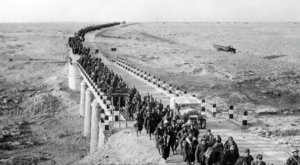
There are photographs from World War II that need no gunfire to make us stop and look. A group of prisoners standing before a camera after liberation. Japanese representatives stepping aboard a battleship to sign the surrender documents. A long column of Italian prisoners leaving Bardia. Children in Berlin in 1945 standing beside weapons left behind in the streets. These images came from different places and different moments, yet together they raise the same question: when a war ends on paper, what truly remains?
At the beginning of 1941, the war showed no sign of ending soon. In North Africa, the port of Bardia on the Mediterranean coast became one of the important points of confrontation between British forces and the Italian army. Bardia had been developed as a fortified position, with defensive works stretching around the area.
On January 4, 1941, Australian troops of the 6th Division launched their attack on Bardia. The fighting was not easy. Italian forces resisted, particularly in the southern sector. But by the end of the afternoon, much of Bardia was in Australian hands. Resistance in the south finally ended the following morning.
What happened afterward made Bardia one of the most memorable images of the North African campaign.
Thousands of Italian soldiers were captured.

The Australian War Memorial records that Australian forces captured around 40,000 Italian prisoners during the Bardia operation, while another museum source estimates approximately 36,000 prisoners and around 1,000 Italian deaths. Differences in the figures reflect different methods of counting, but the scale of the surrender is beyond dispute.
Photographs of Italian prisoners leaving Bardia show an image almost completely different from what people normally imagine when they think of a battlefield.
There were no attacking formations.
No guns firing.
Only long columns of people moving along the road.
On February 5, 1941, one photograph captured Italian prisoners after the fall of Bardia. They moved in long lines. Soldiers who had once belonged to an army still fighting were now prisoners of war.
A battle can be summarized in a few numbers.
But a photograph can reveal something numbers struggle to express: war can turn people into individuals whose fate is suddenly controlled by others.
Bardia was only one battle among many. Yet its consequences were significant. The defeat contributed to the weakening of Italian morale in North Africa. The Australian War Memorial notes that the defeat at Bardia, following the earlier defeat at Sidi Barrani, had a major impact on Italian morale.
And the war continued.
In Europe, another conflict was becoming increasingly brutal.
Not everyone caught in the war carried a weapon.
Within the camp system created by Nazi Germany, millions of people were imprisoned for different reasons. The camps were used for political repression, forced labor, imprisonment, and mass murder. The United States Holocaust Memorial Museum records that Nazi Germany and its allies established tens of thousands of camps and detention sites between 1933 and 1945.
Among those persecuted were Jehovah’s Witnesses.
They were targeted by the Nazi regime because they refused to comply with certain demands of the state, particularly those involving military service and matters of religious conscience. In the camps, they were identified by a purple triangle. According to the United States Holocaust Memorial Museum, at least 3,000 Jehovah’s Witnesses were imprisoned in concentration camps.
This is an easily overlooked part of the history.
World War II was not simply a confrontation between armies on maps.
It was also a war in which governments could determine who a person was considered to be, how that person was allowed to live, what that person was permitted to believe, and whether that person was allowed to exist freely.
By 1944 and 1945, as Allied forces advanced deeper into territory controlled by Germany, they began to see the true scale of the camp system.
In July 1944, Soviet forces reached Majdanek.
In January 1945, Auschwitz was liberated.
On January 27, Soviet soldiers entered the Auschwitz complex, where approximately 7,000 prisoners remained. Many were too weak to be forced onto the evacuation marches that had taken place shortly before.
The soldiers entering the camp did not see only people.
They also saw evidence.
Clothing.
Personal belongings.
Everyday objects.
Documents and other traces.
In several locations, German authorities had attempted to destroy facilities and evidence before retreating. But they could not erase everything.
Sometimes history survives not because people wanted to preserve it, but because the traces left behind could not be completely destroyed.
One of the images mentioned in the original material shows Jehovah’s Witnesses after liberation.
The precise identification of every person, location, and date in photographs circulated online requires caution. A caption shared thousands of times is not automatically proof of the details attached to it. But the broader historical event is firmly documented: Allied forces did liberate prisoners from the Nazi camp system in 1945.
And liberation did not mean that all suffering suddenly ended.
Many prisoners had survived years of hunger, disease, forced labor, and brutal conditions. Some were so severely weakened that they died shortly after liberation.
That is one of the most painful contradictions of 1945.
The war was ending.
But for many people, life after the war was only beginning.
At Buchenwald, on April 11, 1945, prisoners had taken control of parts of the camp before American forces arrived. When U.S. troops entered, more than 21,000 people were still there.
Elsewhere, Allied soldiers encountered prisoners being forcibly marched away during the final days of Nazi rule.
That is why photographs from 1945 carry such particular weight.
They do not simply show the end of the war.
They show what the war had left behind.
But while Europe was moving toward the final days of the conflict, the war was still continuing in Asia.
Japan had not yet surrendered.
In August 1945, decisive events followed one another rapidly. After the atomic bombings of Hiroshima and Nagasaki, the Soviet Union declared war on Japan and invaded Manchuria. On August 15, Japan announced its acceptance of the terms of surrender. But the formal document still had to be signed.
Then came September 2, 1945.
That morning, aboard the USS Missouri in Tokyo Bay, a ceremony was prepared.
It was different from Bardia.
Different from the battlefields of Europe.
There was no army advancing through a defensive line.
Instead, there was a table.
A document.
And signatures that would mark the formal end of the war.
Japanese Foreign Minister Mamoru Shigemitsu and General Yoshijiro Umezu represented Japan. They signed the Instrument of Surrender. The document formally recorded the unconditional surrender of Imperial Japan and its armed forces.
The time was recorded precisely.

9:04 in the morning.
A war that had lasted for years was condensed into a ceremony that lasted only a short time.
But there was nothing simple about that moment.
A signature could not bring the dead back.
A document could not rebuild destroyed cities.
A declaration of peace could not immediately heal those who had lived through the war.
It could only confirm that one era had ended.

And from that moment, the world faced a more difficult task: living with what the war had left behind.
Among the images associated with 1945 are photographs of German children standing in cities devastated by war.
Some children were photographed near weapons left behind on the streets of Berlin.
The detail is haunting not because it shows a battle.
It is haunting because it shows how deeply war had entered the lives of children.
For a child, a weapon lying in the street might simply have been a strange object.
For an adult who understood what had happened, it was evidence of a society that had collapsed.
Those children had not created the war.
Yet they had to grow up surrounded by its consequences.
That is also why ordinary photographs can become powerful historical records.
A soldier.
A child.

A prisoner.
A survivor.
A wounded horse.
A road covered in rubble.
Such images do not always tell a story about victory.
They tell a story about the cost of history.
The original material also includes an image described as a German field veterinary hospital from around 1917–1918, where a horse wounded by shrapnel was being prepared for surgery. That photograph belongs to World War I rather than World War II, but it reflects a broader truth about warfare in the twentieth century: war did not only change borders and national destinies. It created scenes of suffering that people living in peacetime could scarcely imagine.
And this is where we have to distinguish history from the way photographs are assembled.
The original list contains many images from completely different periods: the early twentieth century, World War I, World War II, the Cold War, and the 1970s, 1980s, and 1990s.
A beautiful photograph does not automatically become evidence for a story.
A caption shared thousands of times does not automatically become historical fact.
Some images are correctly identified.
Some are genuine but have been given the wrong date.
Some names have been misspelled.
Some events have been placed into contexts where they do not belong.
And sometimes a real photograph is used to tell a false story.
That is why telling history requires something more difficult than finding an emotional image.
It requires verification.
For example, the original material describes Japanese representatives signing the surrender aboard the USS Missouri. That detail is supported by an official National Archives record. The Instrument of Surrender was signed on September 2, 1945, and the document remains preserved within the U.S. archival system.
Bardia also has a well-documented historical record through the Australian War Memorial, including the date of the battle, its outcome, and the large number of Italian prisoners captured.
The history of the concentration camps and their liberation in 1945 is likewise extensively documented by the United States Holocaust Memorial Museum. These sources show that liberation was not a single simple moment. It was a process that unfolded across different battlefields and over many weeks, involving thousands of survivors who were often in extremely poor physical condition.
And this is where the photographs begin to carry a deeper meaning.
Bardia shows how an army could become a long column of prisoners after a defeat.
The liberated camps show what a regime could leave behind.
Berlin in 1945 shows how children had to live among the remains of a war they had not chosen.
And the USS Missouri shows how, ultimately, a war also has to end through concrete political and legal decisions.
From the distance of more than eight decades, it is easy to think that history was created by great figures.
Generals.
Leaders.
Governments.
Armies.
But photographs often tell another story.
History was also created by ordinary people caught inside decisions much larger than themselves.
The Italian soldier walking in a column of prisoners.
The survivor stepping out of a camp.
The child standing among the ruins of Berlin.
The soldier entering a liberated city.
The civilians watching armies pass.
And the families waiting for someone they loved to come home.
September 2, 1945 is generally recognized as the formal end of World War II. The Japanese Instrument of Surrender recorded that conclusion in an official document preserved by the National Archives.
But simply saying that “the war ended” does not tell the whole story.
The war ended on paper.
Its consequences continued in memory, in destroyed cities, in families who had lost loved ones, in survivors, in people forced to rebuild their lives, and in societies that had to decide what they would do with the memory of those years.
Perhaps that is why an old photograph can still make someone stop after more than eighty years.
Not because the photograph can speak.

But because it forces us to ask questions.
What had the people in the photograph experienced?
What did they know about what was coming?
Did they realize that the moment being captured would one day become part of history?
And without those photographs, how much would we still remember?
History does not exist only in the dates printed in books.
It exists in the roads where columns of prisoners once walked.
On the decks of ships where a signature ended a war.
In rooms where survivors were finally free.
And among children who had to learn how to grow up after adults had destroyed the world they once knew.
Looking back at World War II today should not be only about searching for moments of triumph.
Perhaps what matters more is seeing the human beings behind the numbers.
Thousands of prisoners were not merely a statistic.

Thousands of survivors were not merely a statistic.
Millions of dead were not merely a line in a history book.
Every number once represented a life.
And that is what makes history so difficult to forget.
War may begin with decisions made by governments, but its consequences always fall upon individual human beings.
That is what the old photographs, whether from Bardia, Berlin, the camps, or the deck of the USS Missouri, continue to remind us.
An era had ended.
But the memory of it remained.
And perhaps the most important question is not whether we remember those years, but what we choose to understand from the people who lived through them.
Some content was generated using AI tools (including ChatGPT) and edited by the author for creativity, storytelling, and historical illustration purposes. Historical facts and key details should be verified against reliable historical sources. Any AI-generated or reconstructed visuals are intended for illustrative purposes and should not be interpreted as original historical photographs or archival evidence.
Để lại một bình luận