WHEN A FIRST DOWN BECOMES MORE THAN A STATISTIC
In football, a first down is usually just another number.
It means an offense has moved the chains.
It keeps a drive alive.
It creates another opportunity to score.
Fans celebrate it for a few seconds before turning their attention to the next play.
But in Green Bay, some first downs don’t disappear when the game ends.
They become trees.
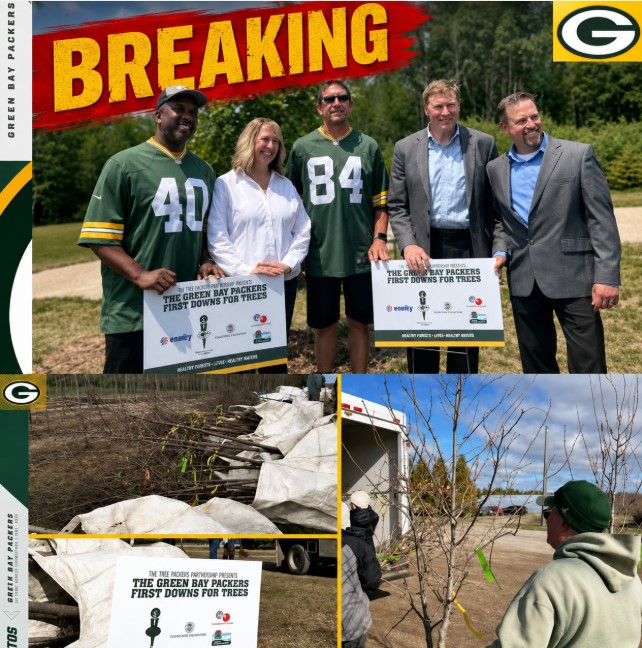
The Packers’ First Downs for Trees program connects the team’s on-field performance with environmental efforts throughout Brown County. For every first down the Packers recorded during the previous season, a tree is contributed to participating local communities.
This year, that number is 394.
That means 394 moments of offensive success have been transformed into something entirely different — trees that can provide shade, improve air quality and help manage stormwater for years to come.
And suddenly, a statistic that normally disappears from a box score has a life far beyond Lambeau Field.
394 TREES, 16 COMMUNITIES AND ONE BIGGER MESSAGE

The 394 trees are being distributed across 16 Brown County communities, including Allouez, Ashwaubenon, Bellevue, De Pere, Green Bay, Hobart, Howard, Lawrence, Ledgeview, Morrison, Oneida, Pulaski, Scott, Suamico and Wrightstown, as well as Brown County itself.
That’s what makes the program particularly powerful.
This isn’t simply a symbolic gesture involving a few trees planted near the stadium.
The impact spreads throughout the surrounding communities.
Residents who may never attend a Packers game can still experience something connected to the team.
A child playing in a local park may eventually sit beneath one of these trees.
A family walking through a neighborhood may see one growing years from now.
And a community dealing with environmental challenges gets another small piece of infrastructure that can continue working long after the people who planted it have moved on.
That’s a different kind of home-field advantage.
THE LATEST TREE HAS A STORY OF ITS OWN
One of the most recent trees planted through the initiative went into Ledgeview Park.
The tree replaced an ash tree that had been damaged by insects.
Officials say the replacement accolade elm could eventually grow nearly 70 feet tall and live for 60 years or more.
Think about that timeline.
A Packers first down lasts only a few seconds.
A football game lasts a few hours.
A season lasts several months.
But the tree connected to that first down could still be standing decades from now.
That’s what gives the program its emotional weight.
Football is built around moments.
A first down.
A touchdown.
A game-winning field goal.
A championship.
But trees are built around time.
They grow slowly.
They provide benefits gradually.
And eventually, they become part of the landscape.
The Packers are essentially taking something temporary and turning it into something permanent.
THE NUMBERS MAKE THE IDEA EVEN MORE IMPRESSIVE
This isn’t the first time the Packers have used their on-field production to support environmental efforts.
The program has been running for 16 years, creating a long-term connection between football and sustainability.
Previous years have produced similarly impressive numbers.
In the 2024 program, for example, 402 trees were planted in Brown County communities. The Packers’ official reporting has described First Downs for Trees as one of the organization’s Green Team initiatives.
That consistency matters.
Anyone can launch a charitable campaign once.
Doing it year after year is different.
It turns an idea into a tradition.
And eventually, a tradition becomes part of an organization’s identity.
For the Packers, that identity has always been deeply connected to Green Bay itself.
The team isn’t simply located in the community.
It is intertwined with it.
WHY THIS IS DIFFERENT FROM A TYPICAL NFL PROMOTION
Professional sports teams regularly participate in charitable initiatives.
They donate money.
They host events.
They support nonprofits.
They encourage fans to volunteer.
All of those efforts matter.
But First Downs for Trees has something particularly clever about it.
The donation is directly connected to what happens on the football field.
The more first downs the Packers produce, the more trees can be planted.
That means offensive success has a tangible community consequence.
A productive offense doesn’t just help the standings.
It can literally help grow the local environment.
That’s a message fans can understand immediately.
And it gives supporters another reason to appreciate something as simple as moving the chains.
Imagine watching a Packers drive next season.
A quarterback completes a pass.
The receiver gains 12 yards.
The referee signals first down.
The crowd erupts.
Somewhere in Brown County, that moment has another meaning.
Another tree could eventually be added to the landscape.
THE REAL IMPACT MAY TAKE YEARS TO SEE
That’s perhaps the most important part of the story.
A tree doesn’t become impressive overnight.
The newly planted trees won’t immediately look like towering landmarks.
They need water.
They need care.
They need time.
But that’s exactly why the program is so meaningful.
The Packers aren’t only investing in something that produces an immediate headline.
They’re helping create something that can benefit future generations.
Trees can provide shade, help reduce stormwater runoff and contribute to cleaner air. In Ledgeview, officials specifically highlighted those long-term benefits of the newly planted tree.
So the real scoreboard for this program isn’t today’s number.
It’s what those trees look like 10, 20 or 50 years from now.
That’s when the meaning of the initiative becomes much clearer.
GREEN BAY IS SHOWING THAT FOOTBALL CAN REACH BEYOND THE FIELD
The Packers have always had an unusual relationship with their community.
Green Bay isn’t one of the biggest American cities.
It doesn’t have the enormous population of New York, Los Angeles or Chicago.
Yet the Packers have built one of the most passionate fan bases in professional sports.
Programs like First Downs for Trees reinforce that connection.
The team succeeds on Sunday.
The community benefits afterward.
And the connection continues.
That’s a powerful model.
Because professional sports can sometimes feel disconnected from everyday life.
Players travel.
Games are played inside massive stadiums.
Fans watch from television screens around the world.
But initiatives like this bring everything back to the local level.
A football statistic becomes a physical tree.
A tree becomes part of a neighborhood.
And eventually, that neighborhood becomes part of the Packers’ story.
THE NEXT FIRST DOWN COULD MEAN SOMETHING DIFFERENT
The beauty of this program is its simplicity.
No complicated explanation is necessary.
One first down.
One tree.
One small connection between football and the environment.
And when you multiply that by 394, the idea suddenly becomes much bigger.
The Packers didn’t just move the chains 394 times.
They helped create 394 opportunities for something new to take root.
And while fans will naturally focus on touchdowns, wins and playoff positioning, perhaps some of the team’s most meaningful victories won’t appear on the scoreboard at all.
They’ll be standing quietly in parks and communities across Brown County.
Growing.
Providing shade.
Cleaning the air.
And reminding people that football can leave behind something more valuable than a final score.
AI CONTENT & IMAGE DISCLAIMER: Some visual content used with this article may have been created or enhanced using artificial intelligence (AI) for illustrative and creative purposes. AI-generated visuals should not be interpreted as official photographs or evidence of events unless specifically identified as such.
EDITORIAL DISCLAIMER: This article is provided for informational and entertainment purposes. Statistics and program details are based on publicly reported information and may change as additional information becomes available.
PERSONAL OPINION: The views expressed in the commentary section are the author’s personal opinions and are not intended to represent the official position of the Green Bay Packers or any affiliated organization.
Để lại một bình luận