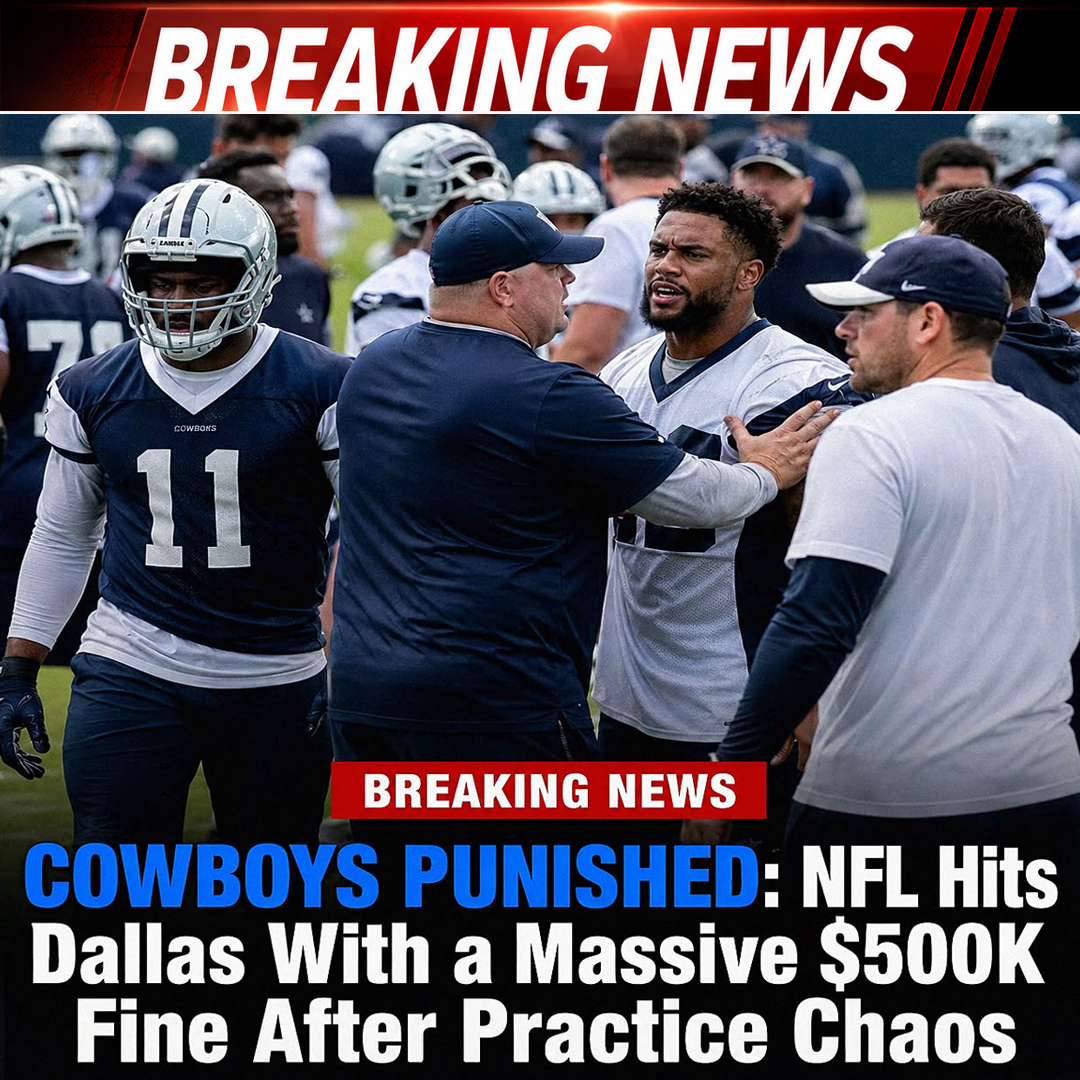
COWBOYS HIT WITH MASSIVE NFL PUNISHMENT: Dallas Fined $500,000 After Saints Practice Spirals Into Chaos

The Dallas Cowboys have received one of the most expensive consequences of the 2026 preseason after the NFL fined the organization $500,000 for the repeated fights that erupted during Tuesday’s joint practice with the New Orleans Saints in Oxnard, California. New Orleans received the same $500,000 punishment, bringing the combined financial penalty for the two organizations to $1 million after a session intended to provide controlled competition instead became one of the league’s most chaotic training-camp stories. The NFL confirmed the fines Thursday and cited the teams’ unsportsmanlike behavior, making clear that the league viewed what happened as far more serious than ordinary pushing and shoving between competitive players.
The punishment followed a practice in which fights repeatedly interrupted football work and eventually forced Cowboys coach Brian Schottenheimer and Saints coach Kellen Moore to discuss ending the session early. Gridiron Heroics cited reports of at least seven altercations during the afternoon, although different observers produced different totals as several confrontations developed across separate areas of the field. Schottenheimer later explained that the coaches had agreed another serious incident could cause them to cancel the remainder of practice, but the teams eventually regained enough control to finish the scheduled work.
The NFL’s response reflects how seriously the league has begun treating joint-practice discipline, particularly after warning teams before training camps that they were responsible for preventing large-scale confrontations. According to the league’s official announcement, clubs were reminded of the importance of sportsmanship and were expected to control players during practices against opposing teams, where normal game penalties and immediate officiating consequences do not always provide the same deterrent. Dallas and New Orleans failed that test spectacularly enough that the NFL decided organizational fines were appropriate rather than limiting discipline only to individual players involved in specific incidents.
One of the most widely discussed moments came when Saints tight end Brock Rechsteiner, the son of WWE Hall of Famer Scott Steiner, appeared to slam Cowboys safety Jalen Thompson to the ground during an altercation. Gridiron Heroics reported that the confrontation began after Dallas cornerback Caelen Carson punched Rechsteiner, illustrating why responsibility for the disorder could not realistically be placed entirely on one team. Helmets were also thrown during the afternoon, while players repeatedly left their immediate drill areas to join confrontations involving teammates, creating exactly the kind of escalating behavior the NFL wants eliminated from joint practices.
Cowboys edge defender Donovan Ezeiruaku became another central figure when he was removed from the practice after throwing a punch, an incident made more concerning because it was his second practice ejection of training camp. For a young defender trying to secure an important role in Christian Parker’s rebuilt defense, repeatedly losing valuable repetitions because of discipline problems is something Schottenheimer cannot simply dismiss as competitive intensity. The regular season will bring real penalties, potential ejections and field-position consequences, meaning Dallas needs players such as Ezeiruaku to understand that retaliating during emotional moments can directly cost the team games.
Schottenheimer did not attempt to defend his roster afterward, acknowledging that Dallas contributed significantly to the confrontations and emphasizing that the Cowboys had failed to demonstrate the discipline required to play winning football. His response was important because joint-practice fights are often followed by coaches claiming their players were merely defending teammates, but Schottenheimer instead focused on the opportunities Dallas wasted every time tempers interrupted a competitive period. That accountability became even more meaningful once the NFL demanded film from the practice to evaluate what had happened and whether further discipline might be warranted.
Cowboys owner and general manager Jerry Jones, however, believes the size of the organizational punishment went too far and has already said Dallas intends to appeal the $500,000 fine. Jones described the penalty as “stiff” rather than simply accepting the league’s decision, indicating that the Cowboys will challenge at least the financial severity even while acknowledging that the practice became unacceptable. Dallas also plans to discipline individual players involved in the confrontations, creating the possibility that some Cowboys could face consequences internally even as the organization attempts to reduce or overturn the league-imposed fine.
That combination reveals an important distinction in Dallas’ position, because appealing the league penalty does not necessarily mean the Cowboys believe their players behaved appropriately. Jones can consider $500,000 excessive while Schottenheimer simultaneously demands better discipline from the roster, and those positions are not mutually exclusive after a practice where responsibility was clearly shared by both organizations. The larger message inside the building will almost certainly be that defending teammates and competing physically remain acceptable, but punches, thrown helmets and players leaving drills to join fights cannot become part of the Cowboys’ identity.
The financial punishment is also notable because joint practices have become increasingly important to NFL teams that want high-quality competition without exposing starters to the full physical risk of extended preseason game action. Coaches can design red-zone periods, third-down situations and two-minute drills against unfamiliar opponents, creating evaluations that are often more useful than exhibition games in which starters may play only briefly. Every fight therefore wastes more than practice time, because it removes precisely the controlled, situational football work that coaches arranged the joint session to produce in the first place.
Dallas can especially ill afford to waste evaluation opportunities this summer because the roster has been substantially reshaped after a disastrous defensive season in 2025. Parker is installing a new system, several veteran additions are learning new responsibilities, and numerous younger players are competing for rotational roles before the 53-man roster must be finalized. When those players spend portions of practice fighting instead of executing assignments against another NFL team, the coaching staff loses valuable evidence it needs to make decisions that will affect the regular season.
The incident also creates an unusual backdrop because Dallas and New Orleans are scheduled to see each other again almost immediately, this time in their preseason finale on August 28. By then, both coaching staffs will expect the emotional temperature to be drastically different, especially after the NFL demonstrated with a combined $1 million punishment that another outbreak of fighting could produce substantial consequences. Players who exchanged punches and words in Oxnard will therefore have another opportunity to prove that the intensity from the joint practice can be redirected into legal football rather than another sequence of confrontations.
For Schottenheimer, the larger concern will be making sure this episode does not become part of a broader discipline problem when the regular season begins. Dallas opens its season with important games immediately carrying playoff and divisional implications, and a 15-yard personal foul in September can change possession, extend an opponent’s drive or turn a manageable situation into a loss far more quickly than an August practice fight. The Cowboys want a more physical team in 2026, particularly on defense, but Schottenheimer must make sure physicality never becomes an excuse for losing control.
The NFL has now delivered a punishment significant enough that nobody inside either organization can dismiss Tuesday’s events as harmless training-camp entertainment. Dallas will appeal the $500,000 fine and may disagree with the price the league placed on the chaos, but Schottenheimer’s own comments show the Cowboys understand why the practice drew such intense scrutiny in the first place. If the episode becomes the moment Dallas learns to separate toughness from recklessness, the financial hit may eventually become a preseason footnote, but another outbreak once games count would make this warning look far more costly than half a million dollars.
AI Content Disclosure:
Some images, graphics, thumbnails, or visual elements used in this article may have been created, enhanced, or edited with the assistance of artificial intelligence (AI) to provide a richer visual experience for readers. These visuals are intended for illustrative, commentary, and entertainment purposes only and should not be considered official photographs or documentary evidence unless explicitly stated.
Content Disclaimer:
This article is based on publicly available information, media reports, analysis, and commentary regarding the Dallas Cowboys and the NFL. Any references to fines, league actions, disciplinary measures, rumors, or potential penalties should be considered informational discussions unless officially confirmed by the NFL, the Dallas Cowboys organization, or verified league sources. Readers are encouraged to consult official announcements for the most accurate and up-to-date information.
Personal Opinion — 2026:
In my personal opinion, any situation involving league discipline, player safety, or organizational responsibility naturally attracts significant public attention, especially when it concerns a high-profile franchise like the Dallas Cowboys. If reports of NFL action prove accurate, the incident could become an important reminder of how closely professional sports organizations are monitored and how seriously league rules are enforced. At the same time, fans should remain patient and rely on verified information before drawing conclusions, as initial reports and speculation can evolve as more details become available.
Để lại một bình luận