On August 9, 1945, an unusual cloud rose above Nagasaki. Somewhere far from that moment, history was also being recorded in quieter ways: a mother holding her children, soldiers caring for animals, workers enduring poverty, families arriving at Ellis Island, and ordinary people caught between wars and changing worlds. These photographs do not tell one single story. Together, they reveal something more difficult to see: how enormous historical events were experienced through small, human moments—and how much can remain hidden inside a single frame.
The photograph of Nagasaki belongs to one of the most consequential moments of the Second World War. On August 9, 1945, the United States dropped an atomic bomb on the Japanese city. The distinctive cloud that followed became an image associated with the destructive power of nuclear warfare. Yet the photograph itself cannot show everything that happened beyond the frame—the civilians, the destruction, and the consequences that would continue long after the cloud had disappeared.
Only a few years earlier, another kind of uncertainty had spread across the world. In 1942, a Japanese American mother embraced her children as families of Japanese ancestry were being relocated to internment camps in the United States. The policy followed America’s entry into the war after the attack on Pearl Harbor. Thousands of families were uprooted. Behind every official order were people facing the same questions: where would they live, what would happen to their homes, and when would their lives return to normal?
Europe carried its own scars. In Dresden in 1945, a woman walked alone through ruins left by military operations near the end of the war. The city had been devastated, and photographs of its shattered streets later became enduring symbols of wartime destruction. But the ruins tell only part of the story. The woman walking among them reminds us that cities do not suffer by themselves. People must eventually return to the places where their lives once seemed ordinary.
Elsewhere, survival could take unexpectedly tender forms. During the Korean War in the early 1950s, Navy Sergeant Frank Prader was photographed feeding an orphaned kitten during a break between military operations. The war was still being fought, yet the image captured something entirely different: a brief act of care. Such photographs can seem almost insignificant beside battles and military maps, but perhaps that is precisely why they endure.
The same contrast appears in wartime photographs of soldiers receiving small holiday comforts in Vietnam in 1967. Gifts and food were sent to troops far from home, reminders of ordinary life in a setting where ordinary life had become distant. During the Second World War, similar needs appeared in another form. Liberty ships were mass-produced from 1941 onward to help replace Allied shipping losses. Behind the enormous industrial effort were workers, machines, schedules, and a question that photographs sometimes leave unanswered: how much human labor was required to keep a global war moving?
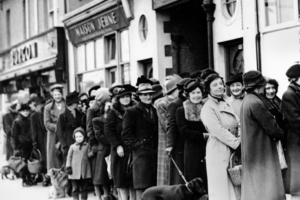
One image brings that industrial world down to a smaller scale. In 1942, people queued outside a butcher shop in England to buy horse meat. Wartime rationing had changed what families could obtain and what foods they were willing to consider. The queue looks ordinary, but it represents an entire society adapting to scarcity. Bread and soup served during the Great Depression tell a similar story from the 1930s, when many families confronted economic hardship and limited resources.
The photographs also reveal how war could follow people even when they were not fighting. A Chinese worker in the 1940s carried a sign identifying himself as Chinese rather than Japanese, apparently to avoid hostility and misunderstanding during a period of intense wartime tension. The sign was simple. Its meaning was not. It showed how international conflict could alter everyday interactions between strangers.
Then there were the soldiers who left home. A young serviceman posed beside his mother before departing for the First World War in 1917. The photograph captures a farewell familiar to thousands of families during wartime mobilization. There is no need to invent what they said. Their posture is enough to suggest the uncertainty surrounding a departure whose ending could not be known.
A different image, from the Second World War, shows the damaged trousers of Adolf Hitler after the failed assassination attempt at the Wolf’s Lair in 1944. The military headquarters, located in what is now Poland, became the site of the July 20 plot to kill Hitler. The photograph records a physical trace of an event that could have changed the course of the war. It raises an uncomfortable historical question without requiring speculation: what might have happened had the attempt succeeded?
History provides no alternate answer.
The photograph of German soldiers and horses moving through heavy snow during Operation Barbarossa offers another reminder of how geography could become an enemy. The German invasion of the Soviet Union began in 1941, and troops and supply systems had to operate across enormous distances and increasingly severe conditions. Snow, cold, roads, animals, machinery, and exhaustion all became part of the logistical reality. Military campaigns were not fought only through strategy. They depended upon the ability of human beings and equipment to survive the environment.

Meanwhile, another kind of wartime communication depended on something much smaller. A World War I pigeon post station received messenger birds returning from the front. Before modern communications could reliably connect distant units, trained pigeons carried messages across dangerous distances. It is easy to overlook such systems today, yet they formed part of the practical machinery of war.
The relationship between humans and animals appears repeatedly throughout these photographs. A dog carefully holding a small picture reflects the enduring cultural image of the dog as man’s best friend. Another photograph shows a famous American general’s dog beside his belongings on the day of his death in December 1945. The image is remembered because of its quiet simplicity. After years in which people had become accustomed to photographs of armies and leaders, here was an animal beside the possessions of its owner.
Not every historical image is about war itself. Some show the societies that war, economic crisis, political change, and technology were transforming. In Johannesburg in 1956, a nanny and the child in her care sat on a bench reserved for Europeans. The photograph belongs to the apartheid era, when South African law enforced racial segregation. What appears to be an ordinary public bench therefore becomes evidence of a much larger system of discrimination.
Another photograph records a very different kind of political tension. Julius and Ethel Rosenberg kissed inside a prison van outside a federal courthouse after being charged with atomic espionage in 1950. Their case became one of the most controversial espionage trials of the Cold War. The image freezes an intimate moment against a background of extraordinary political suspicion.
In Washington, another crowd gathered in November 1963. An aerial photograph of John F. Kennedy’s funeral shows the scale of public mourning surrounding the assassination of the American president. Thousands came to pay their respects as his body lay in state in the Capitol rotunda. The image captures the size of the event, but not the private grief unfolding within the crowd.
War and politics repeatedly intersected with individual lives. Elvis Presley, already a major cultural figure, held a press conference before departing for an 18-month period of service in West Germany in 1958 as a United States Army soldier. His military service became part of his public biography, connecting entertainment, celebrity, and the obligations of national service.

Years later, another photograph would capture the beginning of a completely different kind of public life. In 1963, sixteen-year-old Arnold Schwarzenegger competed in his first bodybuilding competition. At the time, there was no certainty that the young competitor would become an internationally recognized actor and public figure. The photograph is interesting precisely because viewers know what came later while the people inside the original moment did not.
The same feeling surrounds photographs of Marilyn Monroe, Brigitte Bardot, Sophia Loren, Elizabeth Taylor, and other emerging stars. Monroe, aged 22, practiced dance movements in Hollywood in 1949. Bardot danced on a Paris rooftop in 1952, while Loren attended the Venice Film Festival in 1955. Elizabeth Taylor appeared backstage during a 1948 production. Each image captures a career in motion, before later fame had completely reshaped how the world viewed these women.
Then there are moments when entertainment history unexpectedly meets technology. Kenny Baker appears inside the R2-D2 costume during the production of Star Wars in the 1970s. The famous robot would become an instantly recognizable character, but inside the costume was a human performer whose physical work helped make the character possible.

In 1984, Steve Jobs demonstrated a Macintosh computer to Andy Warhol, Keith Haring, and Kenny Scharf. Technology and contemporary art occupied the same frame, revealing a cultural shift that was still unfolding. The computer was not yet the everyday object it would become. The photograph therefore preserves an early encounter between worlds that would later become increasingly connected.
Other images look strange precisely because they were once normal, experimental, or commercially plausible. In 1966, storing five megabytes of data reportedly required around 62,500 punch cards, with loading information potentially taking days. Today, the scale is almost impossible to imagine. Yet the photograph and statistic reveal how dramatically computing changed within only a few decades.
The same fascination with technological possibility appears in the experimental all-terrain Rhino vehicle of 1954 and in a Soviet ground-effect prototype tested on the Caspian Sea during the 1970s. These machines represented attempts to solve transportation problems in unconventional ways. Their designs may look strange now, but innovation often begins with ideas that initially seem unfamiliar.

Even household objects carry traces of changing expectations. A built-in pullout dishwasher from the 1950s was designed to save kitchen space. An antique child car seat used a metal frame and a front-mounted mirror so a driver could watch the baby. These objects seem almost quaint today, yet they reveal how manufacturers and families imagined convenience and safety in earlier generations.
Some photographs preserve social habits that now feel almost unimaginable. A family bicycle photographed in Chicago in 1939 was designed to accommodate an entire family and even included a sewing machine. In Tokyo in 1935, a delivery worker carried boxes stacked on his head while riding through the streets. These images document practical ingenuity, but they also leave us wondering how many everyday solutions disappeared simply because technology moved in another direction.
There are also photographs of people confronting the limits of their time. Children worked in Pennsylvania coal mines in 1911, performing dangerous and exhausting jobs such as sorting coal and operating equipment. The image belongs to an era when child labor remained part of industrial life. Its significance is not merely that children were working, but that society had accepted such work as part of an economic system that depended upon it.

A war veteran selling matchsticks on the streets of Kent in 1930 tells another story of economic hardship. The First World War had ended more than a decade earlier, yet some veterans still struggled to secure stable livelihoods. The photograph quietly demonstrates that the end of a war does not necessarily mean the end of its consequences.
Migration provides another recurring thread. In 1905, a Chinese immigrant family was photographed at Ellis Island, one of the principal entry points for millions arriving in the United States. Their photograph represents a much larger movement of people seeking opportunity and a new life. But every migration statistic consists of individual families standing in places like this, carrying possessions and uncertainty into an unfamiliar future.
The Titanic provides perhaps the most haunting example of a photograph whose meaning changed with time. On April 10, 1912, the ship departed Southampton on its maiden voyage toward New York with more than 2,200 passengers and crew aboard. At that moment, the photograph showed departure and possibility. History would later transform the same image into something else entirely.
Elsewhere, political borders were being redrawn. In 1961, workers and soldiers helped construct the Berlin Wall, dividing East and West Berlin. A photograph of police confronting each other after a woman crossed the border captures the tension of a city physically divided by the Cold War.

Then, in 1989, the meaning of another photograph changed almost instantly. A traffic jam formed near the Brandenburg Gate as East German citizens crossed into West Berlin after the Berlin Wall fell. The same city that had represented division for decades suddenly became a place of movement. The photograph preserves a moment when a barrier that had seemed permanent was no longer able to determine where people could go.
The story of borders appears again in 1975, when crowds struggled to board an aircraft in Vietnam during the United States withdrawal from South Vietnam. The photograph records urgency amid the advance of North Vietnamese forces. Unlike the carefully planned images of political ceremonies, this scene conveys confusion and movement. Yet even here, the most important historical details lie beyond the frame: who was able to leave, who remained, and what happened afterward.
Some photographs record political change more quietly. In 1987, Joe Biden announced his withdrawal from the United States presidential race while serving as a Delaware senator and competing in the Democratic primaries. The image belongs to an earlier chapter of his political career, long before later events would bring him renewed national attention.
The historical record also contains moments of unexpected cultural encounter. Charlie Chaplin was photographed with Winston Churchill on the set of City Lights in 1929. Chaplin was directing and starring in the film, while Churchill was already one of Britain’s most prominent political figures. The photograph brings together two men associated with very different forms of influence.

In another setting, Andre the Giant posed with his stunt double on the set of The Princess Bride in 1986. His role as Fezzik helped define the film’s gentle giant, showing how cinema could transform extraordinary physical presence into a memorable character.
And then there are photographs that simply preserve the strange rhythm of everyday life. A woman walked a leashed seal along Long Beach around 1920 while onlookers watched. A roller skater moved through Midtown Manhattan in 1979. A traffic official manually operated a signal in Philadelphia in 1922. A driver stopped a highway patrol officer in New Mexico in 1939 to ask for directions.
None of these moments changed the course of world history. But that may be precisely why they matter.
History is not made only by presidents, generals, battles, inventions, or disasters. It is also made by people waiting in queues, learning to ride bicycles, traveling to work, caring for animals, building machines, attending concerts, raising children, and simply trying to understand a changing world.

The photographs of the twentieth century therefore create an unusual historical mosaic. Nagasaki stands beside Hollywood. Dresden stands beside a family photograph. A Berlin checkpoint stands beside a household appliance. A soldier in snow stands beside a child in a coal mine. The subjects seem unrelated until one realizes that they are all fragments of the same human century.
The most powerful lesson may be that photographs do not freeze history completely. They freeze only a moment.
Everything before the shutter remains invisible. Everything after it remains unknown.
A mother embraces her children, but the photograph cannot tell us everything she feared. A soldier leaves home, but the image cannot reveal what awaited him. A ship departs Southampton, but nobody in that frame can see the disaster that history will later attach to it. People cross Berlin’s border, but the photograph cannot fully capture decades of separation behind them.
That is why these old photographs remain so compelling. They do not give us the whole story. They invite us to look again.
For me, the greatest value of these images is not their shock or rarity, but their ability to return enormous historical events to human scale. Behind every war, political crisis, technological revolution, or social transformation were ordinary people living through circumstances they could not fully control. Their photographs remind us that history is not merely a sequence of dates. It is a collection of human lives caught in moments that, at the time, may not have seemed historic at all.
And perhaps that is the question these photographs leave behind: when we look at a single frozen moment from the past, how much of the real human story are we still unable to see?
Some content was generated using AI tools (including ChatGPT) and edited by the author for creativity, storytelling, and historical illustration purposes. Historical facts and key details should be verified against reliable historical sources. Any AI-generated or reconstructed visuals are intended for illustrative purposes and should not be interpreted as original historical photographs or archival evidence.
Để lại một bình luận