There are photographs that show history happening, and then there are photographs that seem almost ordinary until you discover what surrounds them. A child sits in the ruins of a bombed city. A soldier reaches down to touch a dog. Workers stand above a bridge suspended over the San Francisco Bay. A scientist in protective equipment watches an experiment unfold. Somewhere, a woman looks into a camera unaware that decades later, strangers will still be studying her face. But among all these images, one scene carries a weight that is difficult to escape: British troops entering Bergen-Belsen in April 1945, confronting evidence of suffering that words alone could never adequately describe. What did the camera record—and what was already disappearing beyond the frame?
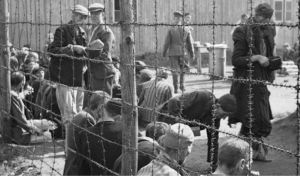
On April 15, 1945, British forces liberated Bergen-Belsen concentration camp in northern Germany. The photographs taken during and after the liberation became some of the most important visual records of the Holocaust’s final months. Imperial War Museums preserves photographs from April 1945 showing the camp, its prisoners, medical conditions, destruction, and the enormous humanitarian crisis encountered by the liberators.
The photographs are difficult because they do not show a distant battlefield. They show a place where human beings had been confined, starved, abused, and killed. The British troops who arrived were not simply entering another military position. They were entering evidence of a crime on a scale that many outside the camp had struggled to comprehend.
And yet even these photographs cannot show everything.
A camera records bodies, buildings, faces, objects, and landscapes. It cannot record every thought of a survivor, every memory of someone who had disappeared, or the full psychological shock experienced by the people who walked through the gates. Perhaps that is why the images remain so powerful. They show us enough to understand that the reality was larger than the photograph.
Only days later, Europe was moving rapidly toward the end of the war. German forces were surrendering in different areas, cities had been devastated, bridges lay broken, and millions of displaced people were trying to understand what remained of their homes.
One photograph of a destroyed bridge captures that collapse of the old world with remarkable simplicity.
A bridge is normally a symbol of connection. It allows people, trains, vehicles, and communities to move from one side to another. In 1945, a destroyed bridge could mean the opposite: isolation, retreat, destruction, and the physical scars left by years of fighting.
Nearby, another image shows a child sitting among the rubble of a bombed building.
There is no battlefield visible.
No advancing army.
No aircraft.
Just a child and the remains of a building.
That may be why such photographs are remembered. The destruction of war becomes understandable through something small enough to comprehend: one person sitting where a home or neighborhood once stood.
Elsewhere in Europe, another photograph presents an unexpected contrast. German soldiers are shown comforting a distressed child.
The image does not erase the crimes of Nazi Germany or the violence of the war. Instead, it captures something more complicated about human behavior under extreme circumstances. Even inside an army responsible for enormous destruction, individual moments could contain gestures of care. History becomes uncomfortable when it refuses to divide every photograph into simple categories of good and evil.
The final months of the war produced another complicated set of images: German soldiers surrendering to Allied forces, civilians leaving ruined communities, and prisoners encountering liberators.
For many soldiers, surrender meant defeat.
For many civilians, it meant uncertainty.
For survivors, liberation could mean something even more difficult: survival itself.
A photograph of a returning soldier in 1945 therefore carries a different emotional meaning. After years of absence, a uniformed man could finally walk back toward a family that had spent years wondering whether he would ever return.
The celebration was real.
So was everything that had been lost.
That contradiction appears again and again in historical photography. One frame can contain relief and grief simultaneously.
Before the war ended, another technological revolution was already transforming the modern world.
On February 8, 1953, an experiment involving extremely low atmospheric pressure demonstrated how scientists were attempting to understand conditions associated with very high altitude. A man in a pressure suit stands beside equipment designed to simulate an environment radically different from ordinary human life.
The photograph looks almost surreal.
A person appears to be standing inside a laboratory while apparently preparing for another world.
But the early Space Age depended on experiments like these. Before humans could safely travel higher and faster, scientists had to understand pressure, temperature, oxygen, equipment, and the limits of the human body.
The strange photograph therefore represents more than an unusual experiment.
It represents a question.
How far could humans go before the environment itself became impossible?
That question would soon become central to aviation and space exploration.
Long before astronauts, however, people were experimenting with other unusual forms of technology.
Pigeons were fitted with miniature cameras in early attempts to obtain aerial photographs. The idea now sounds almost unbelievable because drones and satellites have made overhead imaging routine. Yet early photographers and inventors had to think creatively about how to place cameras above the ground.
A pigeon carrying a camera could become a primitive flying platform.
The technology was crude.
The concept was extraordinary.
And once again, the photograph preserves the moment before a technology becomes normal.
The same spirit of experimentation appears in aviation photographs from the early twentieth century. Aircraft designers experimented with retractable landing gear, improved engines, stronger structures, and more efficient shapes. The Boeing Y1B-9, for example, represented a significant step in the development of high-speed all-metal bombers.
The aircraft itself now looks almost primitive compared with modern aviation.

But every advanced machine begins as something that looks strange to the people seeing it for the first time.
That is one of the hidden stories inside old photographs: the future often looks ridiculous before it looks inevitable.
The Golden Gate Bridge provides another remarkable example.
During construction in the 1930s, chief engineer Joseph Strauss insisted on unusually strict safety measures. A huge safety net was installed beneath the roadway. According to the Golden Gate Bridge authorities, the net ultimately saved the lives of 19 workers, who became known as the “Halfway-to-Hell Club.” Eleven workers nevertheless died during construction.
Look at photographs of those workers and it becomes difficult to understand how they tolerated the height.
They worked above the water, surrounded by wind, steel, cables, and fog.
The bridge that now seems permanent was once an unfinished skeleton.
Every completed monument has a period when it is still uncertain whether the project will succeed.
The same is true of cities.
In San Francisco in 1908, a Victorian house was photographed being moved by teams of horses. Urban development did not always mean demolishing older buildings. Sometimes entire houses were physically transported to make room for new roads, construction, or changing neighborhoods.
The image is almost absurd to modern eyes.
A house becomes a vehicle.
A street becomes a construction site.
And the city becomes something constantly rearranging itself.
London experienced similar transformations.

Photographs of old markets, medieval buildings, motor scooters, workers, and changing streets reveal a city layered with centuries of history. Structures survived, disappeared, changed purpose, or were moved. The modern city was gradually being built on top of the medieval one.
That layering is one reason historical photographs matter so much.
A building that appears ordinary today may have once been new.
A street that looks familiar may once have been unrecognizable.
A person who appears anonymous may have witnessed something extraordinary.
Lewis Hine understood this particularly well.
His photographs of working children and laborers in the United States were not simply snapshots. Hine used photography as a tool for social documentation, drawing attention to working conditions that many Americans might otherwise never have seen.
One photograph of Boston newsboys captures young newspaper sellers gathered beside a dog. The scene may initially appear cheerful.
But Hine’s larger body of work reminds us to look again.
Who were these children?
Why were they working?
What did their days look like when the photographer was not present?

The answers mattered because child labor was not an abstract political issue for the children themselves. It was daily life.
Another photograph from this broader period shows workers, streets, factories, or families simply continuing with their routines.
That is perhaps the most revealing aspect of old photographs.
They rarely tell us everything.
They force us to ask.
The photographs of rural Ireland, traditional Swedish clothing, early twentieth-century China, New York streets, California beaches, and European mountain landscapes reveal societies before globalization made visual culture increasingly uniform.
An Irish spinner working wool by hand represents an economy in which household production remained part of ordinary life.
A Swedish bride in traditional dress preserves a moment of cultural identity.
Street photographs of China from roughly a century ago show markets, clo
Để lại một bình luận