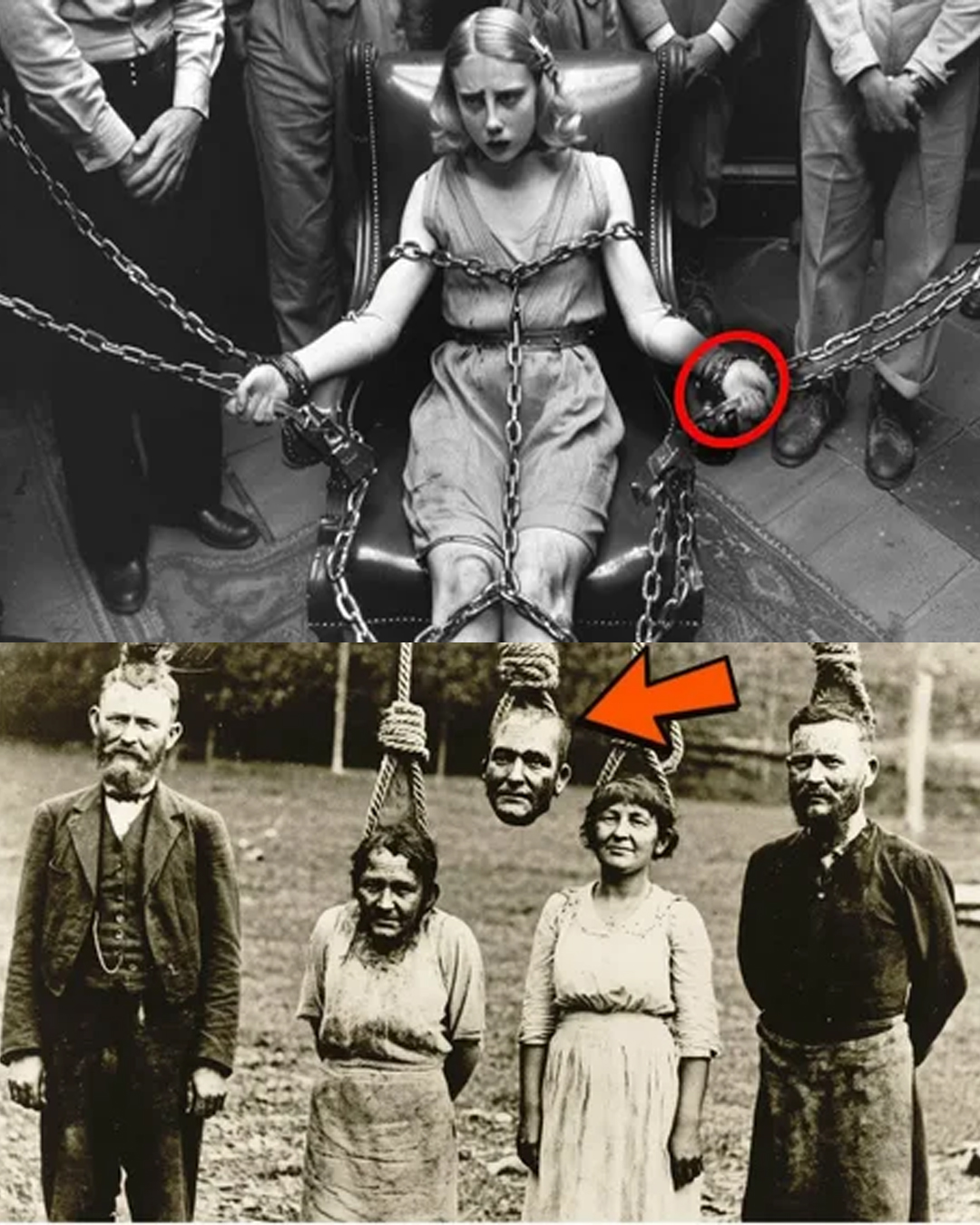
Some historical photographs seem ordinary at first glance. A family stands outside a house. Workers gather around a machine. A celebrity laughs between takes. A crowd fills a city street. A strange vehicle sits motionless on a road.
But photographs have a peculiar power. They preserve details that official histories often leave behind: the clothing people wore, the machines they trusted, the places where they lived, the expressions on their faces, and the strange ideas that once seemed completely normal.
Look closely enough, and an old photograph can become something more than an image. It becomes a doorway into a vanished world.
In Ireland during the late nineteenth century, disputes over land and eviction could become deeply personal. The land question was not simply about property on paper. For families living in rural communities, losing a home could mean losing the foundation of an entire life. Photographs and contemporary records from this era therefore capture more than confrontations between tenants and authorities. They belong to a larger history of poverty, land ownership, resistance, and political change.
Decades later, warfare produced photographs of an entirely different kind. During the Second World War, military planners increasingly understood that survival could depend on whether an aircraft crew could see a target from above.
By 1941, camouflage techniques had become increasingly sophisticated. Nets, ropes, coverings, and artificial concealment could be placed over roads, vehicles, equipment, and positions to make movement harder to detect from the air.

The principle was simple: if an enemy could not easily distinguish a road or vehicle from the surrounding landscape, observation became more difficult.
It was a reminder that modern warfare was becoming a contest not only of weapons, but also of visibility.
Around the same period, aviation engineers were pushing in the opposite direction.
Instead of hiding aircraft, they were trying to make them faster, more capable, and more efficient.
The Messerschmitt Bf 109 became one of the most recognizable fighter aircraft of the Second World War. Its development reflected the extraordinary speed with which aviation technology was changing during the 1930s and early 1940s.
Within only a few decades, aircraft had evolved from fragile machines of wood and fabric into sophisticated metal fighters capable of speeds that earlier generations could scarcely imagine.
And yet history does not always move through giant machines and battlefields.
Sometimes it moves through something as strange as a device placed against a human face.
In the early 1930s, cosmetics pioneer Max Factor was associated with the development of the so-called beauty micrometer, an elaborate apparatus designed to measure facial features.
It looked less like a beauty instrument than something from a laboratory.
The device was intended to identify facial proportions and help determine where makeup might be used to alter or balance particular features. It was developed partly in response to the demands of the film industry, where close-up photography and powerful lighting could make small imperfections much more visible.
Today, the idea of measuring a face mechanically in order to determine cosmetic corrections seems bizarre.
At the time, however, it represented the growing intersection of science, technology, photography, and Hollywood.
The same century that produced machines capable of measuring a human face also produced governments increasingly interested in controlling how people looked in public.
In South Korea during the 1970s, government campaigns included regulations and social controls concerning hairstyles and clothing. These measures reflected a period in which authorities sought to influence public behavior and appearance as part of broader social policies.
A photograph of such a moment can be difficult to understand without context.
A haircut may look trivial to someone viewing it decades later.
But when appearance itself becomes regulated, something as personal as hair can become connected to questions of authority, conformity, and individual freedom.
Other photographs reveal a very different side of everyday life.
In early twentieth-century New York, images of children living under difficult urban conditions documented a city experiencing enormous economic and demographic change.
Children were often visible on streets, in markets, and around working districts because urban poverty was not something that could simply be hidden behind apartment doors.
Their presence reminds us that the modern city was built not only by architects and industrialists, but also by families trying to survive within it.
Thousands of miles away, another photograph could place viewers inside an entirely different world.
In the Horn of Africa during the 1970s, territorial disputes and regional conflicts created instability involving Somalia, Ethiopia, and armed movements including the Western Somali Liberation Front.
Such photographs can be especially deceptive.
A single frame may show only a few people, a vehicle, or a group of fighters. Yet behind that apparently simple scene were questions of territory, nationalism, borders, and the legacy of colonial-era boundaries.
Then, suddenly, history becomes personal again.
One of the strangest photographs associated with Alfred Hitchcock’s household shows his wife, Alma Reville, beside a refrigerator containing a wax replica of Hitchcock’s head.
It sounds almost too strange to be true.
But Hitchcock had a lifelong fascination with macabre humor, and the image fits the playful darkness that often surrounded his public persona.
It is precisely this kind of photograph that gives historical collections their character.
Not every important image depicts a war, a president, or a scientific breakthrough.
Sometimes the photographs people remember most are the ones that reveal how unusual ordinary life could be.
The entertainment world of the twentieth century produced countless such moments.
John Belushi’s photographs from the early 1980s belong to the final chapter of a remarkably brief but influential career. His work with Saturday Night Live and in films such as Animal House helped make him one of the defining comedy performers of his generation.
Images from this period carry a particular poignancy because viewers know what happened later.
But historical photographs should not be reduced entirely to hindsight.
When the camera captured Belushi, it was recording a living performer at a specific moment, surrounded by the culture of American comedy that had made him famous.
Space exploration produced another kind of photograph in which an apparently simple image carried enormous significance.
In the early years of human spaceflight, animals were used in experiments designed to investigate how living organisms responded to the conditions of flight.
One of the most famous was Ham, a chimpanzee launched aboard Mercury-Redstone 2 in January 1961.
Ham survived his flight and became part of the story of America’s preparation for human spaceflight.
The photograph of a chimpanzee after landing may appear almost charming today.
At the time, however, it represented an important scientific question: could a living creature perform tasks during spaceflight and survive the journey?
The answer helped clear another step toward putting humans into orbit.
Not all technological photographs show machines soaring upward.
Some show machines moving through snow and ice.
One unusual photograph from the Soviet period depicts soldiers interacting with bears while operating a tracked vehicle in a cold environment. Such images remind us that historical photographs often capture moments that were never intended to become symbols.
They simply happened.
And sometimes the most intimate images involve people who would soon become historical figures.
In January 1917, the five children of Tsar Nicholas II and Alexandra Feodorovna were photographed with their heads shaved after suffering from measles.
The image is especially striking because of what came afterward.
Only weeks later, the political order that had governed Russia for generations would begin to collapse.
The photograph itself contains no obvious sign of revolution.
There are simply five children.
But historical knowledge changes how we see them.
Within a short time, the Romanov family would be swept into events that transformed Russia and ultimately brought the imperial dynasty to an end.
That is one of photography’s greatest mysteries.
The camera cannot tell us what will happen next.
We can.
During the economic crisis of the 1930s, photographs across the United States documented families moving in search of work and stability.
The Great Depression transformed the meaning of mobility.
Moving from one state to another was sometimes less a choice than a response to economic necessity.
Families packed what they could carry and travelled toward places where they hoped employment might exist.
The same decade that produced images of hardship also produced images of extraordinary technological ambition.
By the 1940s, cities were being rebuilt and reorganized around automobiles, airplanes, electricity, telephones, and mass production.
After the liberation of Paris in 1944, photographs of cafés reopening and ordinary people returning to the streets represented something more profound than a meal or a cup of coffee.
They represented the restoration of ordinary life after occupation.
A plate of food could become a symbol of normality.
A café could become a sign that a city was beginning to breathe again.
During the Second World War, shortages produced their own unusual photographs.
In the United States and elsewhere, women sometimes used cosmetics or leg makeup to create the appearance of stockings when nylon was scarce.
The solution was partly practical and partly psychological.
Stockings were not merely clothing. They were part of fashion and personal presentation.
When materials disappeared because they were needed for the war effort, people adapted.
Another apparently trivial object became the subject of controversy: the pinball machine.
From the 1940s into later decades, some American cities restricted or banned pinball because authorities associated the machines with gambling, organized crime, or other undesirable activities.
Machines were sometimes confiscated and destroyed.
Today, that history can seem surprising.

Pinball is now generally remembered as entertainment.
But the episode demonstrates how quickly public attitudes toward technology can change.
A machine considered suspicious by one generation may become nostalgic to another.
Transportation reveals the same pattern.
In Tokyo, crowded railway stations became symbols of a rapidly modernizing society. By the 1960s, passenger volumes were enormous, and station staff sometimes physically helped compress passengers into trains during peak periods.
The famous photographs of workers assisting passengers at crowded platforms capture an extraordinary moment in the development of urban mass transportation.
The city was learning how to move millions of people through limited physical space.
In New York, another transportation-related spectacle appeared in 1917.
The USS Recruit was a full-sized wooden battleship replica constructed in Union Square as a recruiting and promotional installation for the U.S. Navy.
It could look almost surreal in photographs: a battleship apparently sitting in the middle of Manhattan.
But its purpose was practical.
It brought the imagery of naval service directly into the city and served as a recruitment center during the First World War.
The photograph is therefore more than a curiosity.
It reveals how governments and institutions used spectacle to communicate with the public long before modern digital advertising.
The Second World War produced even larger logistical systems.
American aircraft such as the F4U Corsair and F6F Hellcat were assembled, transported, and prepared for deployment across enormous distances.
Behind every combat aircraft was an industrial network involving factories, mechanics, shipping facilities, fuel, spare parts, and thousands of workers.
Photographs of rows of aircraft waiting for shipment show the industrial scale of modern warfare.
Then, after the war, technology began moving in another direction.
Instead of producing machines primarily for destruction, engineers increasingly designed machines to change daily life.
One of the most remarkable examples came from Manhattan in 1982.
Artist Agnes Denes planted a field of wheat on a landfill in lower Manhattan, close to Wall Street and the World Trade Center.
For several months, golden wheat grew in a place surrounded by skyscrapers and financial institutions.
Denes’s Wheatfield — A Confrontation covered about two acres and was planted and harvested as an artwork.
The contrast was almost impossible to ignore.
Concrete and steel surrounded wheat.
Financial power surrounded agriculture.
The project questioned assumptions about land, value, food, commerce, and the relationship between urban civilization and the natural world.
It remains one of the most extraordinary examples of how a photograph can preserve not simply an event, but an idea.
Around the same broad period, other photographs documented monuments that seemed permanent.
The Eiffel Tower was being constructed in Paris in the late nineteenth century as part of preparations for the 1889 Exposition Universelle.
The Golden Gate Bridge later transformed the San Francisco skyline.
When the Golden Gate Bridge opened to pedestrians on May 27, 1937, thousands crossed its roadway on foot. The following day, it opened to vehicles.
Photographs from the opening capture more than an engineering achievement.
They capture a society witnessing its physical environment change before its eyes.
The same feeling appears in photographs of scientific pioneers.
Marie Curie working in a laboratory represented a new age of scientific research.
Nikola Tesla experimenting with electrical technology represented another.
Albert Einstein visiting California in 1931 showed how scientific fame had already become international.
These people are now names in textbooks.
But photographs return them to human scale.
They stood in rooms.
They travelled.
They worked.
They paused.
They looked at cameras.
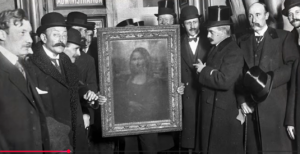
The Mona Lisa offers an even stranger example of historical memory.
In 1911, Leonardo da Vinci’s painting disappeared from the Louvre after being stolen by Vincenzo Peruggia. The theft triggered enormous public attention, and the painting remained missing for more than two years before being recovered.
A photograph or newspaper image associated with the painting’s return therefore belongs to a story much larger than art.
It reminds us that even objects now treated as almost untouchable cultural treasures can once have been vulnerable to ordinary human actions.
Technology continued to reshape everyday life.

Sony’s TV8-301, introduced in 1960, was the world’s first direct-view portable transistor television, according to Sony’s corporate history.
The importance of such a device was not simply its size.
Television was beginning to escape the living room.
Information and entertainment could become mobile.
That transition would eventually lead toward the screens carried in almost every pocket today.
The story of computing followed an even more dramatic trajectory.
In 1946, the University of Pennsylvania introduced ENIAC, the first general-purpose electronic programmable computer.
It was enormous by modern standards.
Yet the machine helped establish a new technological direction.
The computers surrounding us today are descendants of a world in which electronic calculation was still an astonishing novelty.
Some historical photographs, however, have nothing to do with technology.
They are about people.
Vince Lombardi and the Green Bay Packers became central figures in professional football during the 1960s. Lombardi led the Packers to five NFL championships, including victories in the first two Super Bowls.
Larry Bird and Magic Johnson later became central figures in another era of American sports.
Their rivalry helped define professional basketball during the 1980s, while their careers continued to influence the sport long after their playing days.
Wayne Gretzky became another symbol of sporting excellence in ice hockey.
These photographs are different from images of wars or revolutions, but they reveal something equally important.
History is also made through culture.
Movies, music, sports, television, and fashion become part of the memories through which entire generations understand themselves.
Behind the scenes, the photographs become even more revealing.
Images from the production of Star Wars show actors and filmmakers working on a film that would become one of the defining cultural productions of the twentieth century.
Peter Mayhew, Carrie Fisher, and other performers could be seen away from the finished spectacle.
Kenny Baker could be photographed between takes.
Suddenly the fantasy disappears.
What remains is a film set filled with people, costumes, equipment, schedules, and ordinary moments of waiting.
That contrast is part of what makes behind-the-scenes photography so valuable.
The finished movie gives us the illusion.
The photograph gives us the work behind it.
The same applies to music.
Photographs of Freddie Mercury and Michael Jackson together evoke an extraordinary period in popular music. Images of Led Zeppelin backstage capture musicians away from the stage lights. Photographs of Cher, Elton John, Diana Ross, David Bowie, Dolly Parton, Ozzy Osbourne, and countless others preserve moments from eras that now exist only in memory.
Some photographs show friendships.

Others show collaborations.
Still others simply document people before they became the figures we now recognize.
That distinction matters.
When we look backward, we know the ending.
The people in the photograph did not.
A young actress standing beside her child did not know what future fame might bring.
A young musician did not know which songs would define a career.
A young athlete did not know which victories would become legendary.
A young politician did not know whether history would remember his name.
Photographs freeze people before the future has happened.
That may be why photographs of famous people when they were young can feel so strangely intimate.
The same is true of photographs connected to political history.
A 1937 image showing Frida Kahlo with Leon Trotsky and Natalia Sedova records a moment during Trotsky’s exile in Mexico. The photograph is dated January 9, 1937 in the archival record.
Years later, many people would recognize the names immediately.
At the time, however, they were simply people living through a complicated political and personal period.
The distance between those two perspectives is one of the defining characteristics of historical photography.
And sometimes an image captures an entire society at once.
On August 14, 1945, crowds gathered in Times Square after news of Japan’s surrender spread through New York. The Library of Congress identifies the photograph as a V-J Day image taken by Dick DeMarsico.
Look at the crowd and the meaning becomes clear without requiring a caption.
People are waving.
People are gathering.
People are celebrating.
The war that had dominated so many lives was ending.
For those people, the photograph was not history.
It was the present.
The same principle explains why ordinary photographs can become more valuable with time.
A frozen fountain in Detroit during a harsh winter may seem insignificant.

A sausage vending machine in a German railway station may look amusing.
A mobile library vehicle may appear quaint.
A gas-powered taxi in Norway may seem primitive.
A service station in postwar Europe may look familiar yet strangely distant.
A family watching its first television set can look almost exactly like a modern family watching a new device for the first time.
The technology changes.
The reaction often does not.
People remain curious.
They adapt.
They improvise.
They become fascinated by new machines and nostalgic about old ones.
They build bridges, invent vehicles, create art, produce films, play music, compete in sports, and try to make ordinary life easier.
And then the camera captures one moment.
That is why these photographs matter.
They do not give us the whole past.
No photograph can.
They give us fragments.
A child.
A machine.
A street.
A battlefield.
A laboratory.
A theater.
A factory.
A crowded station.
A wheat field growing beneath skyscrapers.
A group of people who had no idea that someone would one day study their faces and ask what their world was like.
History is often taught through dates and names.
Photographs remind us that history was also lived through ordinary mornings, difficult journeys, strange inventions, crowded streets, family gatherings, working days, celebrations, disappointments, and moments nobody present could have recognized as historically important.
The most fascinating photograph may therefore not be the one showing the greatest event.
It may be the one that makes us stop and wonder what happened immediately before the shutter clicked — and what happened after everyone walked away.
Because every photograph contains a moment that ended.
But the world surrounding that moment continued.

And sometimes, decades later, that single frozen second is all we have left through which to imagine it.
What ordinary photograph from the past do you think reveals the most about the world people actually lived in?
Some content was generated using AI tools (including ChatGPT) and edited by the author for creativity, storytelling, and historical illustration purposes. Historical facts and key details should be verified against reliable historical sources. Any AI-generated or reconstructed visuals are intended for illustrative purposes and should not be interpreted as original historical photographs or archival evidence.
Để lại một bình luận