
Buzz Aldrin and the Apollo 11 Moon Landing: What He Really Experienced on the Lunar Surface
Few moments in human history have carried the emotional weight of the first Moon landing.
On July 20, 1969, Apollo 11 astronauts Neil Armstrong and Buzz Aldrin descended toward the lunar surface while Michael Collins remained in lunar orbit inside the command module. For millions watching on Earth, the event represented the triumph of science, engineering and human ambition.
But for the people who actually stood on the Moon, the experience was far more complicated than the iconic television images suggested.
Buzz Aldrin, the second person to walk on the lunar surface, has spent decades reflecting on what Apollo 11 meant—not only as a historic achievement, but as an intensely personal experience that was difficult to translate into words.
His famous description of the lunar environment as “magnificent desolation” captured a contradiction that remains fascinating more than half a century later: the Moon was spectacular, but it was also profoundly empty, silent and unlike anything humans had experienced before.
Apollo 11 Changed Human History Forever
The Apollo 11 mission was not simply another spaceflight.
It was the culmination of years of research, engineering development and enormous national investment during the Space Race. NASA had been given an extraordinary objective: land humans on the Moon and return them safely to Earth.
Armstrong and Aldrin reached the lunar surface in the Lunar Module Eagle, while Collins orbited above them.
When Armstrong stepped onto the Moon, history changed instantly.
Minutes later, Aldrin joined him.
The images transmitted from the lunar surface became some of the most recognizable pictures ever recorded. The astronauts moved slowly across a landscape covered in fine lunar dust, surrounded by mountains, craters and a black sky.
Yet photographs could only communicate part of what the astronauts experienced.
The Moon does not look or behave like Earth.
There is no breathable atmosphere. There is no wind moving across the landscape. There is no ordinary weather. Shadows appear extraordinarily dark, while sunlight is intensely bright.
For an astronaut standing there, the visual environment was unlike anything a human being had previously experienced.
What Did Buzz Aldrin Actually See?
This is where fact and mythology surrounding Apollo 11 often become confused.
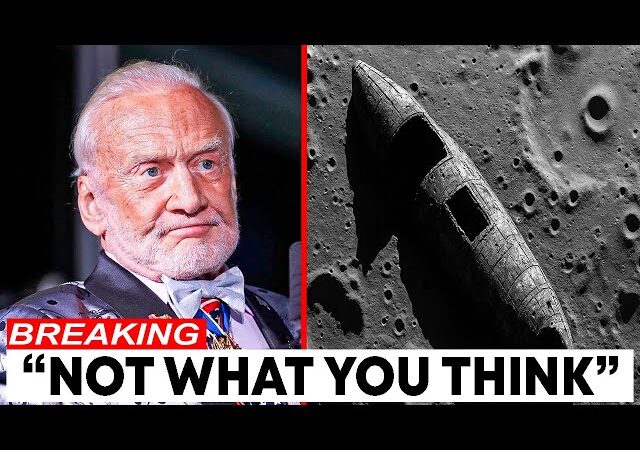
Over the years, countless online stories have claimed that astronauts discovered unexplained objects, artificial structures or evidence of extraterrestrial activity on the Moon.
However, these claims should not be presented as established facts.
There is no verified Apollo 11 evidence demonstrating that Aldrin or Armstrong discovered an alien civilization or mysterious artificial structures on the lunar surface.
What is genuinely remarkable is what they did encounter.
The astronauts observed an ancient geological environment that had been preserved without the erosion processes familiar on Earth. They collected lunar rocks and soil, photographed the surface and conducted scientific experiments.
Their observations helped scientists understand the Moon’s geological history and provided physical samples that researchers could continue studying decades later.
The real story is arguably more extraordinary than many fictional versions.
Humans had traveled nearly a quarter of a million miles through space, landed on another world and returned with pieces of that world in their hands.
The Meaning Behind “Magnificent Desolation”
Aldrin’s phrase, “magnificent desolation,” has become one of the most enduring descriptions of the lunar surface.
The expression works because it captures two opposing emotions.
The Moon is magnificent because of its scale, beauty and historical significance.
At the same time, it is desolate because there are no forests, oceans, animals or atmosphere. The landscape is almost completely silent.
For an astronaut who had spent years preparing to reach the Moon, the reality could be psychologically overwhelming.
The achievement was enormous.
The environment was alien.
And Earth, viewed from the lunar surface, suddenly appeared extraordinarily distant and fragile.
That perspective became one of the most profound themes associated with the Apollo program.
Why Apollo 11 Still Fascinates People Today
More than five decades after the mission, Apollo 11 remains one of the most searched and discussed events in space exploration.
Part of the fascination comes from the technology.
The computers used during Apollo were dramatically less powerful than modern smartphones. Yet engineers successfully navigated astronauts to the Moon, landed them on the surface and brought them safely home.
Another reason is the human story.
Apollo 11 involved risk at every stage.
A malfunction during descent could have ended the mission. A problem with the Lunar Module could have stranded the astronauts. Communication failures, navigation problems or life-support issues could have become catastrophic.
The astronauts knew the risks.
That knowledge makes their calm behavior during the mission even more remarkable.
The Emotional Reality of Returning From the Moon
A Moon landing is often presented as a single triumphant moment.
For the astronauts, however, it was part of a much longer psychological journey.
They spent years training for the possibility of reaching the lunar surface. They experienced extraordinary pressure before launch, intense concentration during the mission and a dramatic transition back to ordinary life afterward.
Returning to Earth did not necessarily mean returning to normal.
Apollo astronauts became global celebrities almost overnight.
They were asked repeatedly to describe an experience that had never happened to anyone before them.
But describing the Moon to people who had never seen it was almost impossible.
A photograph could show the landscape.
A transcript could record their words.
Neither could completely reproduce the experience of standing there.
What Modern Lunar Research Is Revealing
Today, the Moon is once again at the center of ambitious exploration plans.
NASA’s Artemis program and other international and commercial missions are driving renewed interest in lunar science. New spacecraft are examining regions that Apollo astronauts never explored, including permanently shadowed areas near the lunar poles.
Scientists are particularly interested in lunar water ice, surface composition, geological history and the resources that could eventually support sustained human exploration.
This new era sometimes creates sensational headlines suggesting that artificial intelligence has “discovered hidden secrets” that Apollo astronauts somehow missed.
The reality is more nuanced.
Artificial intelligence, machine learning and advanced image-processing techniques can help researchers analyze enormous quantities of scientific data. These technologies may identify patterns that deserve further investigation, but that does not automatically mean they have uncovered extraterrestrial structures or evidence of alien technology.
The distinction matters.
A discovery can be surprising without being extraterrestrial.
AI, Lunar Images and the Search for Hidden Details
Modern spacecraft produce enormous amounts of imagery and scientific measurements.
Researchers can use computational tools to compare images, detect geological features and identify unusual formations. AI-assisted analysis can potentially make this process faster and more systematic.
But an unusual shape in a lunar image is not automatically evidence of something artificial.
The human brain is naturally good at recognizing familiar patterns—even when those patterns occur randomly.
This phenomenon is known as pareidolia.
That is why claims about “faces,” “buildings” or “structures” on the Moon require extraordinary evidence.
Scientific investigation depends on measurements, independent verification and reproducible results—not simply an intriguing photograph.
The Moon Is Not What Popular Culture Imagined
In one sense, the Moon really is “not what you think it is.”
Popular culture has often portrayed it as a simple gray rock floating above Earth.
Modern lunar science paints a much richer picture.
The Moon contains complex geological structures, ancient impact scars, volcanic history, unusual mineral deposits and environments that could preserve water ice.
It is also a record of the early history of the Earth-Moon system.
Every new mission adds another piece to that story.
The greatest mystery may therefore not be whether Apollo astronauts encountered something extraterrestrial.
It may be how much there is still left to learn about a world that humans first visited more than 50 years ago.
What Buzz Aldrin’s Legacy Really Tells Us
Buzz Aldrin’s Apollo 11 legacy extends far beyond being the second person to walk on the Moon.
His experience represents one of humanity’s greatest technological achievements—and one of its most profound psychological experiments.
Humans left Earth.
They traveled to another celestial body.
They walked across its surface.
Then they returned home.
The images remain iconic, but the deeper significance of Apollo 11 continues to evolve.
Today, the Moon is no longer viewed merely as the destination of a historic race. It is increasingly regarded as a laboratory for planetary science, a potential stepping stone for deep-space exploration and a place where future generations could conduct sustained research.
The Real Mystery Is What Comes Next
More than half a century after Apollo 11, the Moon still has the ability to generate enormous curiosity.
Buzz Aldrin’s reflections remind us that the reality of lunar exploration can be more powerful than the mythology surrounding it.
There is no need to invent an alien encounter to make Apollo 11 extraordinary.
The verified story is already astonishing.
Two humans stood on another world while a third astronaut orbited above them. They conducted experiments, collected samples and returned safely to Earth.
And now, a new generation of spacecraft, scientists and AI-powered research tools is beginning to examine the Moon in ways the Apollo astronauts could never have imagined.
Perhaps the most important lesson from Apollo 11 is not that the Moon hides a secret civilization.
It is that humanity has only begun to understand the world beyond Earth.
And the next discovery could come not from a dramatic confession, but from the careful analysis of evidence that has been waiting for us all along.
Để lại một bình luận