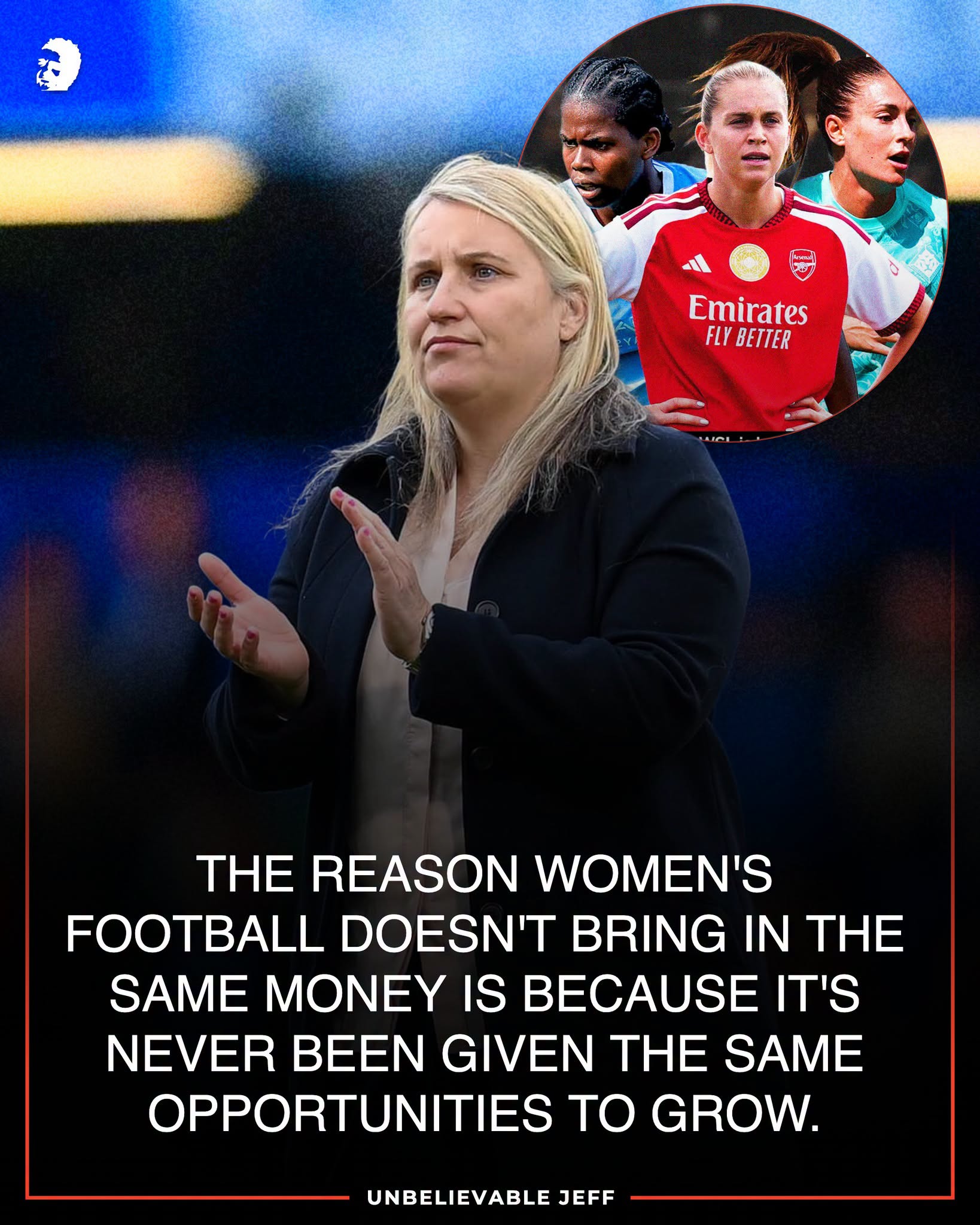
Emma Hayes has spent much of her career pushing women’s football forward, but one of her most important messages is not about tactics, trophies or individual players. It is about the system surrounding the sport — and why the women’s game still has not been given the same opportunity to develop at the speed of the men’s game.
The current head coach of the United States Women’s National Team has repeatedly challenged football’s traditional assumptions, arguing that women’s football should not simply copy the men’s model.
Instead, Hayes believes the women’s game needs to be understood on its own terms.
That argument has become increasingly relevant as women’s football enters a new commercial era.
The sport is attracting larger audiences, bigger sponsorship agreements, growing broadcast interest and increasingly valuable media rights. In England, the Women’s Super League has undergone major commercial expansion since becoming an independent entity, with sponsorship and broadcasting revenues rising sharply.
Yet the growth also exposes an uncomfortable question:
Is women’s football actually developing as quickly as its popularity suggests?
For Hayes, the answer appears to be more complicated than simply putting more money into the sport.
Emma Hayes Has Never Been Afraid to Challenge Football’s Status Quo
Hayes built her reputation as one of the most successful managers in women’s football during her long spell at Chelsea.
She won seven Women’s Super League titles during 12 years in charge of the club before leaving in 2024 to become head coach of the United States.
Her success gave her unusual authority to discuss the structural problems facing the women’s game.
This is important.
Hayes is not criticizing women’s football from the outside.
She has spent years working inside it.
She has experienced the limitations of facilities, staffing, refereeing, player development, commercial investment and media attention firsthand.
And throughout her career, she has repeatedly argued that progress cannot simply mean copying the men’s football structure.
In 2025, Hayes argued that the sport should look at women’s soccer through a “female lens”, saying that the sporting and commercial sides of the women’s game can benefit from approaches different from those used in men’s football.
That idea could become one of the defining debates of the next decade.
Women’s Football Is Growing — But Growth Is Not the Same as Equality
There is no question that women’s football has made extraordinary progress.
The audience is bigger.
The commercial opportunities are larger.
Major clubs are investing more seriously.
Players have become household names.
Sponsors increasingly see women’s sport as an important marketing and advertising opportunity.
The business case is becoming stronger.
Recent developments around the WSL demonstrate just how rapidly the commercial environment is changing. The league’s sponsorship and broadcasting revenues have nearly doubled to £17.4 million in its first year as an independent entity, while major commercial partnerships have expanded the league’s financial reach.
That is significant.
But commercial growth can hide structural problems.
A league can generate more revenue while still struggling with facilities.
Players can become social-media stars while youth pathways remain unequal.
Television audiences can increase while some matches still receive limited exposure.
And major clubs can invest heavily in their first teams while the wider football pyramid develops more slowly.
That distinction is at the heart of the conversation.
The Infrastructure Problem
One of Hayes’ long-running concerns has been infrastructure.
In 2023, she criticized the situation after a Women’s Super League match between Chelsea and Liverpool was abandoned because of an unsafe frozen pitch at Kingsmeadow. The stadium did not have undersoil heating, raising broader questions about whether elite women’s football was receiving adequate facilities.
The incident became symbolic of a much bigger problem.
Professional sport requires professional infrastructure.
That means quality pitches.
Training centers.
Medical facilities.
Sports science.
Recovery technology.
Travel arrangements.
Performance staff.
Analysis departments.
Youth development.
And appropriate match venues.
The women’s game has improved enormously in many of these areas, but Hayes’ broader point remains relevant:
If the sport wants world-class performance, it needs world-class infrastructure.
Why Copying the Men’s Game May Not Be Enough
One of the most interesting elements of Hayes’ philosophy is that she does not believe women’s football should simply become a smaller version of men’s football.
That distinction matters.
Women athletes have different physiological considerations.
Player development can require different approaches.
Injury prevention can require specialized research.
Commercial audiences can behave differently.
Supporter culture can develop differently.
And the history of women’s football is fundamentally different from the history of men’s football.
Hayes has specifically raised concerns about sports science research being disproportionately based on male athletes and argued that some strength and performance programs may need to be better adapted to female athletes.
This is not simply a football argument.
It is a sports-performance argument.
The more professional women’s football becomes, the more important specialized research will become.
The Hidden Business Opportunity
This is where the conversation becomes particularly interesting for investors, brands and the wider sports industry.
Women’s football is increasingly becoming a commercial opportunity in its own right.
Sponsors are no longer looking at women’s sport purely as a corporate social responsibility project.
They are increasingly interested in audience growth, brand visibility, customer engagement and long-term commercial returns.
The WSL’s recent commercial expansion illustrates that shift. Major brands including Nike, Apple and British Gas have been involved in the league’s commercial ecosystem, while broadcasting agreements with Sky and the BBC have strengthened the league’s media profile.
That creates a potentially powerful cycle:
More investment → better facilities → better competition → stronger audiences → greater sponsorship value → more investment.
But the cycle only works if the money is reinvested strategically.
Simply increasing marketing budgets will not solve every problem.
Long-term development requires investment at multiple levels.
Youth Development Could Be the Biggest Test
One of the most important questions for women’s football is what happens below the elite level.
The sport needs a reliable pipeline of talent.
That means young girls must have access to:
- Quality coaching
- Safe facilities
- Competitive matches
- Medical support
- Strength and conditioning
- Appropriate education
- Scouting networks
- Financially sustainable pathways
Hayes has previously warned about the accessibility of women’s football in England and argued that the current academy structure risks losing talented players from less affluent and more diverse communities.
That concern goes far beyond Chelsea.
If the sport wants to become genuinely global, talent identification cannot depend heavily on where a player happens to grow up.
The next superstar may not come from the traditional football pathway.
The industry has to be prepared to find her.
The Commercialization Question
There is another debate emerging as women’s football becomes more commercially successful.
How much commercialization is too much?
Women’s football needs money.
There is no serious argument against that.
Players need better salaries.
Clubs need better facilities.
Competitions need stronger marketing.
Broadcasters need compelling products.
Young players need development opportunities.
But commercial growth also brings risks.
Recent discussion around the WSL has highlighted concerns about maintaining strong connections between clubs and supporters as the league becomes increasingly commercialized.
This creates a delicate balance.
The sport needs to grow without losing the identity that attracted many of its supporters in the first place.
That means commercial strategy cannot simply be about maximizing short-term revenue.
It must also build long-term loyalty.
Why Media Coverage Matters
Visibility is another critical part of the equation.
A sport cannot become commercially powerful if people cannot easily watch it.
Broadcasting creates exposure.
Exposure creates familiarity.
Familiarity creates stars.
Stars create audiences.
Audiences attract sponsors.
Sponsors create investment.
That is the basic commercial cycle.
Women’s football has made significant progress in this area, but consistency matters.
Fans need to know when games are being played.
Matches need reliable distribution.
Highlights need to be easily accessible.
Players need storytelling beyond match reports.
And broadcasters need to treat women’s football as premium sports content rather than an occasional add-on.
This is particularly important for younger audiences who increasingly discover athletes through digital platforms rather than traditional television.
The Role of Star Players
Players such as Alessia Russo, Chloe Kelly and other England internationals are becoming increasingly important to this ecosystem.
They are athletes.
But they are also recognizable personalities.
Their performances create headlines.
Their interviews generate engagement.
Their social-media presence introduces new audiences to the sport.
Their commercial partnerships create opportunities for brands.
That does not mean the game should become personality-driven at the expense of football.
It means the sport should recognize the value of its stars.
The men’s game understood this decades ago.
Women’s football is now developing its own generation of marketable sporting personalities.
That could become a major driver of commercial growth.
Why Coaching Equality Remains a Major Issue
Hayes has also been outspoken about the limited opportunities available to women coaches in men’s football.
In 2024, she argued that men’s clubs were not yet ready to appoint female head coaches, pointing out that women can become pilots, doctors, lawyers and bankers but remain almost completely absent from permanent senior management positions in men’s professional football.
The issue raises an uncomfortable question.
If football genuinely believes coaching ability should be based on competence, experience and results, why is the pathway so different?
This does not mean every female coach should automatically receive a men’s job.
Nor does it mean every male coach is unsuitable for women’s football.
The stronger argument is about opportunity.
Who gets the chance to prove themselves?
Who gets considered?
Who gets investment?
Who gets access to elite coaching roles?
Those decisions shape the future of the entire sport.
Women’s Football Has Its Own Tactical Identity
There is also an important footballing argument behind Hayes’ philosophy.
Women’s football should not constantly be judged against men’s football.
The two games share the same basic principles, but they can develop different tactical characteristics.
Research examining elite men’s and women’s competitions from 2020 to 2025 found substantial tactical evolution in both, with women’s competitions showing particularly strong rates of change across several measures.
That suggests the women’s game is not simply waiting to “catch up.”
It is developing.
It is experimenting.
It is creating its own tactical trends.
And that should be celebrated.
The goal should not necessarily be to make women’s football identical to men’s football.
The goal should be to make women’s football excellent on its own terms.
The Financial Case for Investing Earlier
For businesses and investors, this creates an interesting long-term opportunity.
Early-stage investment in women’s football can potentially produce greater returns as the market expands.
The logic is straightforward.
A growing audience creates greater media value.
Greater media value attracts sponsors.
Sponsors create additional revenue.
Revenue allows clubs to improve infrastructure.
Better infrastructure improves the product.
A better product attracts more fans.
This is a long-term growth strategy rather than a short-term marketing campaign.
The recent expansion of WSL commercial partnerships demonstrates that the market is already moving in this direction.
The next challenge is making sure that growth reaches beyond the biggest clubs.
The Danger of a Two-Speed Women’s Game
Perhaps the biggest threat is the development of a two-speed system.
At the top, wealthy clubs may have:
- Elite training facilities
- International stars
- Large commercial teams
- Strong medical departments
- Major stadiums
- Global audiences
Lower down the pyramid, the resources can be dramatically different.
That creates competitive imbalance.
It also creates a development problem.
If young players outside the biggest clubs cannot access quality facilities and coaching, the overall talent pool becomes smaller.
A healthy football ecosystem needs strong foundations.
The Premier League did not become a global sports business overnight.
It was built on decades of infrastructure, investment, broadcasting development and commercial growth.
Women’s football is now building its own version of that ecosystem.
The question is whether it will be given enough time and investment to do it properly.
Emma Hayes’ Bigger Message
The most important part of Hayes’ argument may therefore be easy to miss.
She is not saying women’s football has failed.
Quite the opposite.
The extraordinary growth of the sport proves what is possible.
Her argument is that the next stage requires a different level of thinking.
The sport cannot simply ask:
“How do we make women’s football look like men’s football?”
It should ask:
“What does women’s football need to become the best version of itself?”
That is a much more ambitious question.
It includes sports science.
It includes facilities.
It includes youth development.
It includes coaching.
It includes commercial strategy.
It includes broadcasting.
And it includes the relationship between clubs, players and supporters.
The Next Decade Could Change Everything
Women’s football is approaching an important moment.
The foundations are stronger than they were a decade ago.
The audience is larger.
The commercial market is developing.
Players are becoming global personalities.
Major clubs are taking the women’s game increasingly seriously.
But the next phase will determine whether the sport becomes a genuinely sustainable global industry or remains heavily dependent on a small number of elite organizations.
That is why voices such as Emma Hayes matter.
She has experienced the growth from inside the game.
She has won trophies.
She has managed elite players.
She has worked in two of the world’s most important women’s football markets.
And she continues to argue that progress requires more than simply putting women’s football beside the men’s game and expecting the same formula to work.
Final Thoughts: The Women’s Game Doesn’t Need to Be a Copy
The debate sparked by Emma Hayes ultimately leads to a powerful conclusion.
Women’s football does not need to become men’s football.
It needs the resources, investment, infrastructure and opportunity to become the best version of itself.
The commercial opportunity is enormous.
The audience is growing.
The players are ready.
The coaches are ready.
The fans are ready.
The question is whether the football industry is ready to invest for the long term.
And that may be the real challenge facing women’s football.
The next breakthrough may not come from one superstar or one trophy.
It may come from better academies, smarter sports science, stronger commercial strategies, improved facilities, greater media exposure and a system capable of finding talent wherever it exists.
Emma Hayes has spent years winning matches. Now, her broader argument is about something much bigger: winning the long-term battle to build a women’s football ecosystem that no longer has to measure its potential against the men’s game.
And if the sport gets that transformation right, the financial, sporting and cultural impact could be far greater than many people currently realize.
Để lại một bình luận