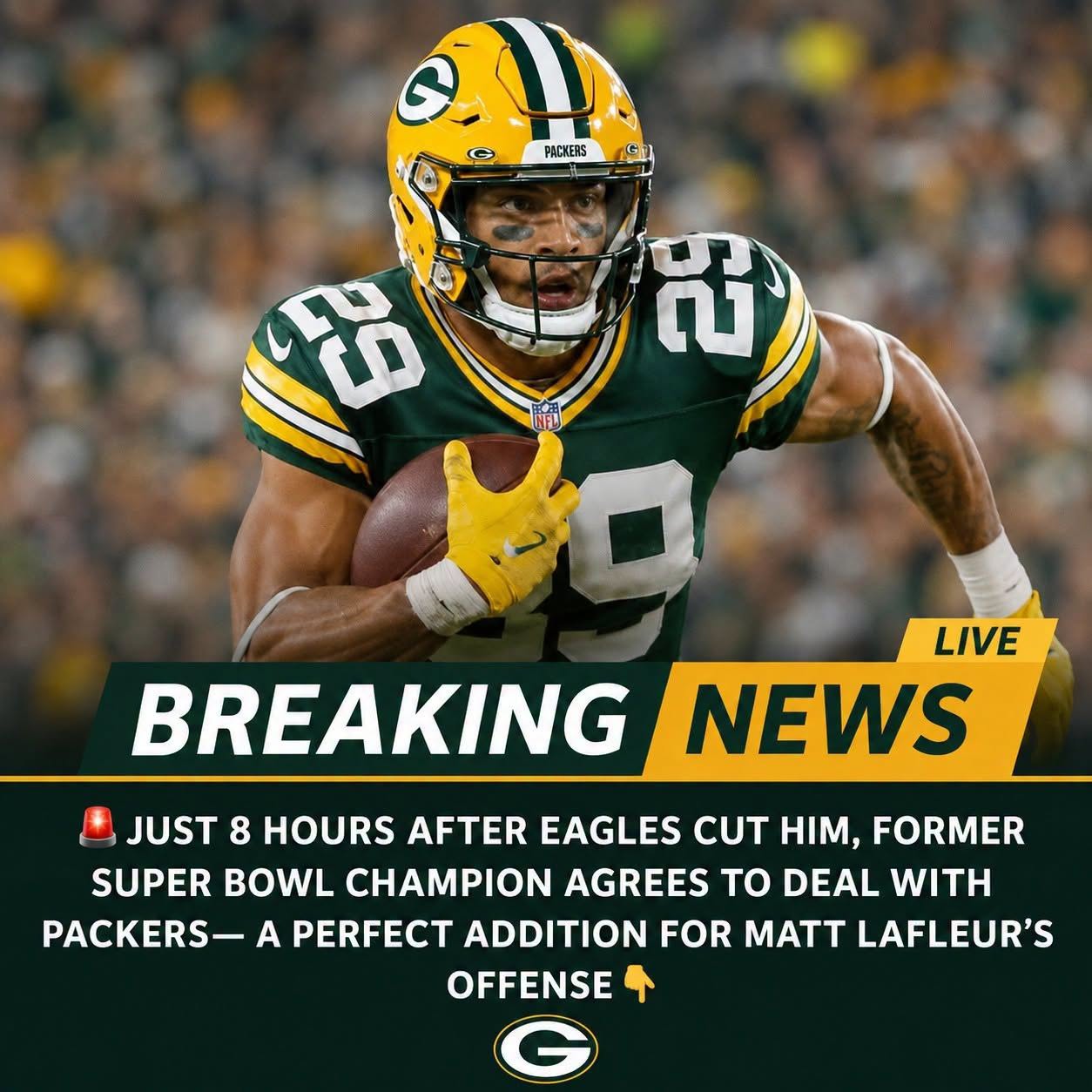
GREEN BAY — Johnny Wilson certainly looks like the kind of player who could create immediate curiosity inside Matt LaFleur’s offense.
He is 6-foot-6.
He has an enormous catch radius.
He has experience blocking in a physical Philadelphia offense.
And his unusual frame gives coaches possibilities that go far beyond simply lining him up as a conventional wide receiver.
That is why a developing story claiming Wilson moved quickly from Philadelphia to Green Bay sounded believable.
There is only one major problem.
It did not happen.
The Philadelphia Eagles officially waived Wilson with an injury designation on August 21.
After no NFL team claimed him, Wilson reverted to Philadelphia’s injured reserve the following day. (Philadelphia Eagles)
That means he is not currently a Packers player.
He did not sign with Green Bay eight hours after leaving Philadelphia.
And unless his status changes through an injury settlement or another subsequent transaction, the Packers cannot simply add him as though he were an unrestricted free agent.
The theoretical football fit is interesting.
The transaction itself is not real.
Philadelphia Did Move On From Wilson’s Active Roster Spot
The first part of the circulating story comes from an actual Eagles transaction.
Philadelphia announced on August 21 that it had waived Wilson with an injury designation while signing center Zeke Correll and receiver Brandon Hayes. (Philadelphia Eagles)
That wording matters.
Wilson was not simply released because Philadelphia decided another receiver was better.
He was waived while injured.
Players in that situation pass through waivers.
If another club claims the player, that club assumes his contract and injury status.
If nobody claims him, he generally reverts to the original team’s injured reserve.
That is exactly what happened here.
Wilson Cleared Waivers
NFL transaction records show Wilson moved to Philadelphia’s reserve/injured list on August 22 after clearing waivers. (NFL)
Yahoo’s transaction tracker reflects the same sequence:
August 21 — waived/injured.
August 22 — placed on injured reserve after clearing waivers. (Yahoo Thể Thao)
So there was no window in which he quietly became a healthy free agent and immediately joined Green Bay.
He remained under Philadelphia’s control.
That Makes the “Eight Hours Later” Story Impossible as Presented
The viral version claims Green Bay identified Wilson almost immediately after Philadelphia released him.
But there is no Packers transaction involving Wilson.
No waiver claim.
No signing.
No reported workout.
No contract.
Nothing on Green Bay’s official transaction trail indicates he joined the organization.
The timeline therefore collapses at its most important point.
Wilson left Philadelphia’s active roster.
He did not leave the Eagles organization.
His Injury Is the Real Reason His Status Changed
This is another important correction.
The story frames Wilson’s departure almost entirely as a football-performance decision.
Philadelphia’s official wording shows injury played a direct role.
Wilson was waived with an injury designation. (Philadelphia Eagles)
That is very different from a healthy player being cut during a pure receiver competition.
It also changes how another team would evaluate him.
Before discussing red-zone packages or blocking roles, a club would first need to know whether Wilson is medically capable of contributing.
The Eagles Retained Him on Injured Reserve
Because Wilson cleared waivers, Philadelphia retained his contractual rights while he moved to reserve/injured.
That means the Eagles still have an organizational decision to make.
They can keep him on injured reserve.
They could eventually reach an injury settlement depending on his recovery and league rules.
Or his status could change later.
But none of those possibilities equals a Packers signing today.
Why the Green Bay Fit Sounds So Convincing
The rumor probably gained traction because Wilson’s football profile genuinely seems compatible with LaFleur’s offense.
Wilson is not built like a normal receiver.
At roughly 6-foot-6, he can create size mismatches against defensive backs.
His frame also gives him potential value as a perimeter blocker.
Green Bay values receivers willing to participate physically in the running game.
That makes the idea easy to imagine.
LaFleur Does Value Versatility
The Packers have long preferred offensive players who can perform multiple assignments.
Receivers are asked to block.
Tight ends are moved around formations.
Running backs become receiving options.
Motion is used to manipulate defensive leverage.
A player such as Wilson theoretically offers another way to blur positional lines.
He could align outside on one snap.
Move tighter to the formation on another.
Block a safety.
Run a fade.
Work the middle against zone coverage.
That is why the hypothetical deserves discussion even though the transaction does not.
Wilson’s Size Is Truly Rare
There simply are not many NFL receivers with Wilson’s dimensions.
At 6-foot-6, his catch radius was one of the biggest reasons he attracted attention entering the NFL.
He can present quarterbacks with throwing windows that smaller receivers cannot create.
A pass that looks slightly high for an ordinary wideout may be comfortable for Wilson.
Near the goal line, that becomes particularly interesting.
Red-Zone Football Is the Obvious Attraction
If a healthy Wilson ever became available, Green Bay could theoretically consider him for specialized red-zone work.
That is where size matters most.
Defensive backs have less space to recover.
Throwing windows become compressed.
Physical leverage becomes more important.
Wilson can potentially create a target above smaller corners.
That does not automatically make him a dominant red-zone receiver.
But it gives an offensive coordinator another option.
His Blocking Could Be Just as Important
This may actually be the more realistic reason a team like Green Bay could find him attractive.
Large receivers who embrace blocking can help disguise offensive personnel.
If Wilson enters a game and defenses assume pass simply because he is listed as a receiver, Green Bay could attack them on the ground.
If defenses respond with heavier personnel because of his size and blocking, LaFleur could release him into routes.
That kind of multiplicity is valuable.
Philadelphia Saw Similar Possibilities
The Eagles did not draft Wilson expecting him to become a traditional 100-catch receiver immediately.
His physical profile always suggested a more specialized developmental path.
He could contribute as a blocker.
Use his frame in contested situations.
Develop as a red-zone target.
And help in specific offensive packages.
Those concepts remain reasonable evaluations of the player.
They simply do not mean Green Bay currently owns him.
Wilson Was Part of Philadelphia’s Championship Environment
The original story also correctly notes that Wilson experienced football inside a championship-level organization.
Philadelphia’s recent success exposed younger players to playoff preparation, veteran leadership and demanding standards.
That experience can be useful.
But “championship experience” should not be confused with major postseason production.
Wilson was never a central offensive star.
His value has always been based more on traits and developmental possibilities than established NFL statistics.
Green Bay Already Has Significant Receiver Competition
This is another reason a hypothetical Packers move would not automatically guarantee Wilson anything.
Green Bay entered 2026 with multiple receivers already competing for offensive roles.
The Packers even traded Dontayvion Wicks to Philadelphia in April, showing that they were willing to reshape the receiver room rather than simply accumulate bodies. (Yahoo Thể Thao)
Any outside addition would have to earn his place.
Wilson’s size alone would not protect him.
The Packers Would Need a Specific Role
That is usually what determines whether a late roster addition works.
A team does not ask:
“Is this player interesting?”
It asks:
“What exactly does he do for us on Sundays?”
For Wilson, that answer might be:
Red-zone target.
Blocking receiver.
Specialized big-slot option.
Heavy-package receiver.
Possession target against certain defensive looks.
If Green Bay could identify two or three reliable functions, then the idea would become much more attractive.
He Would Not Need High Target Volume
One reason the theoretical fit works is that Green Bay would not need Wilson to become its primary receiver.
A situational player can still affect games with limited touches.
Three receptions might matter enormously if two convert third downs.
One red-zone catch could change a game.
Several good blocks might create explosive runs without appearing in Wilson’s receiving statistics.
That is how specialized roster players create value.
But Health Comes Before Scheme
All of that remains secondary right now.
Wilson was waived with an injury designation.
The Eagles retained him on injured reserve.
Until his health and contractual status change, discussing immediate offensive packages is premature.
The first question is not how Matt LaFleur would use him.
The first question is when Wilson can play football again.
Green Bay Did Not Claim Him
This point also matters because Wilson did pass through waivers.
Had the Packers wanted to claim him under his existing contract and injury status, they had the opportunity within the waiver process.
No claim occurred.
He cleared.
That does not prove Green Bay dislikes him.
Teams may decline injured players for numerous reasons.
But it directly contradicts the idea that the Packers were aggressively pursuing him immediately after Philadelphia’s move.
Philadelphia’s Decision Was Not a Normal Cut
Calling Wilson simply “released” can create confusion.
The Eagles specifically used the waived/injured process. (Philadelphia Eagles)
That carries different consequences.
A normal released vested veteran can immediately negotiate with clubs.
A younger player waived/injured must first pass through waivers.
Wilson did.
Then he reverted to Philadelphia.
That sequence explains why there is no Green Bay signing.
Could Wilson Eventually Become Available?
Potentially.
NFL injury situations can change.
The Eagles could eventually negotiate an injury settlement.
Wilson could later become healthy and available under applicable roster rules.
Philadelphia could make another move.
But those are future possibilities.
They should not be converted into current news.
As of now, he remains associated with the Eagles on injured reserve.
If He Eventually Becomes Available, Green Bay Could Be Worth Watching
This is where the speculative part can be useful.
A healthy Wilson could make sense for several teams.
Green Bay would be one of them because of its offensive philosophy.
A team searching for:
Size.
Blocking.
Red-zone flexibility.
Developmental upside.
Could reasonably study his tape.
That is much more defensible than claiming a signing already happened.
Matt LaFleur Has Built an Offense Around Stressing Defenses
LaFleur’s offense works best when defenders cannot easily identify what is coming from personnel.
Receivers who block create uncertainty.
Tight ends who catch create uncertainty.
Running backs who can split outside create uncertainty.
A 6-foot-6 receiver with legitimate blocking ability could theoretically add another layer.
The attraction is understandable.
Physical Receivers Have Extra Value in Green Bay
Green Bay’s weather also eventually changes how offense is played.
Late-season games can become more physical.
Conditions deteriorate.
Running games matter.
Blocking on the perimeter becomes more important.
A large receiver who can help in that area offers something beyond highlight catches.
Again, Wilson’s profile fits the concept.
His current roster status does not.
Wilson Still Has Development Ahead
Even before the injury, Wilson was not a finished NFL receiver.
Large receivers sometimes struggle with separation.
Changing direction against smaller corners can be difficult.
Route precision becomes critical.
Simply having a huge catch radius does not guarantee consistent targets.
Wilson would still need development in any new offense.
That is why describing him as an immediate “dangerous offensive weapon” would be premature even if a signing occurred.
The Eagles’ Decision Shows There Were Concerns
Philadelphia had every reason to continue developing Wilson if everything were progressing perfectly.
Instead, the club used the waived/injured procedure.
That tells us there was a health issue serious enough to alter his roster status.
It does not mean the Eagles abandoned his potential.
His return to their injured reserve actually demonstrates the opposite.
They still retain him.
The Packers Do Not Currently Have Access to Him
This is perhaps the cleanest way to state the situation.
Wilson is not sitting on the open market waiting for Green Bay to call.
Philadelphia still holds his rights after he cleared waivers and reverted to injured reserve. (Yahoo Thể Thao)
For the Packers to sign him later, another transaction would first have to make him available.
That has not happened.
The Viral Story Likely Confuses “Waived” With “Free Agent”
This is common during NFL roster season.
A headline says a player was waived.
Readers assume the player instantly became free.
For younger NFL players, that is often incorrect.
Waivers give every other team an opportunity to claim the existing contract.
If nobody does, the next step depends on circumstances.
In Wilson’s case, because he was injured, he reverted to Philadelphia’s reserve/injured list.
That procedural detail completely changes the story.
Green Bay Has No Need to Invent a Signing to Create Interest
The Packers’ roster is already full of fascinating decisions.
Young players are developing.
The offense is evolving.
Roster churn will continue after cutdowns.
Waiver claims and practice-squad moves can still happen.
If Green Bay adds another receiver, that can be reported when it actually occurs.
There is no benefit to attaching Wilson prematurely.
Wilson’s Future Remains Worth Monitoring
Despite the correction, his situation remains interesting.
He is young.
His physical profile is unusual.
He has experience in Philadelphia.
A future injury settlement could potentially reopen his market.
If that happens, teams searching for a specialized big receiver could become involved.
Green Bay could theoretically be one of them.
That is a reasonable future angle.
But Today’s Story Is About Philadelphia, Not Green Bay
The confirmed timeline is straightforward.
August 21: Philadelphia waived Johnny Wilson with an injury designation. (Philadelphia Eagles)
August 22: Wilson cleared waivers and reverted to Eagles injured reserve. (NFL)
No Packers signing has been announced.
No claim.
No contract.
No immediate fresh start in Green Bay.
The Accurate Headline Is Still Intriguing
Instead of:
“Packers Sign 6-Foot-6 Former Eagles Receiver Johnny Wilson Hours After Surprise Release.”
The more accurate headline is:
“Johnny Wilson Would Be an Intriguing Packers Fit After Eagles Roster Move — But the 6-Foot-6 Receiver Remains on Philadelphia’s Injured Reserve.”
That tells fans what is actually happening.
It preserves the football discussion.
And it avoids turning speculation into a transaction.
Wilson Could Still Become an Interesting Name Later
NFL seasons change quickly.
Receivers get injured.
Depth charts shift.
Players reach settlements.
Practice squads evolve.
Green Bay may revisit the receiver market several times before the season is over.
If Wilson eventually becomes healthy and available, his rare size would make him worth evaluating.
But that opportunity has not arrived yet.
The Real Situation Is Simple
Johnny Wilson was waived by Philadelphia because of an injury.
Nobody claimed him.
He reverted to the Eagles’ injured reserve. (Yahoo Thể Thao)
The Green Bay Packers did not sign him eight hours later.
The Packers did not claim him.
And there is currently no credible report showing that LaFleur has added Wilson to his offense.
The theoretical fit is legitimate.
The reported transaction is not.
For now, Johnny Wilson remains an injured Eagles player — not Green Bay’s newest offensive weapon.
Để lại một bình luận